

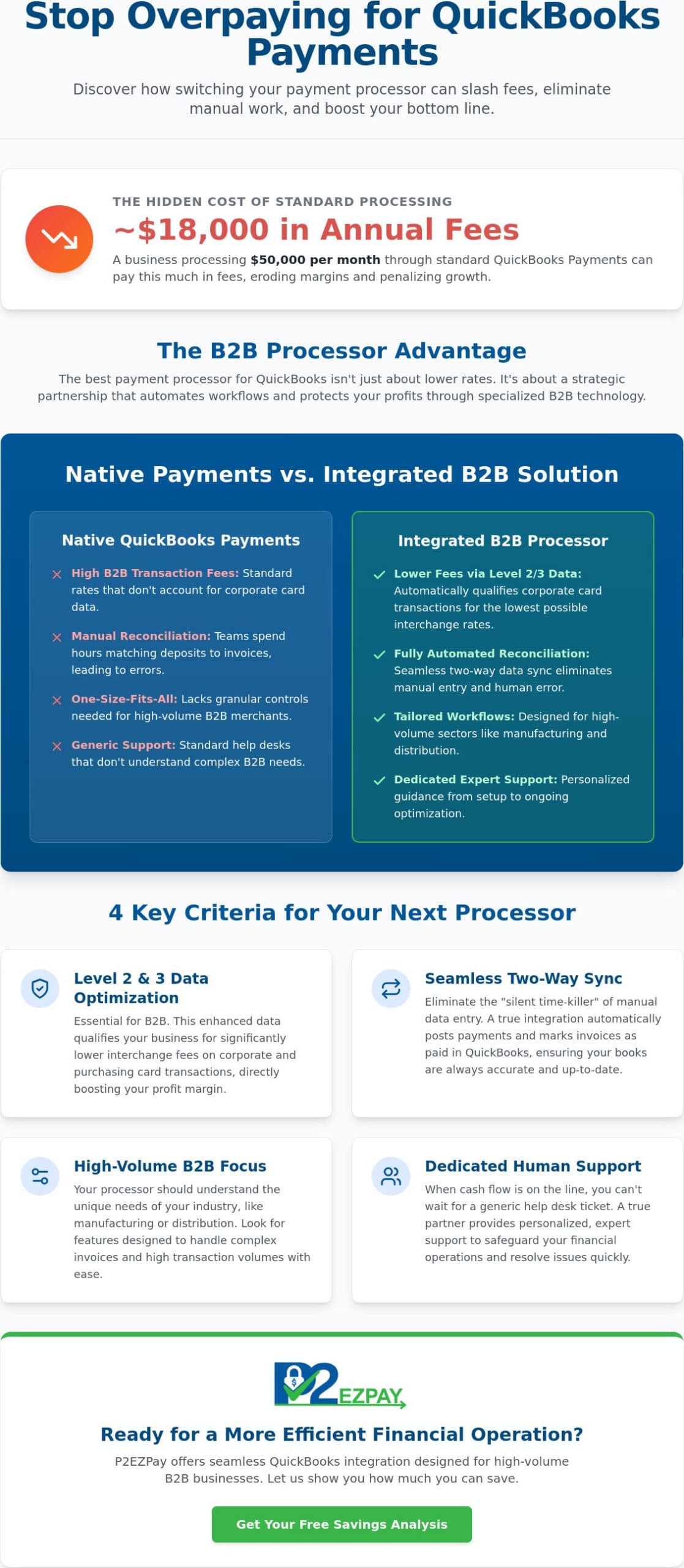
A business processing $50,000 per month through standard QuickBooks Payments can expect to pay nearly $18,000 annually in processing fees. While the convenience of a built-in solution is tempting, many B2B leaders find that the costs of manual reconciliation and excessive corporate card fees quickly erode their margins. You deserve a system that works for your bottom line, not one that penalizes your growth. Finding the best payment processor for QuickBooks isn’t just about finding the lowest rate; it’s about finding a partner that understands the nuances of B2B transactions and the value of your time.
We’ve designed this guide to help you identify a processing partner that integrates seamlessly with your accounting software while slashing costs through Level 2 and 3 data optimization. You’ll discover how to automate your daily reconciliation and move away from the frustration of manual data entry for good. We’ll also examine how personalized support and specialized B2B solutions provide the strategic leadership and protection your high-volume business requires in 2026. By the end of this article, you’ll have a clear roadmap to a more efficient, cost-effective financial operation.
Key Takeaways
- Evaluate the hidden costs of native payment solutions and how a strategic shift in your processing partner can significantly improve corporate cash flow.
- Learn how the best payment processor for QuickBooks utilizes Level 2 and Level 3 data to qualify your business for lower interchange fees on corporate card transactions.
- Identify the essential features for a seamless, two-way data sync that removes the burden of manual reconciliation and data entry from your accounting team.
- Discover the benefits of a tailored approach to payment workflows, designed specifically to meet the high-volume needs of sectors like manufacturing and distribution.
- Gain insights into selecting a partner that offers both technical proficiency and the dedicated, human support required to safeguard your financial operations in 2026.
Why Your Choice of QuickBooks Payment Processor Impacts Your Bottom Line
Selecting a financial partner often feels like a secondary task compared to managing daily operations. However, the default choice isn’t always the most efficient for your specific business model. For a growing company, the best payment processor for QuickBooks is one that prioritizes margin protection over mere convenience. In 2026, the landscape of B2B transactions has shifted, making the gap between native tools and specialized integrations wider than ever. Many businesses assume that the native payment tool inside their accounting software is the gold standard; while it offers ease of setup, it often lacks the granular controls needed to minimize interchange fees on corporate cards. For high-volume merchants, these small percentage differences add up to thousands of dollars in lost revenue every month.
Speed is more than just a metric; it’s the lifeblood of your working capital. When your payment processor facilitates rapid settlement and provides transparent data, it directly impacts your ability to reinvest in inventory or payroll. Beyond speed, the precision of the technology determines your accounting accuracy. High-volume B2B merchants often handle complex invoices that require more than a “one size fits all” approach. Without specialized integration, your team might find themselves reconciling thousands of dollars in “ghost” transactions or correcting entry errors that could’ve been avoided with a more robust system. A tailored solution ensures that every dollar is accounted for from the moment a client clicks “pay” to the final bank deposit.
The Evolution of Integrated Payments in 2026
Payments are no longer just about moving money from one account to another. They’ve evolved into comprehensive workflow automation tools. While consumer-focused gateways focus on a simple checkout experience, corporate-grade solutions focus on the entire lifecycle of a transaction. Real-time data synchronization has become a competitive advantage, allowing leaders to see their true financial position at any given moment. This shift from simple “pay now” buttons to full workflow automation means your accounting software becomes a live dashboard of your business health rather than a lagging record of the past.
Reconciliation: The Silent Time-Killer
Manual data entry remains one of the most significant bottlenecks in modern accounting. If your team spends hours every week matching bank deposits to QuickBooks invoices, you’re losing valuable time to a solvable problem. Automated posting reduces human error and accelerates the month-end closing process. By removing these manual hurdles, you allow your financial staff to focus on strategic growth rather than clerical maintenance. Seamless synchronization doesn’t just save time; it provides the peace of mind that your financial reports are always accurate and audit-ready. To understand the full scope of what’s possible, explore the detailed steps to automate QuickBooks reconciliation for B2B efficiency and eliminate the manual workflows that drain your team’s productivity.
Key Criteria for Evaluating QuickBooks Integrated Payment Solutions
Identifying the best payment processor for QuickBooks requires looking past basic transaction features to examine how a provider handles the complexities of B2B commerce. A truly integrated solution must offer full compatibility with both QuickBooks Online and Desktop versions, ensuring that your financial data flows correctly regardless of your software environment. Many providers promise integration but deliver a fragmented experience that requires frequent manual intervention. You need a partner that provides transparent fee structures rather than complex tiered pricing. This clarity allows you to predict costs accurately, which is vital for maintaining healthy margins in a high-volume environment.
Technical support and deployment speed are equally critical. When your payment flow is the primary engine of your cash flow, you cannot afford to wait days for a response from a generic help desk. High-level merchant services prioritize personalized support, providing a steady hand to guide you through initial setup and ongoing optimization. If you’re looking for a partner that balances technical proficiency with this type of dedicated care, exploring integrated payment solutions can help clarify your specific needs and potential savings.
Level 2 and Level 3 Processing for B2B
Level 3 data is the specific transaction information, such as freight amounts and tax rates, that credit card networks use to assess risk. By providing this advanced data, B2B merchants qualify for significantly lower interchange fees. Native QuickBooks payments often miss these discounts because they’re designed for the simplicity of consumer transactions rather than the data-heavy requirements of corporate purchasing. The ROI of switching to a processor that supports Level 3 data is often substantial. For businesses handling large-scale invoices, the reduction in interchange costs can save thousands of dollars annually, turning your payment processing from a cost center into a strategic advantage.
Security and Compliance in a Corporate Environment
Protecting high-volume transaction data requires more than basic encryption. Advanced tokenization ensures that sensitive cardholder information never touches your local servers, which drastically reduces your PCI compliance burden. This security layer must work in tandem with your QuickBooks sync to maintain a clean, secure audit trail. Effective fraud management also includes integrated reporting for chargebacks. Instead of managing disputes in a separate portal, an integrated system allows you to view and respond to risks directly within your financial workflow. This methodical approach ensures your business remains protected while maintaining the stability required for long-term growth.
Comparing Native QuickBooks Payments vs. Integrated Third-Party Processors
Choosing the right financial infrastructure often comes down to a trade-off between immediate simplicity and long-term scalability. For many businesses, the convenience of clicking “enable” on the built-in payment tool is hard to ignore. However, as your transaction volume grows, the limitations of a mass-market solution become more apparent. The best payment processor for QuickBooks isn’t necessarily the one that is easiest to turn on; it’s the one that adapts to your specific B2B requirements. While native tools offer a unified interface, they often lack the flexibility to handle high-ticket ACH transfers or complex corporate credit card data efficiently. This gap can lead to higher costs and a lack of transparency that complicates your financial oversight.
Support response times also vary significantly between these two models. When you rely on a giant tech company, your business is one of millions. If a transaction fails or a deposit is delayed, you’re often left waiting in a generic support queue. In contrast, an integrated third-party partner treats your business as a priority. This level of personalized care ensures that your cash flow remains steady and that technical issues are resolved with the urgency your operations require. By choosing a partner that understands the high-stakes nature of B2B commerce, you gain a steady hand to help protect your margins and your reputation.
Native Payments: The Cost of Simplicity
For a small startup with a handful of monthly invoices, the native QuickBooks fee structure is often manageable. As of mid-2026, these rates typically sit at 2.99% for standard card transactions and can climb to 3.5% for keyed-in payments. While the 1% fee for ACH transfers (capped at $10) seems reasonable, the total cost of ownership rises when you factor in the lack of custom B2B reporting. You eventually reach a breaking point where these flat-rate fees make native processing unsustainable. Without the ability to customize workflows or access deeper transaction data, your team is forced to work within a rigid system that doesn’t account for the nuances of manufacturing or wholesale distribution.
Third-Party Integrated Solutions: The Corporate Choice
External processors hook directly into the QuickBooks API, allowing for a seamless flow of data that matches the native experience while providing superior flexibility. These solutions excel in handling high-volume ACH and e-check payments, which are vital for B2B firms looking to avoid the high costs of credit card interchange. You can customize the checkout experience to match your clients’ expectations, offering them the specific payment methods they prefer. This independent approach provides better long-term protection, as you aren’t locked into a single ecosystem that can increase prices or change terms without warning. A tailored integration ensures your financial data posts automatically, maintaining the accuracy you need without the “convenience tax” of a default setup.
How Milwaukee Businesses Can Optimize QuickBooks Workflows
Milwaukee is more than just a city; it’s an industrial powerhouse where manufacturing and distribution define the local economy. For companies operating in the Menomonee Valley or suburban industrial parks, the best payment processor for QuickBooks isn’t a faceless corporation based in a distant tech hub. It’s a partner that understands the specific cadence of Wisconsin supply chains and regional banking requirements. When you work with a local provider, you gain access to on-site support that can navigate the technical nuances of complex software integrations. This proximity allows for a level of collaboration that generic help desks simply can’t match, ensuring your financial infrastructure remains as robust as your production line.
Navigating the transition from legacy systems to modern integrated payments requires a steady hand and a clear strategy. Regional businesses often face unique hurdles, such as coordinating with local community banks or managing high-ticket transactions that exceed standard consumer limits. By leveraging a processor with deep roots in the Milwaukee business community, you ensure that your QuickBooks setup is tailored to these specific needs. This bespoke approach removes the obstacles that often hinder cash flow, providing the clarity and flexibility required to maintain a competitive edge in a demanding market.
Industry-Specific Optimization for Wisconsin
Wholesale distributors in the region often manage payment cycles that don’t fit into standard retail models. By adapting QuickBooks to handle high-volume ACH transfers for local supply chain partners, you can significantly reduce the friction of net-30 or net-60 terms. For example, a Milwaukee-based manufacturer can transition from manual check processing to a fully integrated e-check solution, saving dozens of administrative hours each month. This level of optimization ensures that your cash flow matches your operational needs, allowing for smoother transitions between procurement and delivery. When your payment data flows directly into your ledger, you eliminate the risk of human error that often plagues manual entry systems.
The Value of Local Consultancy
Building a long-term partnership for financial growth requires more than just a software license. It requires a relationship grounded in mutual success and constant accessibility. When you have a question about your merchant statement or need to troubleshoot a sync error, a phone call to a Milwaukee expert is inherently more valuable than a generic support ticket. At P2EZPay, we focus on supporting the local business community by acting as a seasoned mentor in a complex field. We provide strategic leadership that helps you identify the best payment processor for QuickBooks while protecting your bottom line. If you’re ready to move beyond generic solutions, contact our Milwaukee team to discuss a tailored payment strategy for your business.
P2EZPay: Seamless QuickBooks Integration for High-Volume B2B
P2EZPay represents a fundamental shift in how financial partnerships should function. We don’t just provide a tool; we offer strategic leadership to help you navigate the complexities of modern commerce. By focusing on the unique requirements of high-volume B2B merchants, we’ve established ourselves as a definitive choice for those seeking the best payment processor for QuickBooks. Our approach centers on the removal of obstacles, ensuring that your financial data flows seamlessly from the point of sale to your general ledger without the friction of manual intervention. We act as a seasoned mentor, providing the guidance and protection your business deserves as it scales.
The P2EZPay Integration Advantage
Our direct sync technology eliminates the repetitive data entry that often drains your team’s productivity. If you’ve struggled with mismatched records or delayed postings in the past, our tailored merchant services provide the stability you need. We maintain a high formality register to command respect in the corporate world, yet our support remains accessible and community-oriented. This human-first approach means you’re never just a ticket number. Instead, you have a loyal ally who is deeply invested in your long-term success. We combine technical terminology with clear communication, ensuring you understand exactly how your funds are moving and where your savings are coming from.
Our expertise in Level 2 and Level 3 processing is a core component of this advantage. While native solutions often ignore the data-heavy requirements of corporate cards, we prioritize these nuances to slash your transaction costs. By automating the collection of required data points, we ensure your business qualifies for the lowest possible interchange rates on every high-volume invoice. This methodical and deliberate rhythm reflects the stability required in the financial sector, providing you with a safe and professional narrative for your business growth.
Next Steps to Optimize Your Payments
Transitioning to a more efficient system shouldn’t be a source of stress. We’ve refined a white-glove setup process specifically for Milwaukee businesses to ensure a smooth migration from your current provider. During this phase, our consultants handle the technical heavy lifting, from API configuration to staff training. We analyze your transaction history to identify specific areas where automated reconciliation can save your team hours every week. This objective advice is part of our commitment to transparency and partnership.
We invite you to Optimize your QuickBooks payments with P2EZPay today by requesting a free B2B payment cost analysis. Our team is ready to walk you through a detailed explanation of strategic solutions tailored to your industry. By aligning your technology with your high-volume needs, you can secure the strategic advantage and long-term support required for sustainable growth in 2026.
Securing Your Financial Future with Strategic Integration
Your search for the best payment processor for QuickBooks should lead you to a partner that prioritizes both technical precision and human connection. We’ve explored how moving beyond native defaults can slash transaction costs through Level 2 and Level 3 data while removing the burden of manual data entry from your accounting team. By choosing a solution that aligns with your specific B2B workflows, you ensure that your financial infrastructure supports your growth rather than acting as a bottleneck. With over 30 years of industry experience, P2EZPay provides the specialized expertise and local Milwaukee-based support needed to navigate the complexities of corporate payments in 2026.
If you’re ready to protect your margins and reclaim your time, we’re here to act as your loyal ally and strategic guide. You can begin this journey by taking a closer look at your current overhead and identifying opportunities for automation. Get a Free B2B Payment Cost Analysis from P2EZPay to discover how our tailored approach can transform your financial operations. We look forward to helping you build a more efficient, secure, and profitable future through dedicated partnership.
Frequently Asked Questions
Is it possible to use a third-party payment processor with QuickBooks?
Yes, you can use an external partner to handle your transactions while keeping everything synced within your accounting software. Many high-volume businesses find that the best payment processor for QuickBooks is actually a third-party specialist that offers more competitive rates than the native option. This approach allows you to maintain your familiar bookkeeping environment while benefiting from a provider that understands the specific needs of corporate commerce.
How does QuickBooks payment integration save money on B2B transactions?
Integration saves money by qualifying your transactions for wholesale interchange rates and eliminating the high cost of administrative errors. When you provide the detailed data required for corporate card networks, you lower the risk profile of each sale. Additionally, automating the posting process removes the need for your staff to spend hours on manual reconciliation, which provides a direct boost to your operational efficiency.
Can I process ACH and e-checks through QuickBooks using P2EZPay?
Yes, we provide comprehensive ACH and e-check solutions that integrate directly with your QuickBooks environment. These methods are particularly effective for high-value B2B transactions where credit card fees might be prohibitive. By utilizing our specialized gateway, you can offer your clients flexible payment options while ensuring every deposit is automatically recorded and matched to the correct invoice in your system.
How long does it take to set up a new payment integration in QuickBooks?
Most businesses can complete our white-glove setup process within three to five business days. This timeline includes the initial configuration of the sync technology and a thorough testing phase to ensure your data flows correctly. Our team acts as a steady hand during this transition, providing the strategic leadership needed to minimize any disruption to your daily operations and cash flow.
What is the difference between QuickBooks Online and QuickBooks Desktop integration?
QuickBooks Online utilizes a cloud-based API for real-time synchronization, while the Desktop version typically uses a secure plugin to bridge the gap between your local database and the payment gateway. While the technical delivery differs, both environments can achieve a high level of automation. We ensure that your integration is bespoke to your specific software version to maintain a clean and accurate audit trail.
Will switching payment processors lose my existing transaction history in QuickBooks?
No, your historical transaction data remains untouched within your QuickBooks database. Switching processors only changes how future payments are handled and recorded. We focus on a seamless transition that preserves your existing records while introducing more efficient workflows for all upcoming sales. Your previous financial reports and customer histories will stay exactly where they are without any loss of information.
What are Level 2 and Level 3 processing fees?
These are reduced interchange rates provided by card networks when you include extra transaction details like tax amounts and shipping codes. These discounts are specifically designed for B2B transactions where corporate cards are used. By working with the best payment processor for QuickBooks that supports advanced data capture, you can qualify for lower costs that aren’t typically available through standard consumer-focused processors.
Is integrated payment processing secure for high-volume corporate data?
Security is a foundational element of our integrated solutions, utilizing advanced tokenization to protect sensitive corporate information. This technology ensures that actual card data never touches your local servers, which significantly reduces your liability and PCI compliance requirements. Our methodical approach provides the protection your high-volume business needs to maintain long-term trust with your clients and supply chain partners.