

What if the hours your team spends correcting manual entry errors in QuickBooks were actually costing you more in lost opportunity than the errors themselves? You likely already feel the strain of slow reconciliation cycles and the unnecessary sting of high interchange fees on your largest transactions. It’s a common frustration; even in 2026, many organizations still struggle with fragmented workflows that hinder cash flow and limit scalability. Adopting modern B2B payment automation strategies isn’t just about upgrading your software. It’s about reclaiming your time and protecting your margins through a more sophisticated approach to financial operations.
We’re here to help you transform your accounts receivable from a manual burden into a high-speed engine for corporate growth. This guide provides the strategic clarity you need to achieve a seamless payment-to-accounting sync and slash transaction costs by leveraging Level 2 and 3 data processing. We’ll also explore how the $10 million transaction limits now available on FedNow and RTP networks can drastically accelerate your payment cycles. By the end of this article, you’ll have a clear roadmap to a more efficient, data-rich operation that supports your long-term success and fosters lasting professional partnerships.
Key Takeaways
- Transition from manual invoicing to “invisible” workflows by integrating digital payment gateways directly with your existing ERP system.
- Discover how specific B2B payment automation strategies, such as capturing Level 2 and Level 3 data, can drastically lower interchange costs on high-volume transactions.
- Identify the critical steps for achieving a seamless QuickBooks sync to eliminate manual data entry errors and accelerate your reconciliation cycles.
- Navigate the proactive security requirements of PCI-DSS 4.0 to maintain robust protection while sharing financial data across automated environments.
- Establish a clear 2026 roadmap by defining KPIs that focus on reducing Days Sales Outstanding (DSO) and overall operational overhead.
What is B2B Payment Automation in 2026?
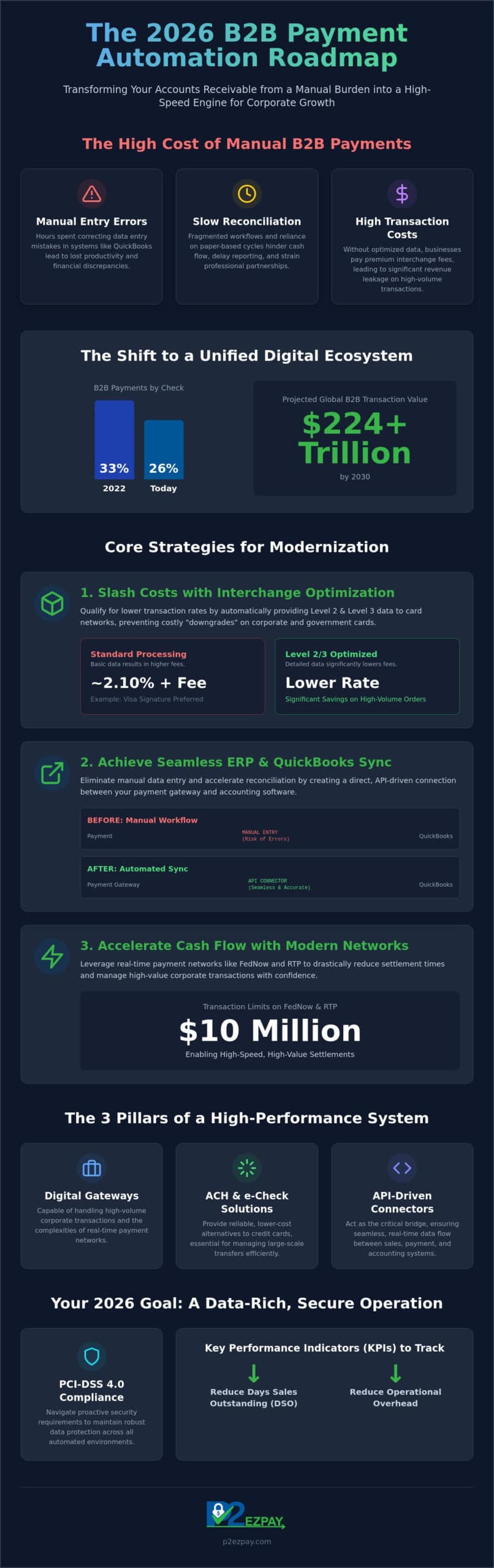
In 2026, B2B payment automation represents a fundamental shift from isolated financial tasks to a unified, digital ecosystem. It is defined as the deep integration of high-performance digital gateways with Enterprise Resource Planning (ERP) systems. While traditional invoicing relied on manual data entry and paper-based cycles, today’s standard focuses on “invisible” workflows where payments happen in real-time. This evolution is necessary as the global B2B transaction value is projected to exceed $224 trillion by 2030, according to industry forecasts. Businesses can no longer afford the delays inherent in legacy systems that treat payments as a separate, manual step after the sale.
Transitioning to modern B2B payment automation strategies allows your finance team to move from reactive accounting to proactive cash flow management. Instead of waiting for a check to clear or manually matching an invoice to a bank statement, data flows seamlessly from the point of sale to the general ledger. This real-time visibility ensures that your balance sheet reflects the actual state of your business at any given moment. With checks now representing only 26% of B2B payments, down from 33% in 2022, the move toward digital-first operations is a clear industry mandate. High-performing firms now expect data to be as liquid as the capital it represents.
The Core Components of an Automated System
An effective B2B payment processing framework relies on three technical pillars. First, you need digital gateways capable of handling the complexities of high-volume corporate transactions, including the $10 million transaction limits now supported by FedNow and RTP networks. Second, integrating ACH and e-check solutions provides a reliable, lower-cost alternative to credit cards for large-scale transfers. Finally, API-driven connectors act as the bridge between your sales platform and your accounting software. These foundations are similar to those found in a standard e-commerce payment system, yet they’re tailored to meet the rigorous demands of corporate security and high-value settlements.
Why Automation is No Longer Optional for Wisconsin Firms
For firms in Wisconsin, particularly in hubs like Milwaukee, these B2B payment automation strategies solve immediate operational challenges. Local manufacturing and wholesale distribution sectors face persistent labor shortages in accounting departments, making manual reconciliation unsustainable. Automation provides a significant competitive edge by allowing smaller teams to manage larger volumes of work with higher accuracy. B2B automation is the strategic elimination of friction between transaction and reconciliation. By adopting these systems, local businesses protect their margins and build stronger, more reliable partnerships within their supply chains. For a comprehensive overview of how to evaluate local providers, the Wisconsin Merchant Services for Business: The 2026 B2B Resource Guide offers detailed guidance tailored to the region’s manufacturers and distributors.
Interchange Optimization: The Secret to High-Volume Savings
Many executives view interchange fees as a fixed, unavoidable cost of doing business. This assumption often leads to significant revenue leakage, especially during high-volume corporate transactions. By implementing specific B2B payment automation strategies, your organization can move beyond standard processing rates. These strategies focus on interchange optimization, a method of qualifying for lower rates by providing card networks with more detailed transaction data. When you process a corporate or government card without this extra information, the networks often categorize it as a higher-risk consumer transaction. This results in you paying a premium that could have been avoided with better data visibility.
The financial impact of these “downgrades” is substantial. For context, the average interchange fee in the U.S. is approximately 1.80%, but premium cards like the Visa Signature Preferred can reach 2.10% plus a per-transaction fee. The transition to automated data capture is a cornerstone of effective B2B payment automation strategies. It bridges the gap between your sales department and your bank, ensuring that every dollar spent on processing is as low as possible. This isn’t just about saving pennies; it’s about protecting your margins on every large-scale order your business fulfills.
Understanding Level 2 and Level 3 Processing
Level 2 processing requires basic details like the customer’s tax ID, zip code, and the specific tax amount. It’s a foundational step for reducing costs on corporate cards. Level 3 processing is the gold standard for B2B efficiency. It demands granular line-item detail, including product codes, descriptions, and quantities. Providing this data proves to the card networks that the transaction is a legitimate business-to-business exchange, which justifies a lower rate. You can find more technical specifications on how this works within our B2B payment processing solutions.
Automating the Data Capture Workflow
Capturing the 15 to 20 data points required for Level 3 processing is nearly impossible through manual entry. Human error frequently leads to missing fields, causing the transaction to default to a more expensive rate. In 2026, sophisticated gateways automatically extract this information directly from your digital invoices. This automation ensures every eligible transaction meets the highest data standards without adding extra work for your staff. For companies utilizing high-volume merchant services, these savings directly impact the bottom line by preserving capital that would otherwise be lost to transaction fees. If you’re ready to see how these savings apply to your specific volume, you can connect with our consultancy team for a detailed rate analysis.
How to Optimize B2B Payment Efficiency with QuickBooks
While the interchange optimization discussed earlier protects your margins, the way you manage those funds within your ledger determines your operational speed. For many finance teams, manual reconciliation remains a primary friction point. You might find your staff stuck in a cycle of exporting bank statements and manually matching them to open invoices. This process isn’t just slow; it’s a breeding ground for data entry errors that can take hours to untangle. To achieve true efficiency, your B2B payment automation strategies must bridge the gap between your payment gateway and your accounting software.
Optimizing this workflow requires a methodical three-step approach. First, you must select a payment processor that offers a native QuickBooks integration. This ensures that data moves between platforms without the need for manual CSV uploads. Second, configure automated payment posting to eliminate double-entry. When a client pays an invoice, the system should automatically mark that invoice as “paid” in your ledger. Third, set up real-time ACH sync to provide immediate cash flow visibility. For a deeper dive into these technical setups, see our guide on B2B Payment Integration with Accounting Software: A 2026 Strategy Guide.
Eliminating Manual Reconciliation
Automated posting changes the fundamental rhythm of your accounting department. Instead of “monthly batching,” where you reconcile weeks of transactions at once, you move to a “daily sync” model. This shift ensures your financial reports are always current, allowing for more accurate forecasting. It’s a transformative change for growing businesses. QuickBooks integration reduces accounting overhead by up to 80% by automating the most repetitive aspects of the reconciliation process. This reclaimed time allows your team to focus on high-level financial strategy rather than clerical data entry. For organizations looking to take this further, automating B2B accounts receivable with the latest 2026 strategies can transform your entire revenue cycle into a streamlined, cost-saving engine.
Streamlining Corporate ACH and E-Check Workflows
Managing high-volume transfers shouldn’t require jumping between different software windows. By integrating ACH payment services directly into the QuickBooks interface, you can initiate and track corporate transfers from one central location. This setup is particularly effective for managing recurring corporate clients. You can automate the authorization process, ensuring that fixed-amount bills are paid on time without manual intervention. This seamless flow handles high-volume e-check processing with the same level of security and oversight as traditional credit card transactions, all while keeping your general ledger perfectly in sync.
Security and Compliance in Automated B2B Environments
The most common question we hear from finance leaders is whether automated data sharing is truly safe. This concern is valid. According to 2024 data, 79% of organizations experienced attempted or actual payments fraud. In 2026, implementing robust B2B payment automation strategies requires more than just speed. It demands a defensive posture that evolves with the threat landscape. The current PCI DSS 4.0 standard reflects this shift. It moves away from once-a-year validation toward continuous security monitoring. By automating your workflows, you actually gain more control because you eliminate the human vulnerabilities that often lead to data leaks or misplaced sensitive information.
Security in 2026 isn’t a static wall; it’s a dynamic process of verification. Automated systems allow for real-time fraud detection in ACH workflows, which is vital now that transaction limits have reached $10 million on networks like FedNow and RTP. These systems can flag unusual patterns or unauthorized account changes instantly, providing a level of oversight that manual reviews simply can’t match. When your B2B payment automation strategies prioritize these built-in safeguards, you protect your capital and your professional reputation simultaneously.
The Role of Tokenization and Encryption
Tokenization is a critical layer in this defensive strategy. It replaces sensitive corporate banking data with unique identifiers, or “tokens,” during the sync process. This means your local servers never store actual credit card or bank account numbers. For Milwaukee-based distributors handling high-value client data, this removal of liability is essential. If a breach occurs, the stolen tokens are useless to hackers. We often see these same high-level protections in ecommerce payment processing gateways. Applying these retail-grade security standards to the B2B world ensures your transactions remain private and your reputation stays intact.
Maintaining Compliance Across the Midwest
Regional businesses in Madison and Brookfield face a unique corporate landscape that requires specific regulatory knowledge. While federal standards like PCI DSS 4.0 provide a baseline, a partner who understands the Midwest’s distribution and manufacturing sectors can offer better guidance. They help you navigate the nuances of high-volume fraud detection and ensure your systems adapt to local financial expectations. You can learn more about finding the right ally in our guide on Corporate Payment Processing: A 2026 Guide to Selecting the Right Partner. Maintaining compliance isn’t just a checkbox; it’s a commitment to your clients’ security. If you want to secure your payment environment with a tailored approach, our team is ready to assist.
Developing Your 2026 Payment Automation Roadmap
Implementing a sophisticated financial ecosystem requires more than just purchasing new software; it necessitates a structured roadmap that aligns with your long-term corporate vision. Transitioning your accounts receivable from a manual burden into a high-speed engine starts with a cold, hard look at your current state. By the time you reach this stage, you’ve already seen how interchange optimization and QuickBooks integration can protect your margins. Now, the focus shifts to the practical steps of execution. Effective B2B payment automation strategies are built on a foundation of measurable goals and a clear understanding of where your resources are currently being drained.
Your roadmap should prioritize the definition of clear Key Performance Indicators (KPIs) to track your progress. The most critical metrics for 2026 include a measurable reduction in Days Sales Outstanding (DSO) and a significant decrease in total transaction fees. If your automation doesn’t lead to faster capital availability or lower overhead, it isn’t serving your strategic interests. By establishing these benchmarks early, you ensure that every technical adjustment you make contributes directly to your bottom line and supports a more resilient cash flow model.
Assessing Your Current Financial Workflow
The first step in your audit is calculating the “true cost” of manual data entry within your organization. This calculation should include the hourly wages of your accounting staff, the average time spent on reconciliation, and the cost of correcting human errors. You’ll likely find that “bottleneck” departments, often where Sales handoffs meet Accounting, are the primary sources of delay. As you plan for the future, ask yourself if your current B2B payment automation strategies can handle 10x your current volume. True scalability means your systems should grow alongside your ambitions without requiring a proportional increase in headcount. Businesses evaluating their options can benefit from reviewing the criteria outlined for a B2B merchant account in Wisconsin to ensure their chosen solution aligns with the specific demands of high-volume regional commerce. Finance leaders seeking a broader perspective on reducing DSO and improving cash flow can also explore the latest insights on automating B2B accounts receivable to benchmark their operations against 2026 industry trends.
Choosing a Partner for the Long Haul
Success in this complex field often depends on the quality of your guidance. While large banks offer generic tools, they often lack the bespoke, tailored approach required for high-volume B2B operations. Independent consultancies provide objective advice that isn’t tied to a single bank’s proprietary system. For businesses in Pewaukee, Waukesha, and New Berlin, having local support means you have a partner who understands the regional economic landscape and is accessible when you need strategic leadership.
P2EZPay Merchant Services acts as a seasoned mentor for corporations, providing a steady hand as you navigate the 2026 payment landscape. We believe the business relationship is a partnership grounded in mutual success, moving beyond simple software provision to offer strategic guidance and protection. If you’re ready to move from fragmented processes to a unified, high-speed financial engine, it’s time to take the next step. You can partner with a Merchant Services Advisor to build your custom B2B strategy today.
Securing Your Path to Financial Acceleration
The transition from fragmented, manual processes to a unified digital ecosystem is no longer a luxury for growing corporations. By prioritizing interchange optimization and achieving a native sync with your accounting software, you protect your margins while reclaiming hundreds of hours for your finance team. These B2B payment automation strategies provide the structural stability required to handle the high-volume demands of 2026. As you move forward, remember that the right technology is only half of the equation; the other half is a partner who understands the nuances of your specific industry and region.
With 30+ years of industry experience and specialized QuickBooks integration expertise, P2EZPay Merchant Services provides the steady guidance your business deserves. Our team offers local support for Milwaukee and Madison corporations, ensuring that your strategic leadership remains accessible and grounded in your community’s needs. We invite you to optimize your B2B efficiency with a P2EZPay Merchant Services expert today. Your journey toward a more efficient, data-rich future starts with a single, decisive step toward better operational clarity. We look forward to building that future alongside you.
Frequently Asked Questions
What are the primary benefits of B2B payment automation for mid-sized corporations?
B2B payment automation strategies allow mid-sized corporations to scale their operations without a proportional increase in accounting headcount. By eliminating manual data entry, your team can pivot from clerical tasks to high-level financial analysis and strategic growth. These systems also foster stronger professional partnerships by ensuring consistent, on-time payments and providing vendors with real-time transparency into transaction statuses.
How does B2B payment automation lower transaction fees for high-volume merchants?
High-volume merchants lower their costs by utilizing automated systems to capture and transmit Level 2 and Level 3 data. This granular information, which includes tax IDs and line-item product details, proves the legitimacy of a business transaction to card networks. Providing this data allows you to qualify for significantly lower interchange rates that are unavailable through standard consumer-grade processing methods.
Can automated payment systems integrate with older versions of QuickBooks Desktop?
Most modern automated solutions support integration with older versions of QuickBooks Desktop through specialized API connectors or secure plugins. While the technical bridge might vary depending on your specific version, the goal remains a seamless sync of your payment data. This connection ensures that your historical financial records remain intact while your current reconciliation process becomes much faster and more accurate.
Is ACH processing more secure than traditional paper checks for B2B transactions?
ACH processing is significantly more secure than paper checks because it removes the physical vulnerabilities of mail theft and manual handling. Digital transfers rely on end-to-end encryption and tokenization to protect sensitive banking data during the sync. With nearly 79% of organizations reporting fraud attempts in 2024, shifting to a digital-first approach is a necessary step to protect your corporate capital.
How long does it typically take to implement a full B2B payment automation strategy?
A comprehensive implementation typically spans two to six weeks, depending on the complexity of your ERP system and current workflows. This period includes a thorough audit of your processes, the technical integration of B2B payment automation strategies, and specialized training for your finance team. A methodical rollout ensures that your daily business operations continue without disruption while the new system is being optimized.
What is the difference between Level 2 and Level 3 processing in B2B automation?
Level 2 processing requires basic information such as the customer’s tax ID and zip code to qualify for moderate fee reductions. Level 3 is more comprehensive, requiring detailed product codes, descriptions, and quantities for every transaction. Automated systems are essential for Level 3 because they pull this data directly from your invoices, ensuring you consistently meet the standards for the lowest possible interchange rates.
How does automated reconciliation improve cash flow visibility?
Automated reconciliation improves visibility by replacing traditional monthly batching with real-time data synchronization. As soon as a payment is authorized, it’s reflected in your general ledger, providing an immediate and accurate view of your available liquidity. This constant update allows leadership to make strategic decisions based on live financial data rather than waiting for weeks to see the final results of a billing cycle.
Will automating my payments require me to change my current bank account?
Implementing an automated system typically doesn’t require you to change your existing bank account. Most high-performance corporate payment solutions are designed to be bank-agnostic, meaning they can deposit funds directly into your established accounts. This flexibility allows you to maintain your current banking relationships and treasury management structures while gaining the efficiency of a modern, automated gateway.