

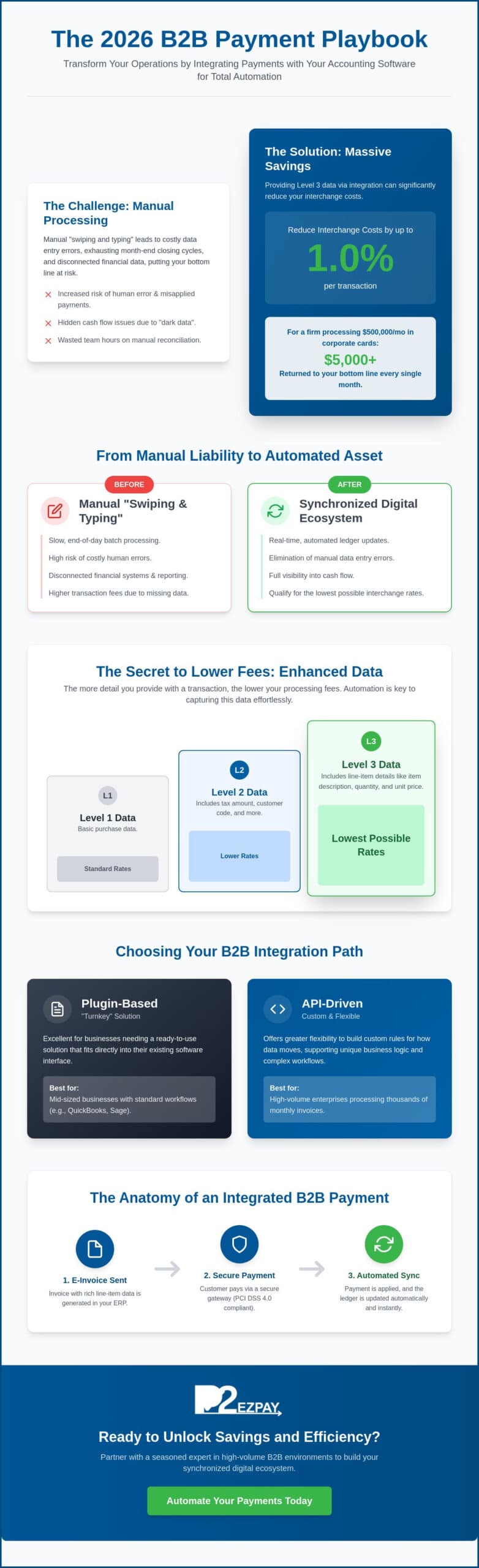
Did you know that providing Level 3 data can reduce your interchange costs by up to 1.0% per transaction? For a firm processing $500,000 monthly in corporate cards, that’s $5,000 returned to your bottom line every single month. Achieving these results requires more than just a basic connection; it demands a sophisticated B2B payment integration with accounting software that automates the flow of data across your entire enterprise.
We understand the frustration of manual data entry errors and those exhausting month-end closing cycles that never seem to get shorter. It’s difficult to lead with confidence when your financial data is disconnected and your interchange fees continue to climb despite your best efforts. You deserve a system that acts as a loyal ally rather than a constant technical hurdle.
This 2026 strategy guide will show you how to transform your operations by connecting your B2B payment processing with your accounting software for total automation. You’ll learn how to leverage the latest Commercial Enhanced Data Program requirements to slash transaction costs and gain real-time visibility into your cash flow. We’ll walk through the transition to PCI DSS 4.0 standards and the new NACHA fraud monitoring rules to ensure your business remains both efficient and secure.
Key Takeaways
- Transition from manual “swiping and typing” to a synchronized digital ecosystem that updates your ledger automatically.
- Evaluate the differences between API-driven and plugin-based B2B payment integration with accounting software to find the most efficient fit for your transaction volume.
- Unlock substantial savings by capturing Level 3 data automatically, ensuring your transactions qualify for the lowest possible interchange rates under the 2026 Visa and Mastercard guidelines.
- Follow a structured implementation roadmap that begins with a lifecycle audit and concludes with a processor capable of direct, seamless ERP synchronization.
- Understand the value of partnering with a seasoned Milwaukee-based mentor who offers decades of specialized experience in high-volume B2B environments.
What are Integrated B2B Payment Workflows?
An integrated workflow is a synchronized ecosystem that bridges the gap between your payment gateway and your Enterprise Resource Planning (ERP) system. It replaces the outdated “swiping and typing” method with automated digital ledger updates that occur the moment a transaction is authorized. For Wisconsin-based manufacturers and distributors, P2EZPay facilitates these connections through specialized B2B payment processing solutions tailored to complex supply chains. This shift is critical because 2026 corporate standards have moved beyond slow, end-of-day batch processing. Modern treasury management now demands real-time data to maintain liquidity and a competitive edge in a fast-moving market.
True integration means your financial systems talk to each other without a human middleman. When you implement a B2B payment integration with accounting software, you’re building a bridge that allows data to flow freely. This isn’t just about moving money; it’s about moving information that validates every cent of that money. It ensures that your sales team, your warehouse, and your accounting department are all looking at the same set of numbers at the same time. This transparency is the foundation of a healthy, scalable business relationship.
The Anatomy of a Modern B2B Payment
The lifecycle begins with electronic invoicing, which triggers a data packet containing essential line-item details. When a customer pays, the integration ensures that the fund settlement and the ledger entry happen simultaneously. Data packets move securely between the merchant account and the accounting software, creating a bi-directional sync. This means that if an invoice is adjusted in the ERP, the payment portal reflects it immediately. It keeps your accounts receivable department from chasing payments that have already been settled or misapplying credits to the wrong accounts. This accuracy is vital for maintaining professional trust with your long-term clients.
Why Manual Reconciliation is a Liability
How Payment Integration with Accounting Software Works
A successful B2B payment integration with accounting software relies on a precise technical “handshake” between your merchant services and your financial hub. This isn’t a simple data transfer; it’s a structured exchange where your processor communicates directly with platforms like QuickBooks or Sage. When you implement a QuickBooks payment integration, the system identifies an open invoice, matches it to an incoming payment, and updates your general ledger. This happens without a single keystroke from your staff, effectively turning your accounting software into a real-time command center.
Choosing the right architecture depends on your specific transaction volume and technical requirements. Plugin-based integrations are excellent for mid-sized businesses that need a “turnkey” solution that fits right into their existing software interface. However, for high-volume enterprises processing thousands of monthly invoices, an API-driven B2B payment integration with accounting software offers greater flexibility. APIs allow you to build custom rules for how data moves, ensuring your unique business logic remains intact while maintaining a seamless flow of information between disconnected departments.
The Role of the Payment Gateway
The gateway serves as the secure translator in this equation. It sits between the customer’s bank and your accounting software, ensuring that sensitive data is never stored on your internal network. By handling PCI compliance externally, the gateway protects your business from the significant liabilities of data breaches. It also manages tokenization, which is essential for recurring B2B contracts. Tokenization replaces actual card numbers with unique digital identifiers, allowing you to process future payments securely without re-collecting information for every new invoice cycle.
Real-Time vs. Batch Synchronization
Real-time synchronization offers the most accurate view of your current cash flow. Every transaction updates your ledger instantly, providing a clear picture of your liquidity. This is ideal for businesses that need to make rapid purchasing or investment decisions. On the other hand, batch synchronization is often more efficient for firms with massive daily transaction volumes. It groups payments together to be processed at a specific time, which can simplify reconciliation if your bank settlements also occur in batches.
Handling exceptions is a critical part of this integrated loop. If a payment fails, the system should automatically flag the invoice as “unpaid” and trigger a notification to your accounts receivable team. This proactive approach prevents the “dark data” issues mentioned earlier, ensuring no transaction slips through the cracks. If you’re ready to modernize your reconciliation process, you can speak with one of our advisors to determine which synchronization strategy fits your model best.
Capturing Level 2 and Level 3 Data: The Secret to Lower Fees
Many business owners view interchange fees as an unavoidable fixed cost of doing business. It’s a common misconception that often leads to thousands of dollars in wasted capital every year. In reality, a robust B2B payment integration with accounting software turns these fees into a variable you can actively manage. By providing enhanced transaction data, your business qualifies for lower rates reserved for commercial and government transactions. As of January 2026, Visa retired its Level 2 program, meaning that capturing Level 3 data through the Commercial Enhanced Data Program (CEDP) is now the primary way to secure these significant discounts.
Integrated workflows act as the bridge that makes this data transmission possible. When a payment is processed, the system automatically pulls line-item details directly from your digital invoice and attaches them to the transaction packet. This transparency reduces the perceived risk for card networks, which they reward with lower interchange costs. You can explore the specific Level 2 and Level 3 processing benefits to see how these incentives apply to your specific industry and card mix.
What Qualifies as Level 3 Data?
Level 3 data requires a level of detail that goes far beyond a simple transaction amount. To qualify, you must transmit specific information, including:
- Total tax amounts and tax indicators
- Freight and shipping codes
- Commodity codes and product descriptions
- Unit prices and quantities
- Merchant and customer postal codes
Manual entry of this information is functionally impossible for high-volume merchants. It would require your staff to spend hours typing in codes for every single invoice, negating any potential savings through increased labor costs. P2EZPay systems automate this entire process. Our technology identifies the required fields within your ERP and maps them to the payment gateway, ensuring every transaction arrives at the card network fully optimized for the lowest possible rate.
The Impact on Your Bottom Line
The return on investment for this integration is often immediate. Research indicates that Level 3 data processing can reduce interchange costs by up to 1.0% per transaction. For Milwaukee-based companies processing $1M monthly in corporate card volume, this translates to $10,000 in monthly savings. These recovered funds often exceed the entire cost of the B2B payment integration with accounting software within the first few months of operation. We’ve seen local manufacturers significantly reduce their overhead simply by switching to an integrated gateway that prioritizes data accuracy. It transforms your payment department from a cost center into a strategic contributor to your firm’s profitability. To further explore how automation compounds these gains, review our comprehensive B2B payment automation strategies that outline how leading organizations are reclaiming time and protecting margins in 2026.
Best Practices for Implementing Your Integrated Workflow
Deployment success depends on a clear understanding of your current operational hurdles. You should start by auditing your entire accounts receivable lifecycle to pinpoint exactly where manual intervention slows your team down. If your staff spends significant hours matching payments to invoices, that’s your primary target for improvement. Selecting a processor with direct sync capabilities for your specific ERP or QuickBooks environment is the next logical step. This ensures your B2B payment integration with accounting software functions as a native part of your financial stack rather than a fragile third-party add-on.
A comprehensive solution shouldn’t be limited to a single payment type. You must ensure your chosen gateway supports credit cards as well as ACH and e-check solutions. This flexibility allows you to adapt to your customers’ preferences while maintaining a single source of truth for all incoming funds. Partnering with a merchant services advisor provides the strategic leadership and local Wisconsin presence necessary to tailor these technical tools to your specific business model.
Evaluating Compatibility
Not all integrations are created equal. You must verify if the solution supports your specific software version, whether that’s QuickBooks Online, Desktop, or the more robust Enterprise edition. It’s also vital to identify potential bottlenecks in your existing network infrastructure before you begin the rollout. If your current system struggles with high-volume data packets, you’ll need to address those issues to ensure a smooth handshake between platforms. A scalable integration should handle your current load while offering the headroom required for future volume increases.
Security and Compliance Standards
As of 2026, all organizations must validate their compliance against the full PCI DSS 4.0 standard. Your integrated environment must utilize tokenization and end-to-end encryption to keep sensitive cardholder data off your internal servers entirely. Additionally, implementing multi-factor authentication (MFA) for anyone accessing financial data is no longer optional; it’s a fundamental requirement for risk management. Security should be baked into the integration, not bolted on. This proactive stance protects your reputation and ensures you meet the latest NACHA fraud monitoring rules for ACH transactions.
If you’re ready to design a more resilient and automated financial workflow, reach out to our team for a personalized strategy session.
Why Milwaukee Businesses Choose P2EZPay for B2B Integration
Milwaukee businesses often find that generic software giants lack the nuanced understanding required for complex local operations. Choosing a regional consultancy like P2EZPay means you aren’t just another ticket in a support queue. We bring over 30 years of specialized experience to the table, helping firms navigate the intricacies of high-volume B2B environments. Whether you’re a manufacturer in Kenosha or a distributor in Madison, our team provides the on-site and remote assistance necessary to keep your financial operations running smoothly. We focus on building long-term trust through a sense of loyalty and approachability that global providers simply can’t match. Local manufacturers and distributors looking to evaluate their options can benefit from reviewing our Wisconsin merchant services guide for B2B merchant accounts, which outlines how to select the right strategic partner in Southeast Wisconsin.
Every business model has unique requirements, which is why we reject the rigid, generic models favored by larger competitors. We offer customized paths for B2B payment integration with accounting software that respect your existing workflows while introducing high-level automation. This bespoke approach ensures that your transition is seamless and that your team feels supported at every step of the process. Our goal is to act as a seasoned mentor, providing the strategic leadership you need to thrive in a competitive marketplace.
Expertise in QuickBooks and High-Volume Sync
Our expertise lies in creating a seamless bridge between your accounting team and your payment technology. We specialize in QuickBooks payment integration, ensuring that every transaction is reconciled without manual intervention. For high-volume merchants, we integrate ACH and e-check solutions alongside traditional credit card processing. This comprehensive approach ensures that your systems are robust enough to handle thousands of daily entries while remaining simple enough for your staff to manage with ease.
Ready to Automate Your Workflow?
Transforming your financial workflow begins with a clear understanding of your current state. We offer a free, detailed analysis of your existing processing fees and reconciliation workflows to identify immediate areas for improvement. From there, we develop a tailored B2B integration plan that aligns with your specific accounting software and business model. You don’t have to navigate these technical complexities alone; our advisors act as a steady hand throughout the entire transition. Contact P2EZPay today for a B2B payment integration consultation.
Securing Your Financial Future Through Automation
Implementing a robust B2B payment integration with accounting software is no longer a luxury for growing firms; it’s a strategic necessity. By automating the handshake between your merchant services and your ledger, you eliminate the clerical errors that drain resources and cloud your visibility into cash flow. You also position your business to capture the significant savings offered by specialized Level 3 processing, effectively turning your payment department into a source of capital rather than a simple expense.
Our team brings more than 30 years of industry experience to every partnership, offering local Wisconsin support that spans from Milwaukee and Madison to Kenosha. We understand that your business requires a bespoke approach rather than a rigid, generic model. We’ll act as a steady hand, guiding you through the technical nuances of PCI DSS 4.0 and NACHA compliance while ensuring your systems remain flexible and secure. You don’t have to navigate these shifts alone.
Streamline your B2B payments with P2EZPay-Contact our Milwaukee experts today. We look forward to helping you build a more resilient and efficient financial future.
Frequently Asked Questions
How does B2B payment integration reduce manual labor?
B2B payment integration reduces manual labor by automating the reconciliation process between your merchant account and your general ledger. Instead of staff manually matching bank statements to digital invoices, the system updates the status of an invoice to “paid” the moment a transaction is authorized. This removes the “swiping and typing” cycle, allowing your accounting team to focus on strategic financial analysis rather than repetitive clerical data entry.
Can I integrate my payment processor with QuickBooks Desktop and Online?
You can integrate your payment processor with both QuickBooks Desktop and QuickBooks Online, though the technical handshake differs slightly between the two platforms. Online versions typically utilize API-driven connections for real-time updates, while Desktop and Enterprise versions often use specialized plugins to bridge the gap. P2EZPay ensures that your B2B payment integration with accounting software is optimized for whichever version your business utilizes to maintain total data integrity.
What is the difference between Level 2 and Level 3 processing in B2B?
The primary difference lies in the depth of data transmitted to the card networks to qualify for lower interchange rates. Level 2 processing requires basic information like tax amounts, while Level 3 demands extensive line-item detail, such as commodity codes and freight amounts. Providing this extra data reduces the perceived risk for Visa and Mastercard, which results in significant cost savings for high-volume corporate and government transactions.
Is integrated payment processing secure for high-volume transactions?
Integrated processing is highly secure because it utilizes tokenization and end-to-end encryption to protect sensitive financial data at every step. By using a secure gateway, your business ensures that cardholder information is never stored on your internal servers, which significantly reduces your liability. Modern standards like PCI DSS 4.0 are baked into these workflows to protect your business from the risks associated with high-volume digital commerce.
How long does it typically take to set up an accounting software integration?
The setup timeline typically ranges from a few business days to two weeks, depending on the complexity of your existing ERP environment and transaction volume. Simple plugin installations for QuickBooks can often be completed quickly, while custom API integrations for larger enterprises require more thorough testing. Our advisors work closely with your team to ensure the transition is methodical and does not disrupt your daily business operations.
Does P2EZPay support ACH payments within the integrated workflow?
We provide full support for ACH and e-check solutions as a core component of your automated workflow. This allows you to offer your customers a variety of payment methods while maintaining a single, synchronized ledger for all incoming funds. By including ACH in your B2B payment integration with accounting software, you can further reduce transaction costs and improve cash flow predictability through standardized NACHA entry descriptions.
Will integrating my payments change how my invoices look to customers?
Integrating your payments does not change the professional branding of your invoices, but it does add a secure “Pay Now” link for your customers. This enhancement allows clients to settle their balances immediately via a secure portal, which then triggers the automated posting back to your software. It creates a more convenient experience for your customers while accelerating your internal accounts receivable lifecycle and reducing the time to settlement.
What happens if a payment fails to sync with my accounting software?
If a synchronization error occurs, the system automatically flags the transaction for manual review by your accounting team. Most integrated platforms include an exception report that identifies exactly where the data handshake failed, allowing for quick resolution without losing track of the payment. This fail-safe ensures that your ledger remains accurate and that no cash flow issues arise from technical glitches or temporary network interruptions.