

The lowest quoted “flat rate” for your B2B merchant account in Wisconsin might actually be the most expensive mistake your accounting department makes this year. It’s a frustrating reality for many local manufacturers and distributors who see their margins eroded by high interchange fees on corporate and purchasing cards. You’ve likely felt the strain of these costs, compounded by the tedious hours your team spends on manual reconciliation between your payment gateway and QuickBooks. This lack of expert local support for high-volume environments often leaves businesses settling for generic solutions that don’t address the specific nuances of B2B commerce.
We’re here to change that perspective. In this 2026 guide, you’ll learn how to evaluate Wisconsin merchant services to slash B2B interchange fees by capturing Level 3 data and finally automating your accounting sync. We’ll provide a clear roadmap for selecting a strategic local partner in Southeast Wisconsin who can transform your payment processing from a technical hurdle into a streamlined financial advantage. By the end of this resource, you’ll have the insights needed to reclaim both your time and your revenue through smarter, more integrated payment strategies.
Key Takeaways
- Understand how capturing Level 2 and Level 3 data can significantly reduce the interchange fees associated with high-volume corporate and purchasing card transactions.
- Discover the operational benefits of a seamless QuickBooks payment integration to eliminate manual reconciliation and improve the accuracy of your financial reporting.
- Learn how to evaluate a Wisconsin B2B merchant account provider based on their ability to offer specialized solutions rather than generic, one-size-fits-all hardware.
- Identify the strategic advantages of choosing an independent B2B specialist over a traditional bank to ensure your payment infrastructure scales with your business growth.
- Recognize why local expertise in the Milwaukee and Madison corridors remains a vital asset for navigating the specific regulatory and economic landscape of the Midwest.
Navigating the Wisconsin Merchant Services Landscape in 2026
The corporate financial environment in Wisconsin has shifted significantly as we progress through 2026. For businesses operating within the Milwaukee-Madison corridor, payment processing is no longer just a back-office utility. It has become a strategic financial lever that can either accelerate growth or drain resources through inefficiency. Establishing a robust B2B merchant account Wisconsin is now a foundational requirement for companies that handle complex, high-volume transactions across industrial and manufacturing sectors. To understand the basics of these financial tools, it helps to first clarify what is a merchant account and how it functions as a dedicated bank account for business transactions.
The Evolution of Payment Processing in Southeast Wisconsin
Businesses from Waukesha to Kenosha are increasingly moving away from restrictive legacy POS hardware that once anchored their operations. The industrial backbone of our state requires more than just a place to swipe a card; it demands systems that can handle large-scale invoices and complex data sets. Selecting a partner who understands the specific needs of Wisconsin’s manufacturing sector ensures that your payment infrastructure supports your unique operational flow. B2B merchant services act as the bridge between sales and automated accounting. By moving toward B2B payment processing solutions that prioritize digital integration, companies can reduce the friction that often plagues traditional billing cycles.
Regional Service vs. National Aggregators
Choosing a generic national aggregator often leads to unforeseen complications for Wisconsin corporations. While these massive processors offer simplicity, they don’t provide the depth required for specialized B2B needs, such as Level 3 data capture or bespoke integration with existing ERP systems. When you secure a B2B merchant account Wisconsin through a local specialist, you gain access to a consultant familiar with the regional regulatory environment. This provides a level of security that national call centers simply cannot replicate. Local support in cities like Brookfield, New Berlin, and Madison ensures that troubleshooting is handled by professionals who understand your business community. This regional expertise allows for faster resolution of technical issues and a more nuanced approach to risk management. High-volume environments in the Midwest thrive when they have a steady, accessible partner who treats the relationship as a long-term collaboration rather than a series of disconnected transactions. Using a merchant services advisor ensures that your business remains agile as technology and regulations continue to change.
Why Wisconsin B2B Entities Require Specialized Processing
A fundamental mistake many Wisconsin corporations make is treating their payment infrastructure as a commodity. While a local retail shop in Madison focuses on foot traffic and quick swipes, a high-volume industrial distributor in Waukesha faces a completely different set of financial variables. The distinction lies in the complexity and volume of the transactions. B2B payments often involve corporate or purchasing cards, which carry significantly higher interchange fees than standard consumer debit cards. If your system isn’t configured to handle these specific card types, you’re essentially leaving money on the table every time an invoice is paid.
One of the most persistent myths in the industry is that all processors charge the same basic rates. While the card networks set the wholesale interchange fees, your final cost depends heavily on the data you provide during the transaction. By transmitting specialized data, you lower the perceived risk of the transaction, which allows the card networks to offer a lower rate. This is why a dedicated B2B merchant account Wisconsin is essential. It moves your business beyond the “flat rate” trap and into a model where your data works for your bottom line. If you’re curious about how these optimizations fit your specific business model, you can speak with a consultant to review your current statements.
Unlocking Savings with Level 2 and Level 3 Data
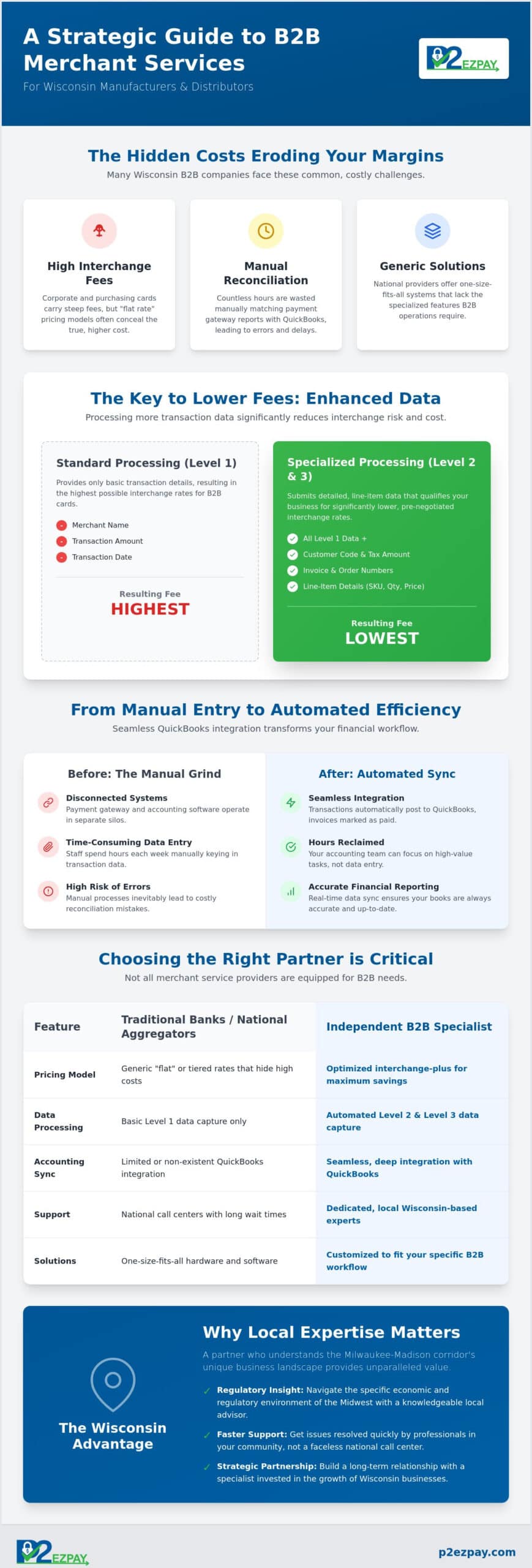
For B2B entities, the key to fee reduction is Level 2 and Level 3 data capture. This involves providing detailed line-item information, such as tax amounts, customer codes, and product descriptions, directly to the card networks. Most standard retail terminals or basic mobile readers simply aren’t designed to collect this level of detail. When these details are missing, the transaction is processed at a higher “standard” rate. When you’re accepting credit card payments from other businesses, failing to provide this data can result in fees that are 0.50% to 1.20% higher than necessary. High-volume environments can’t afford that kind of inefficiency.
High-Volume ACH and E-Check Solutions for Manufacturers
Credit cards aren’t always the most efficient way to handle large-scale industrial transactions. Wisconsin manufacturers and distributors often find that ACH payment services offer a more stable and cost-effective alternative for recurring or high-value orders. ACH payment services can reduce transaction costs by up to 80% compared to cards, providing a massive boost to net margins. These electronic check solutions come with rigorous security protocols designed to protect large-scale transfers in the industrial sector. By diversifying your payment methods, you provide flexibility to your clients while maintaining control over your own processing expenses.
Evaluating Local Providers: Banks vs. Independent B2B Specialists
Many Wisconsin executives prioritize convenience by bundling their payment processing with their commercial banking. It’s a logical move on the surface. However, securing a B2B merchant account Wisconsin through a traditional bank often leads to a “utility” relationship rather than a strategic partnership. Banks generally offer rigid, non-customizable software platforms that aren’t designed to scale with the complex demands of high-volume B2B growth. This often results in the “hardware trap,” where your business becomes tied to a specific POS brand or terminal that limits your operational flexibility.
For companies in Brookfield and Delafield, a consultancy-first approach is vital. You need a partner who views your payment infrastructure as a financial engine, not just a line item on a monthly statement. Standard bank contracts frequently contain hidden service charges and “non-qualified” fees that remain buried until a specialist uncovers them. By choosing an independent specialist, you gain the freedom to select platforms based on your specific volume and technical requirements rather than being forced into a one-size-fits-all model.
The Limitations of Traditional Bank Merchant Accounts
Banks naturally prioritize retail clients. Their systems are optimized for the quick, low-ticket transactions of a coffee shop or a boutique. Consequently, they often lack the technical depth required for high-end accounting software integrations. If your business relies on precise data flow to manage inventory or payroll, a generic bank solution will likely create more manual work for your team. Independent advisors offer objective platform selection, ensuring your technology stack remains independent and adaptable.
Strategic Advocacy and Ongoing Optimization
The value of a merchant services advisor lies in their role as a long-term advocate for your bottom line. They don’t just set up your account and disappear. Instead, they provide proactive auditing of your monthly statements to ensure you’re always receiving the best possible rates. As your business volume scales in Racine or Oshkosh, your processing costs should be renegotiated to reflect your increased leverage.
A reputable local partner should provide a thorough statement audit at no cost. This process identifies hidden B2B fees and identifies where Level 3 data capture could be better utilized. Optimization isn’t a one-time event; it’s a continuous process of refinement that keeps your overhead low and your cash flow predictable. This level of steady, professional guidance is what separates a strategic consultant from a mere vendor.
Optimizing Financial Workflows with QuickBooks Payment Integration
Manual payment reconciliation is an invisible tax on your accounting department. For many Wisconsin finance teams, the hours spent matching bank deposits to open invoices represents a significant operational bottleneck. By implementing a sophisticated B2B merchant account Wisconsin, you can transition from manual data entry to a system of real-time synchronization. This shift ensures that your general ledger reflects your actual cash position without the delay of human intervention. It provides your leadership team with a clear, accurate view of cash flow, allowing for more confident decision-making during expansion or seasonal shifts.
The primary advantage of a direct integration is the elimination of double data entry. When a payment is processed through your gateway, the transaction data should flow directly into your accounting environment. This creates a closed-loop system where human error is minimized and financial records are perpetually up to date. If you are ready to eliminate these manual hurdles, you can schedule a workflow consultation to see how an integrated approach fits your current setup.
Seamless Accounting Synchronization and Reconciliation
High-volume environments in West Bend and Fond du Lac often struggle with excessive administrative overhead during the monthly close. Direct B2B payment integration with accounting software automates the “match” process for incoming payments. Instead of your staff manually searching for corresponding invoice numbers, the system identifies the transaction and updates the record instantly. This level of automation is particularly beneficial for manufacturers and distributors dealing with hundreds of monthly line items. It frees your skilled accounting staff to focus on high-level financial analysis rather than repetitive data entry. For a deeper look at how this automation extends across your entire revenue cycle, explore the latest strategies for automating B2B accounts receivable to reduce Days Sales Outstanding and protect your margins.
B2B Ecommerce and Online Payment Portals
Modern B2B buyers expect a secure, self-service payment experience that mirrors the convenience of retail. Providing an online portal allows your customers to settle balances on their own schedule, which often leads to faster payment cycles. These sales integrate directly into your ecommerce payment processing workflows, ensuring that every digital transaction is captured and categorized correctly from the start. Automated posting of these web-based payments significantly speeds up the monthly financial close by ensuring all revenue is accounted for in real time. This digital-first approach reduces the friction of traditional billing and positions your company as a modern, accessible partner in the Wisconsin industrial landscape.
Selecting Your Strategic Payment Partner in Southeast Wisconsin
The transition into 2026 has made it clear that a standard vendor relationship is no longer sufficient for high-growth firms. A modern B2B merchant account Wisconsin requires a partner who acts as a strategic consultant, ensuring that your payment architecture remains optimized against rising interchange costs. Having a local presence in Milwaukee, Waukesha, and Madison provides a distinct competitive advantage. It ensures that when technical hurdles arise or when you need a deep dive into your financial data, you have access to experts who understand the regional industrial climate and the specific challenges of the Midwest market.
Before committing to a new provider or renewing a legacy contract, evaluate your current processor against these 2026 standards:
- Does the platform automatically trigger Level 3 data fields for corporate and purchasing cards to ensure the lowest possible rates?
- Is there a native, bidirectional sync with your QuickBooks environment to eliminate manual reconciliation?
- Does your provider offer transparent interchange-plus pricing, or are your potential savings hidden behind a simplified flat-rate model?
- Do you have a dedicated merchant services advisor who proactively audits your monthly statements for errors or rate creep?
Initiating a professional payment cost analysis shouldn’t disrupt your daily operations. A thorough audit of your current processing statements can reveal significant inefficiencies without requiring any changes to your existing software or hardware during the review phase. This objective look at your data provides the clarity needed to make informed decisions about your financial future.
The P2EZPay Independent Consultancy Advantage
Our approach is built on an exclusive focus on corporate and high-volume B2B environments. We understand that firms from Racine to Janesville require more than just a gateway; they need a partner experienced in Level 2 and Level 3 optimization. By focusing on QuickBooks automation and specialized B2B payment processing, we help Wisconsin firms reclaim lost margins. We remain deeply committed to the local business community, acting as a steady hand for manufacturers and distributors who have outgrown generic, national processors that lack regional depth.
Next Steps for Wisconsin Corporations
Your journey toward a more efficient financial workflow begins with a complimentary statement audit. This process reveals precisely where hidden fees are eroding your profits and where automation can save your accounting team hours of manual labor. Preparing for a seamless transition involves identifying these gaps before they impact your quarterly goals. For a more comprehensive look at optimizing your infrastructure, read our pillar resource on corporate payment processing: a 2026 guide to selecting the right partner. Taking this step ensures your business is protected and positioned for long-term growth in the evolving Midwest economy.
Future-Proofing Your Wisconsin B2B Operations
Success in the 2026 industrial market requires a payment infrastructure that works as hard as your production line. You’ve seen how specialized Level 2 and Level 3 data capture can significantly reduce overhead, while seamless QuickBooks integration removes the friction of manual accounting. These aren’t just technical upgrades; they’re essential steps toward protecting your margins and scaling your corporate reach. By prioritizing automation and data accuracy, you position your firm to thrive in an increasingly digital Midwest economy.
Securing an optimized B2B merchant account Wisconsin means moving beyond generic bank solutions and toward a partnership grounded in specialized expertise. With over 30 years of industry veteran experience, we provide the deep B2B workflow integration and interchange optimization your high-volume environment demands. We’re committed to helping you navigate these complexities with steady, professional guidance that respects your business’s unique journey. It’s time to stop settling for “good enough” rates and start leveraging a strategic financial engine.
Partner with a Wisconsin B2B Payment Expert Today to discover how a tailored strategy can strengthen your bottom line. We look forward to supporting your long-term growth and success as a trusted ally in the Wisconsin business community.
Frequently Asked Questions
What are the typical fees for Wisconsin merchant services for business in 2026?
Fees are generally structured on an interchange-plus model, which separates the card network’s wholesale cost from the processor’s markup. This transparency is standard for a professional B2B merchant account Wisconsin in 2026. While specific markups vary based on transaction volume, the final cost is heavily influenced by the type of cards accepted and the level of data provided during the transaction process.
How does Level 3 processing specifically lower B2B transaction costs?
Level 3 processing lowers costs by transmitting line-item transaction details that reduce the risk profile of the payment in the eyes of the card networks. This data includes tax amounts, customer codes, and unit prices. By providing this enhanced information, businesses qualify for lower interchange categories that are specifically reserved for corporate and government transactions, often resulting in significant savings compared to standard processing.
Can I integrate my payment processing with both QuickBooks Online and Desktop?
Yes, modern payment gateways support native integration with both QuickBooks Online and QuickBooks Desktop versions. This connectivity allows for bidirectional data flow, ensuring that invoices are marked as paid and bank deposits are reconciled automatically. It is essential to select a provider that offers specialized plug-ins or APIs designed for your specific version of the software to ensure a stable and reliable connection.
Is it better to get merchant services through a local Wisconsin bank or an independent provider?
Independent providers are generally better suited for B2B needs because they offer objective consultancy and platform flexibility that traditional banks often lack. While banks might offer the convenience of bundled services, they frequently use rigid software that doesn’t support advanced Level 3 data capture. Independent specialists act as long-term advocates, auditing your statements to ensure you maintain the lowest possible rates as your volume scales.
What is required for a Hartland Wisconsin business to set up a high-volume merchant account?
Setting up a high-volume account for a Hartland business requires standard corporate documentation, including your EIN, recent bank statements, and a processing history if available. For B2B environments, you’ll also need to demonstrate how you intend to capture Level 2 and 3 data. This preparation ensures your account is underwritten correctly for the high-ticket transactions that are common in the Wisconsin industrial sector.
How long does it take to implement a new B2B payment gateway with accounting integration?
A standard implementation for a B2B payment gateway with full accounting integration typically takes between one to two weeks. This timeline includes the initial account underwriting, technical configuration of the gateway, and the mapping of data fields for your QuickBooks environment. A methodical approach ensures that your existing workflows aren’t disrupted during the transition to the more efficient system.
Do I need specific hardware to accept corporate credit cards at the lowest rates?
You don’t necessarily need specific physical hardware to achieve the lowest rates for corporate cards; virtual terminals and integrated gateways are often more effective. These digital platforms are specifically designed to handle the extensive data fields required for Level 3 qualification. While traditional terminals can accept these cards, they often lack the interface needed to input the line-item details that drive down interchange costs.
What security measures are essential for high-volume ACH and e-check processing in Wisconsin?
Essential security for high-volume ACH and e-check processing includes tokenization, encryption, and robust identity verification protocols. For Wisconsin businesses, ensuring compliance with the latest Nacha regulations is a foundational requirement for all electronic transfers. These measures protect large-scale transfers from unauthorized access while providing a secure alternative to traditional paper checks for industrial orders.