

Did you know that non-compliant B2B transactions under Visa’s Commercial Enhanced Data Program (CEDP) now face penalty rates up to 0.40% higher than qualifying payments? It’s a frustrating reality for many finance leaders who see their margins eroded by hidden surcharges and high interchange fees on corporate purchasing cards. You’ve likely spent hours trying to reduce transaction costs for B2B only to find that the logic behind merchant statements remains intentionally opaque. We understand that manual reconciliation labor and rising processing fees feel like an unavoidable cost of doing business, but it doesn’t have to stay that way.
In this 2026 strategy guide, we’ll show you exactly how to slash your payment fees by up to 40% through precise data optimization and automation. We’ll move beyond simple negotiation and dive into the technical steps required to unlock lower effective rates. You will learn how to leverage Level 3 data, automate your QuickBooks Enterprise reconciliation, and strategically migrate your clients toward higher-margin payment channels like ACH, which saw nearly 10% volume growth last year. Our goal is to provide you with a clear, sophisticated roadmap to transform your payment processing from a cost center into a streamlined operational advantage.
Key Takeaways
- Distinguish between hard interchange fees and the soft “shadow costs” of manual reconciliation to uncover the true price of your current payment workflows.
- Learn how to provide enhanced data to card networks to qualify for Level 3 rates, which is a primary strategy to reduce transaction costs for B2B credit card processing.
- Evaluate the financial benefits of migrating high-volume customers from percentage-based credit card fees to more predictable flat-fee ACH and e-check solutions.
- Master a simple two-step audit to calculate your effective rate and isolate non-qualified surcharges hidden in your monthly merchant statements.
- Streamline your back-office operations by integrating payment processing directly with QuickBooks to automate real-time invoice posting and reconciliation.
The Hidden Anatomy of B2B Transaction Costs: Hard vs. Soft Expenses
B2B payments often feel like a black box where profit margins quietly disappear. Most controllers look at their monthly statement and see a single percentage, but that number is actually the sum of several distinct layers. To effectively reduce transaction costs for B2B, you must first separate the non-negotiable fees from the operational inefficiencies that drive your effective rate higher than it needs to be. Unlike retail environments where transactions are straightforward, B2B payments involve complex card types and data requirements that change the cost profile of every swipe or digital entry.
Hard Costs: Deciphering the Interchange Markup
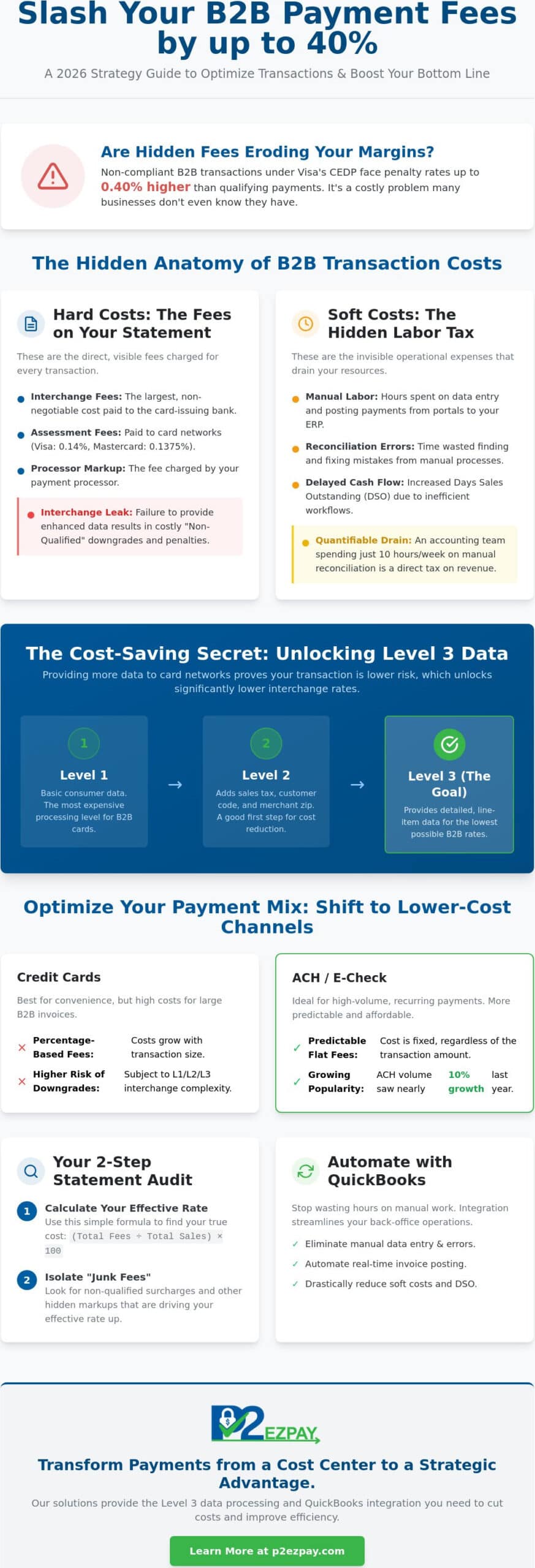
Hard costs are the direct fees listed on your merchant statement. They follow a logical three-tier structure consisting of interchange, assessments, and the processor’s markup. Interchange is the non-negotiable fee paid to the issuing bank. This fee makes up the largest portion of your costs and is set by the card networks rather than your processor. Assessment fees are smaller, fixed percentages paid directly to Visa or Mastercard to maintain their global networks. For instance, the Visa assessment fee for credit transactions in 2026 is 0.14%, while Mastercard’s fee typically sits at 0.1375%.
Corporate and purchasing cards carry higher base costs than consumer cards because they offer specialized reporting and higher credit limits to the buyer. If you process these high-value cards without providing enhanced line-item data, you trigger what we call an “Interchange Leak.” This happens when transactions fail to meet the technical requirements for lower rates, forcing them into expensive “Standard” or “Non-Qualified” categories. Under the current Visa Commercial Enhanced Data Program (CEDP), failing to provide this data can lead to penalty rates up to 0.40% higher than the qualifying rate.
Soft Costs: The Labor Behind the Payment
While hard costs are visible on a statement, soft costs often hide within your administrative payroll. These are the expenses associated with manual data entry, physical check handling, and reconciliation errors. If your accounting team spends ten hours every week manually posting payments from a merchant portal into your ERP, those labor hours represent a direct tax on your revenue that most businesses fail to quantify. It’s an invisible drain on resources that complicates your financial oversight.
This administrative burden often extends to the vetting of business entities. For organizations managing international partners or requiring thorough due diligence, Verifica Processo provides an efficient platform to verify judicial records and legal standing, ensuring that your financial oversight is backed by reliable data.
Consider the impact on a Milwaukee distribution firm managing hundreds of wholesale invoices monthly. When payment workflows remain disconnected from their accounting software, the resulting friction increases their Days Sales Outstanding (DSO). Every day a payment sits unapplied or trapped in a manual verification queue is a day that capital isn’t working for the business. These inefficiencies lead to a slow margin erosion that simple rate negotiation can’t fix. Achieving true stability requires a B2B payment processing strategy that addresses both the technical data requirements of the card networks and the human labor involved in the transaction lifecycle.
Unlocking Level 2 and Level 3 Processing: The B2B Cost-Saving Secret
Many organizations unknowingly treat their high-value corporate transactions like simple coffee shop purchases. When you process a business-to-business card through a standard retail terminal, the card networks categorize it as “Level 1.” This is the most expensive way to accept payments because the networks assume a higher risk level due to the lack of descriptive data. To effectively reduce transaction costs for B2B, you must transition to Level 2 and Level 3 processing, which provides the card networks with the specific transaction details they require to lower your interchange rates.
Level 2 Data: The Entry Level for B2B
Level 2 processing is a step above retail standards and requires three primary data points: the sales tax amount, a customer reference number, and the merchant’s zip code. While Mastercard continues to support Level 2 processing as of 2026, it’s important to recognize that Visa has retired its standalone Level 2 program in favor of the Commercial Enhanced Data Program (CEDP). Providing this basic data typically results in a noticeable basis point reduction compared to standard rates. The challenge for many firms is that standard POS hardware often lacks the interface to capture these fields, causing transactions to “downgrade” to higher retail rates automatically.
Level 3 Data: Maximum Savings for High-Volume Merchants
Level 3 data is the gold standard for B2B cost reduction. It requires deep line-item detail, including item codes, descriptions, quantities, and unit prices for every product on the invoice. While this sounds administratively heavy, the financial incentive is significant. The interchange gap between Level 1 and Level 3 can often exceed 100 basis points. For a company processing $1 million in monthly volume, this difference represents thousands of dollars in reclaimed profit every single month. Modern B2B payment processing systems solve the manual entry problem by automatically “injecting” this data from your invoices directly into the payment gateway.
Achieving these savings doesn’t require your accounting team to spend hours on data entry. Automation tools now handle the technical heavy lifting, ensuring that every qualifying corporate card meets the CEDP requirements without human intervention. If you aren’t sure whether your current processor is capturing this data or if you’re facing the 0.40% penalty rates for non-compliance, you might want to speak with a consultant to audit your current data flow. Moving to Level 3 is often the single most impactful change a merchant can make to reduce transaction costs for B2B and protect their margins.
Strategies to Shift B2B Payments from Credit to ACH and E-Check
Optimizing credit card data is a vital defensive strategy, but the most aggressive way to reduce transaction costs for B2B involves a structural shift toward bank-to-bank transfers. While credit cards offer convenience, they carry a percentage-based fee that scales directly with your revenue. In contrast, ACH payment services typically operate on a flat-fee basis, allowing you to retain more profit on high-value invoices. Transitioning your client base requires a nuanced approach that addresses their desire for credit card rewards while highlighting the efficiency of digital bank transfers.
According to the latest data, B2B volume on the ACH Network increased by 9.9% between 2024 and 2025, reaching 8.1 billion transactions. This growth reflects a broader industry realization that percentage-based fees are unsustainable for large wholesale orders. To encourage this shift, many firms now implement “Cash Discount” models or adjust net terms to favor bank transfers. If a customer insists on the float and rewards of a corporate card, you might offer a small discount for payments made via ACH. This often proves more cost-effective than absorbing the full card fee, creating a transparent way to share savings with your partners.
The Structural Shift: Card vs. ACH Comparison
The financial disparity between these channels becomes undeniable when examining large-scale transactions. If a client pays a $10,000 invoice via credit card at a 2.9% rate, your business loses $290 to processing fees. Processing that same $10,000 through ACH might cost as little as a flat $1.50 or a small capped percentage. This dramatic difference is why high volume ACH processing has become the preferred choice for scalable B2B growth. Beyond the immediate cost, ACH offers a superior risk profile; card transactions are subject to chargebacks for months, whereas ACH returns are strictly governed by Nacha’s 0.5% unauthorized return threshold.
Implementing Electronic Check Solutions
Despite the rise of digital options, industry estimates show that more than 60% of B2B payments still involve paper checks. This reliance creates significant “Check-in-the-mail” delays, especially for Wisconsin manufacturing firms dealing with complex multi-state supply chains. Moving these customers to electronic check processing for business bridges the gap between traditional habits and modern speed. By converting a physical check into a digital transaction, you eliminate the estimated $25 administrative cost associated with manual check handling. Electronic checks provide the same familiar bank-to-bank settlement without the security risks of a lost or stolen paper document.
Auditing Your Merchant Statement: Identifying and Eliminating Junk Fees
Your monthly merchant statement is more than just a bill; it is a diagnostic tool for your business health. To reduce transaction costs for B2B effectively, you must learn to read between the lines of these often-convoluted documents. Most processors rely on the complexity of their reporting to hide markups that have no basis in actual network costs. A systematic audit allows you to reclaim lost revenue by identifying exactly where your dollars are leaking into the processor’s pocket.
The first step in any forensic review is calculating your “Effective Rate.” You do this by taking your total fees and dividing them by your total processing volume. If your effective rate is significantly higher than the base interchange rates discussed in previous sections, you’re likely paying for services you don’t need or penalties you can avoid. Once you have this baseline, you can begin isolating “Non-Qualified” surcharges. These surcharges are often the result of technical data gaps rather than actual card costs, serving as a clear signal that your transactions aren’t meeting Level 3 requirements.
Beyond data penalties, you should scan for “Junk Fees” that provide zero value to your operations. These often include:
- PCI Non-Compliance Fees: A monthly penalty for not completing a simple security questionnaire.
- Statement Fees: Charges for the “privilege” of receiving a bill.
- Batch Header Fees: Small daily charges for closing out your terminal that add up over time.
The ultimate goal of this audit is to move your account to an Interchange-Plus pricing model. This transparent structure separates the non-negotiable fees paid to the banks from the processor’s markup, ensuring you always know exactly what you’re paying for. It eliminates the guesswork and allows you to see the direct impact of your cost-reduction strategies.
The Red Flags of B2B Merchant Statements
Tiered pricing is perhaps the most common trap in the industry. It bundles hundreds of different interchange rates into three arbitrary buckets: Qualified, Mid-Qualified, and Non-Qualified. This lack of transparency makes it impossible to see if you’re actually benefiting from Level 3 savings. You should also watch for excessive gateway fees that scale with your volume without a clear technical reason. If your statement feels like a puzzle, a merchant services advisor can provide the clarity needed to identify these hidden costs and restore transparency to your billing.
Negotiating with Leverage in the Milwaukee Market
B2B firms in the Milwaukee area have unique leverage that they often overlook. If your business is part of the industrial clusters in Waukesha or Brookfield, your processing volume is a powerful tool for negotiation. Local industrial volume allows you to demand more competitive markups than a standalone retail business. Big-box banks often provide rigid, high-fee structures because they prioritize their own stability over your growth. Choosing an independent partner allows for a bespoke approach with lower objective markups. For businesses looking to compare their options, including cross-border solutions, PaySelect serves as an independent platform to help select the most suitable payment gateways. We always recommend maintaining month-to-month contracts; it ensures your processor must earn your loyalty every single month through performance and transparency. This accountability is the best way to reduce transaction costs for B2B over the long term.
For industrial leaders who also value operational safety alongside financial efficiency, you can explore PetroHab Hot Work Safety Enclosure (HWSE) to protect your facility during critical maintenance.
If you suspect your current statement is inflated by hidden surcharges, you can request a professional statement review to uncover the exact savings available to your firm.
Operational Efficiency: Reducing Costs Through QuickBooks Integration
Technical data optimization and channel shifting provide immediate financial relief, but the final pillar of a robust strategy to reduce transaction costs for B2B lies in your back-office operations. Manual reconciliation creates significant “shadow costs”—the hidden labor expenses incurred when your accounting team must cross-reference merchant portals with bank statements and open invoices. These inefficiencies don’t just waste time; they introduce human error that can lead to misapplied payments and expensive audit corrections. By implementing a sophisticated QuickBooks Payment Integration, you eliminate the need for duplicate data entry, ensuring that your general ledger remains a real-time reflection of your cash position.
While many of these technical strategies are universal, successful firms often reinvest their operational savings into high-quality corporate hospitality. For those looking for specialized event services, you can explore Paella Catering to see how authentic cuisine can enhance a professional gathering.
The transition toward automated accounting is no longer a luxury. As Intuit phases out older versions of QuickBooks Desktop, businesses must adapt to modern, cloud-connected workflows to maintain their competitive edge. A disconnected payment gateway acts as a bottleneck, forcing staff to act as manual data bridges. When you automate this flow, you don’t just save on processing fees; you reclaim hundreds of hours of professional labor every year. For global enterprises looking to scale, you can find out more about how cloud-based automation streamlines channel management. This holistic approach ensures that your pursuit of lower rates doesn’t inadvertently increase your administrative overhead.
For specialized suppliers like ReadyPep, who distribute high-precision research pens, these automated workflows are essential for maintaining a lean back-office while scaling their operations.
Automating the Reconciliation Workflow
The synchronization process creates a seamless bridge between your ecommerce payment processing and your general ledger. When a customer pays an invoice online, the system automatically posts the payment and marks the invoice as paid without any human intervention. This level of automation is particularly valuable for growing firms in New Berlin or Racine that need to scale their transaction volume without proportionally increasing their administrative headcount. It replaces the tedious task of matching bank deposits with a logic-driven workflow that provides steady confidence in your financial reporting and significantly reduces the risk of bank deposit discrepancies.
Leveraging Integrated Data for Level 3 Qualification
Integration is also the engine behind the Level 3 savings we explored in previous sections. An integrated system doesn’t require your staff to manually type in item codes, quantities, or unit prices for every transaction. Instead, the software pulls that line-item data directly from the QuickBooks invoice and injects it into the payment stream automatically. This ensures every eligible transaction qualifies for the lowest possible interchange tier, protecting your margins from the penalty rates associated with missing data.
As we look toward the future of B2B commerce, a QuickBooks ACH integration stands out as the ultimate efficiency tool for 2026. It combines the low cost of bank transfers with the speed of automated reconciliation. Navigating these technical nuances requires a specialized partner who understands both the payment landscape and the nuances of industrial accounting environments. Achieving true stability in your payment operations requires this blend of technical proficiency and strategic leadership, moving your business toward a future of collaborative growth and long-term financial health.
Securing Your Profit Margins for 2026 and Beyond
Managing a complex B2B financial environment requires a shift from passive observation to active optimization. By implementing the technical data requirements for Level 3 processing and leveraging automated reconciliation, you transform your payment processing from an expense into a strategic advantage. These strategies, combined with a move toward transparent Interchange-Plus pricing, ensure that your business remains resilient against hidden fees and rising network costs. It’s about taking control of your data to ensure every transaction is handled with maximum efficiency. In a similar vein of optimization, you can explore AL Priority System to enhance the security and awareness of your business vehicles.
With over 30 years of industry experience, P2EZPay Merchant Services specializes in the nuances of high-volume B2B environments. We offer dedicated local support for Milwaukee and SE Wisconsin businesses, serving as a steady hand to help you reduce transaction costs for B2B. If you’re ready to uncover the specific savings available to your firm, we invite you to Get a Free Forensic Rate Audit from P2EZPay Merchant Services today. Reclaiming your profit margins is a deliberate process, and we’re committed to guiding you through every technical and operational step.
Frequently Asked Questions
How much can I realistically save by switching to Level 3 processing?
Level 3 processing can reduce your interchange rates by as much as 1.00% to 1.50% compared to standard Level 1 transactions. Because corporate and government purchasing cards carry the highest base costs, providing the required line-item data allows you to qualify for the lowest possible rate tiers reserved for data-rich transactions. This shift is one of the most effective ways to reduce transaction costs for B2B without needing to negotiate with card networks.
Is ACH really safer than accepting credit cards for high-value B2B orders?
ACH is considered highly secure for high-value B2B orders because it eliminates the risk of lost or stolen physical checks and offers a much stricter dispute window than credit cards. While cardholders can dispute transactions months after the sale, ACH returns are governed by Nacha rules that maintain a low 0.5% threshold for unauthorized returns. This system provides a stable, professional environment for large-scale transfers where security and finality are paramount.
What is the “Effective Rate” and why is it more important than my quoted percentage?
Your effective rate is the only metric that reveals the true cost of your processing because it accounts for every fee, markup, and surcharge on your statement. You calculate it by dividing your total monthly fees by your total processing volume. A quoted percentage often only reflects the processor’s markup, hiding the expensive “non-qualified” surcharges and assessments that actually drive your costs higher. Monitoring this number ensures you have a transparent view of your financial health.
Do I need to change my bank account to lower my transaction costs?
No, you don’t need to change your existing business bank account to access lower processing rates. Most specialized B2B processors are bank-agnostic, meaning they can deposit your daily settlements into any US-based commercial checking account. This allows you to keep your established banking relationships and credit lines intact while still benefiting from more sophisticated, cost-effective payment technology and lower markups.
How does QuickBooks integration reduce my overhead costs?
QuickBooks integration reduces overhead by automating the manual reconciliation process and eliminating the need for duplicate data entry. When payments are processed, they post directly to your general ledger and mark invoices as paid in real time. This automation allows your accounting team to focus on higher-value tasks rather than matching bank deposits to invoices, enabling your firm to scale its volume without the need to hire additional administrative staff.
What are the most common “junk fees” found on B2B merchant statements?
The most common junk fees include PCI non-compliance penalties, statement fees, and batch header charges that provide no operational value. You should also watch for inflated assessment fees that exceed the standard 2026 rates of 0.14% for Visa and 0.1375% for Mastercard. Identifying and eliminating these unnecessary line items is a critical step to reduce transaction costs for B2B and ensure your processor’s interests align with your own.
Can I pass credit card processing fees onto my B2B customers legally?
Passing credit card fees to B2B customers through surcharging is legal in most states, provided you follow strict card network regulations. You must notify the networks in advance, provide clear signage at the point of sale, and ensure the surcharge doesn’t exceed your actual cost of acceptance, which is capped at 4%. Many firms find that offering a “Cash Discount” for ACH or e-check payments is a more seamless and professional way to encourage lower-cost payment methods.
How long does it take to implement Level 2 and 3 data processing?
Implementing Level 2 and 3 data processing typically takes between 24 and 72 hours once your gateway or accounting integration is configured. The process involves mapping your invoice fields so that data like tax amounts and line-item descriptions flow automatically to the card networks. Once the technical setup is complete, your qualifying corporate transactions will begin meeting the enhanced data requirements immediately, triggering the lower interchange rates on your next statement. For organizations ready to modernize their entire infrastructure, exploring corporate electronic payment services designed for 2026 B2B efficiency can accelerate this transition and deliver compounding savings across every payment channel.