

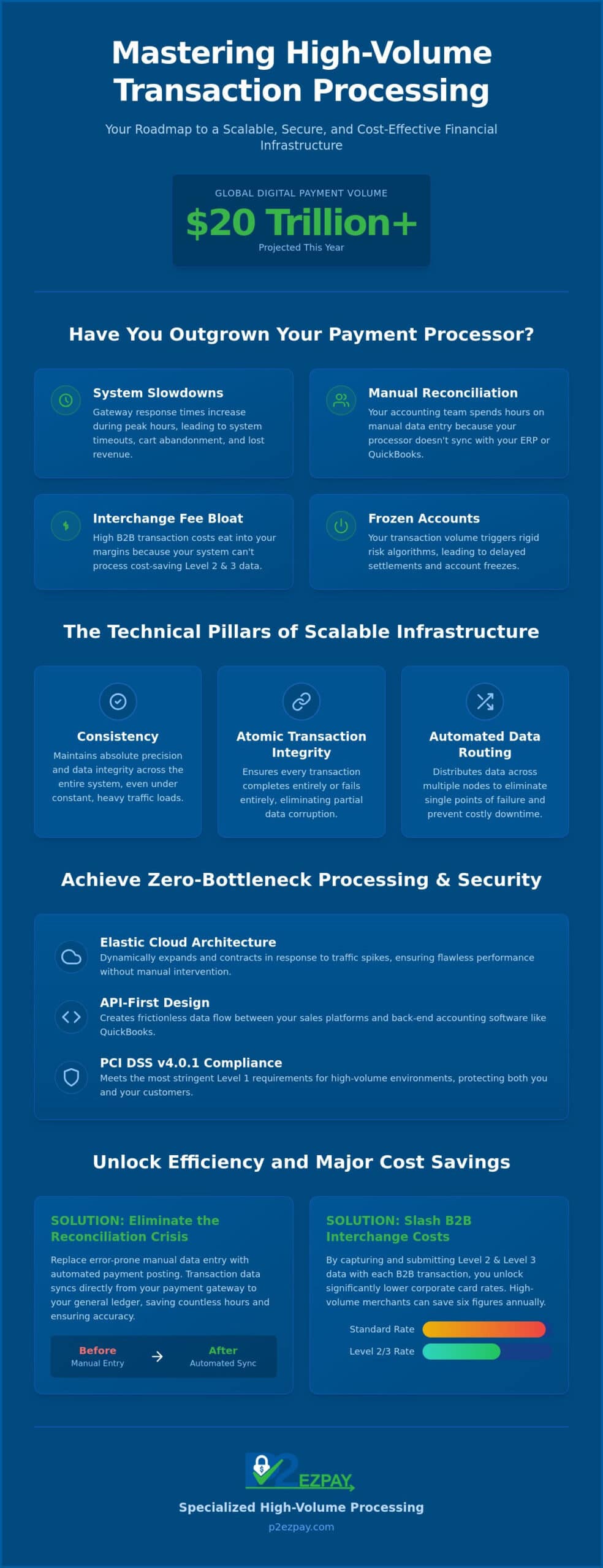
With global digital payment volumes projected to exceed $20 trillion this year, the margin for technical error in your financial infrastructure has effectively vanished. If your system struggles during peak periods, you’re facing more than just a speed issue. True high volume transaction processing is a sophisticated operational strategy that must balance rapid throughput with automated accounting and aggressive interchange optimization.
You likely feel the weight of manual reconciliation or the sting of interchange fee bloat on large B2B transactions. These aren’t just minor inconveniences; they’re signs that your scaling efforts have outpaced your current tools. We’re here to help you bridge that gap. This guide provides the roadmap to master the technical infrastructure and automation tools required to manage massive transaction loads without operational friction. We’ll explore how to achieve zero-bottleneck processing, automate your QuickBooks workflows, and leverage Level 2 and 3 data to significantly reduce B2B costs while staying ahead of PCI DSS v4.0.1 compliance requirements.
Key Takeaways
- Implement elastic cloud architecture and API-first designs to ensure your payment gateway expands dynamically without performance degradation during traffic spikes.
- Master the core requirements of high volume transaction processing, focusing on atomic transaction integrity and automated data routing to maintain system consistency.
- Eliminate the reconciliation crisis by replacing manual data entry with automated payment posting that syncs transaction data directly to your general ledger.
- Reduce B2B interchange costs by capturing Level 2 and Level 3 data, which can unlock significantly lower corporate rates and save high-volume merchants six figures annually.
- Leverage the strategic guidance of a local advisor to tailor payment workflows specifically for the unique operational needs of Wisconsin-based distributors and manufacturers.
What is High-Volume Transaction Processing?
At its core, high volume transaction processing refers to a financial infrastructure designed to manage thousands of exchanges per hour without measurable latency. While a standard merchant account might handle a few dozen sales a day with ease, enterprise-scale systems must maintain absolute precision under the weight of constant, heavy traffic. This requires a robust Transaction processing system that prioritizes three technical pillars: consistency, atomic transaction integrity, and automated data routing.
Atomic integrity ensures that every transaction is treated as a single unit; it either completes entirely or fails entirely, leaving no room for partial data corruption. As we move through 2026, the industry has shifted decisively from legacy batch processing toward real-time clearing. This evolution allows businesses to move capital and update ledgers instantly, which is essential for maintaining liquidity in a fast-paced market. However, this shift often exposes the “mid-market gap.” This occurs when a growing firm’s transaction count exceeds the capacity of standard merchant services, leading to frozen accounts or delayed settlements because the processor’s risk algorithms aren’t built for that specific scale.
The Benchmarks of Scale: TPS and Beyond
While engineers often point to Transactions Per Second (TPS) as the primary health metric, enterprise leaders should look at sustained volume. For a consumer retailer, a spike during a holiday sale is a temporary hurdle. For a B2B payment processing environment, the load is often steady and high-value, requiring infrastructure that doesn’t just survive a peak but thrives under a permanent, heavy workload. Infrastructure health in 2026 is measured by how well the system handles complex data payloads, such as Level 3 line-item details, without slowing down the authorization path.
Signs Your Business Has Outgrown Standard Processing
Identifying the need for a more sophisticated high volume transaction processing partner usually starts with observing subtle friction points. You might notice your payment gateway response times creeping up from milliseconds to seconds during busy hours. This latency is a precursor to system timeouts and lost revenue. Beyond technical speed, look at your accounting department. If they’re drowning in manual reconciliation because your current processor doesn’t sync directly with your ERP, you’ve outgrown your tools.
Another red flag is an increase in fraud false-positives. Basic processors often use rigid, “one-size-fits-all” security filters. When your volume increases, these primitive filters often misidentify legitimate enterprise transactions as high-risk, leading to frustrated clients and lost sales. Transitioning to a high-volume specialist allows for more nuanced, AI-driven risk scoring that protects your revenue while maintaining high approval rates.
The Technical Pillars of Scalable Payment Infrastructure
Achieving true resilience in high volume transaction processing requires more than just adding servers. It demands an elastic cloud architecture that expands dynamically in response to traffic spikes. In 2026, the standard for enterprise scaling is an API-first design. This approach ensures that data flows without friction between your front-end sales platforms and back-end accounting software. When your system can automatically route data across distributed nodes, you eliminate the single points of failure that often lead to costly downtime during peak processing periods.
Security shouldn’t come at the expense of speed. Modern platforms utilize real-time AI fraud detection to scan thousands of data points in milliseconds. This balances rigorous security with the rapid authorization times your customers expect. To maintain this level of throughput, developers must implement sophisticated database performance tuning strategies. By optimizing schemas and query indexing, your infrastructure remains responsive even as your transaction counts climb into the millions. If you’re unsure if your current stack can handle your projected growth, it might be time to consult with an advisor regarding your technical roadmap.
High-Volume Gateway Security and Compliance
High-volume environments must adhere to PCI-DSS Level 1 requirements, which is the most stringent level of compliance. As of July 2026, this includes meeting the full scope of PCI DSS v4.0.1 standards, which became mandatory in 2025. Tokenization is a critical component here. It replaces sensitive card data with unique identifiers, ensuring that your massive customer databases remain protected. If a node does experience a slowdown, distributed tracing allows your team to isolate the specific transaction node that’s causing the bottleneck before it impacts your overall success rate. For a comprehensive overview of what these requirements mean for your corporate transactions, reviewing the 2026 B2B payment security standards checklist can help ensure your infrastructure meets every mandatory control.
API Performance and Monitoring
Low-latency API response times are non-negotiable. In a high-volume ecommerce payment processing setting, a delay of even half a second can lead to cart abandonment and lost revenue. We recommend establishing strict performance SLAs with your payment partners to ensure accountability. Beyond this, the use of “atomic transactions” is vital. This ensures that even if a lag occurs, the data remains consistent across all systems. This prevents double-postings or missing records that would otherwise require manual intervention from your finance team.
Solving the High-Volume Reconciliation Crisis
As transaction counts climb, the primary bottleneck often shifts from the server room to the accounting department. This is what we call the “Data Deluge,” and it remains the number one failure point for scaling firms. When you rely on manual entry for high volume transaction processing, you introduce a margin for human error that compounds with every sale. Automated payment posting solves this by syncing transaction data directly to your general ledger. This bridge between your payment gateway and ERP system ensures that your financial records are always current, allowing for faster settlement and a dramatic reduction in “Days Sales Outstanding” (DSO).
Relying on manual workflows during a growth phase creates several hidden risks that can stall your momentum:
- Increased manual labor costs that eat into your scaling margins.
- Delayed financial reporting that masks critical cash flow issues.
- Greater risk of reconciliation errors that lead to audit failures.
- Inconsistent data across different sales channels and departments.
QuickBooks Payment Integration for High-Volume Firms
For many growing enterprises, a robust QuickBooks payment integration serves as the cornerstone of their workflow automation. Instead of wasting hours on CSV imports and tedious manual matching, direct integration allows for the seamless synchronization of ACH, e-check, and credit card data. This creates a single source of truth within your accounting software. By automating these repetitive tasks, you eliminate the risk of duplicate entries or missed payments, ensuring that your books remain audit-ready at all times. It’s a fundamental shift from reactive accounting to proactive financial management.
Automated Cash Flow Management
True scalability requires more than just raw processing power; it requires a clear view of your liquidity. Real-time reporting tools provide an immediate snapshot of your cash position, which is essential for making informed strategic decisions in a volatile market. When you use automated reconciliation, you can spot transaction leakages or unexpected fee spikes before they impact your bottom line. This level of oversight is only possible when you move away from bank-feed dependencies and focus on direct processor integration.
Beyond the numbers, there’s a significant human element to consider. When your accounting team is no longer bogged down by data entry, they’re free to focus on strategic analysis and financial planning. This shift transforms your finance department from a cost center into a value-added partner in your business’s growth. If you’re ready to move beyond manual workflows, exploring ACH and e-check solutions alongside your credit card processing can provide the comprehensive data coverage your firm needs.
Optimizing B2B Transaction Costs at Scale
Managing high volume transaction processing isn’t just about technical throughput; it’s a game of basis points. For enterprises processing millions of dollars monthly, a mere 0.5% reduction in interchange fees can translate into six-figure annual savings. This isn’t just theory. As of April 2026, Visa and Mastercard interchange rates remain complex, with specific card types like corporate credit cards often carrying higher fees than standard retail cards. By understanding the math behind these charges, you can implement strategies that significantly lower your effective rate.
Strategic merchant account consultancy plays a pivotal role here. Rather than accepting flat-rate pricing, high-volume firms should leverage interchange-plus models. This transparency allows you to see the exact cost of each transaction and identify where optimization is possible. When you combine this with the right technical tools, you transform your payment infrastructure from a cost center into a source of operational efficiency. It’s about ensuring that your growth doesn’t lead to a corresponding explosion in processing overhead.
Leveraging Level 2 and Level 3 Data
Qualifying for lower corporate rates requires more than just a basic transaction record. You must provide enhanced data points, such as tax IDs, invoice numbers, and freight amounts. This is known as Level 2 and Level 3 processing. We recommend automating the collection of this data at the gateway level to ensure every eligible transaction qualifies for the lowest possible rate. It’s a simple way to protect your margins without adding manual work for your team. You can explore our B2B payment processing solutions to see how these fee reductions work in practice.
High-Volume ACH and E-Check Solutions
While cards offer convenience, many high-volume firms are shifting large B2B payments toward ACH payment services. The cost benefits are undeniable, especially for recurring enterprise billing where transaction values are high. ACH and e-checks bypass the interchange system entirely, offering a flat-fee structure that is far more predictable at scale. Additionally, these methods provide enhanced security for long-term business relationships by reducing the risk of chargebacks associated with credit cards.
Operating at this scale requires rigorous attention to NACHA compliance and return risks. A sophisticated platform will automate these checks, ensuring that your high-volume ACH batches remain secure and compliant without slowing down your cash flow. If you’re ready to audit your current fee structure and find these hidden savings, contact our team for a detailed analysis of your processing costs.
Navigating High-Volume Merchant Services in Wisconsin
Scaling an enterprise within the Midwest brings a unique set of logistical and financial challenges. For Wisconsin-based firms, high volume transaction processing is more than a technical requirement; it’s a critical component of supply chain efficiency. Working with a local merchant services advisor provides a distinct advantage that national, “one-size-fits-all” processors cannot replicate. This proximity allows for a deeper understanding of the specific operational rhythms found in Milwaukee’s manufacturing corridors and Madison’s growing tech and distribution hubs.
P2EZPay Merchant Services acts as a strategic ally for local corporate entities, moving beyond the role of a simple vendor to become an independent consultant. We focus on tailoring payment workflows to the needs of regional distributors and manufacturers who often deal with complex, high-value B2B cycles. By providing objective advice and bespoke configurations, we help Wisconsin businesses navigate the transition from mid-market operations to true enterprise-level scaling without the common pitfalls of system downtime or settlement delays.
Local Expertise for Milwaukee and Madison Enterprises
Enterprises in Brookfield, Waukesha, and the surrounding areas require support that extends beyond a help desk ticket. A partner who understands the Wisconsin B2B landscape can anticipate regional growth trends and adjust your processing parameters accordingly. By aligning payment infrastructure with the specific logistical demands of the Great Lakes region, Milwaukee enterprises can transform their financial operations from a static cost into a dynamic growth engine. This localized focus ensures that your payment ecosystem supports your physical operations rather than hindering them.
Preparing Your Business for 2026 and Beyond
As we look toward the remainder of 2026, the shift toward real-time payment rails and enhanced data standards is accelerating. Future-proofing your infrastructure now ensures you don’t be left behind as global digital payment volumes continue their climb. A scalable, integrated payment ecosystem allows you to adopt these new technologies seamlessly as they become standard. Taking the next steps for a professional B2B merchant account optimization is the most effective way to secure your firm’s financial future. By prioritizing high volume transaction processing today, you build a foundation for sustainable, long-term success in an increasingly digital marketplace.
Securing Your Growth in an Evolving Payment Landscape
Transitioning to a sophisticated payment ecosystem is a strategic necessity for any enterprise looking to thrive in 2026. We’ve explored how technical elasticity, automated reconciliation, and Level 2/3 data capture work together to remove the friction from your scaling journey. Managing high volume transaction processing shouldn’t be a source of operational stress; it should be a competitive advantage that protects your margins and empowers your finance team to focus on high-level strategy.
With over 30 years of industry experience, P2EZPay Merchant Services provides the specialized B2B optimization and local Milwaukee-area consultancy required to navigate this complex field. We act as a steady hand, ensuring your infrastructure remains secure and your costs stay controlled as you reach new benchmarks of success. Our commitment is to provide the clarity and technical expertise you need to lead your industry with confidence.
Consult with a P2EZPay Merchant Services Advisor to Optimize Your High-Volume Processing
Your business is ready for the next level, and we’re here to ensure your transition is seamless and rewarding.
Frequently Asked Questions
What is considered high-volume transaction processing?
High volume transaction processing typically involves systems handling thousands of financial exchanges per hour or businesses exceeding $100,000 in monthly sales. At this scale, standard merchant accounts often fail because they lack the necessary technical elasticity. True high-volume systems prioritize atomic transaction integrity, ensuring that every data packet is processed accurately without latency. This level of throughput requires a dedicated infrastructure that can manage constant, heavy traffic without compromising security or performance.
How does high-volume processing affect transaction fees for B2B companies?
High-volume processing grants B2B companies significant leverage to negotiate lower interchange-plus markups. By processing larger quantities, firms can move away from restrictive flat-rate models that eat into margins. Additionally, high-volume environments allow for the automation of Level 2 and Level 3 data. Capturing these extra details qualifies corporate card transactions for lower interchange categories, which can save an enterprise six figures in annual processing costs.
Can I integrate high-volume processing with my current QuickBooks setup?
You can absolutely integrate high-volume solutions with your existing QuickBooks environment. Modern API-first designs facilitate a direct link between your payment gateway and accounting software. This synchronization eliminates the need for manual CSV imports or tedious matching processes. Automated payment posting ensures your general ledger remains a real-time source of truth, allowing your finance team to spend their time on strategic analysis rather than repetitive data entry.
What are the security requirements for processing high volumes of data?
Security for high-volume environments centers on continuous compliance with PCI DSS v4.0.1 standards. This requires robust tokenization strategies to replace sensitive card data with unique identifiers, protecting your massive customer databases. Beyond basic encryption, you need real-time AI fraud detection and distributed tracing. These tools help isolate sluggish nodes and identify suspicious patterns across thousands of simultaneous transactions without slowing down the authorization path for legitimate customers. Staying current with evolving B2B payment security standards is essential to ensure your controls remain sufficient as regulatory requirements continue to advance.
Is ACH better than credit cards for high-volume B2B transactions?
ACH is frequently the superior choice for high-volume B2B transactions due to its predictable, flat-fee structure. While credit cards offer speed, their percentage-based fees can become prohibitively expensive as transaction values climb. ACH and e-checks bypass the interchange system entirely, making them ideal for large enterprise payments and recurring billing cycles. They also offer enhanced stability for long-term business relationships by reducing the frequency of card-related chargebacks.
What is the difference between real-time and batch processing at scale?
Real-time processing clears each transaction as it occurs, while batch processing groups transactions for settlement at the end of a cycle. Real-time clearing is the 2026 enterprise standard because it provides immediate liquidity and up-to-the-minute cash flow visibility. Batching can still be useful for managing high volumes of smaller transactions, but real-time systems offer the agility needed to respond to modern market demands and maintain a competitive edge.
How do I choose a merchant service provider for high-volume needs in Wisconsin?
Choosing a provider in Wisconsin requires finding a partner who understands the regional B2B manufacturing and distribution landscape. A local advisor offers a level of accessibility and tailored consultancy that national vendors can’t match. Look for an independent mentor who prioritizes your long-term success over aggressive sales tactics. This partnership ensures your payment workflows are optimized specifically for the Milwaukee or Madison markets while remaining scalable for global growth.
What happens if my payment gateway bottlenecks during peak volume?
If your gateway bottlenecks, you’ll experience increased latency, system timeouts, and ultimately, lost revenue. This usually happens when infrastructure isn’t elastic enough to handle traffic spikes. To prevent this, you need a gateway built on elastic cloud architecture that expands capacity dynamically. Redundancy and failover protocols are also vital; they ensure that if one node fails, the transaction load is immediately rerouted to maintain a seamless experience.