
For B2B merchants, commercial-card interchange costs can vary significantly depending on the card product, transaction characteristics, merchant category and whether applicable enhanced-data requirements are met. Most B2B leaders accept high transaction costs as an inevitable part of doing business, especially following the January 2026 Visa rate increases for small business cards. It’s frustrating to watch profit margins erode while managing the complexities of Level 2 and Level 3 processing and the tedious manual data entry often required for corporate invoices.
Providing accurate enhanced transaction data can help eligible commercial-card transactions qualify for the applicable interchange treatment and can also improve the quality of payment and reconciliation data. This approach is no longer just a technical preference. Visa’s U.S. commercial interchange framework changed substantially in 2025–2026: Product 3 replaced the former Commercial Level III classification, and Level 2 interchange incentives for Small Business and Commercial Credit products were phased out in April 2026. This guide explains how detailed commercial transaction data can affect interchange qualification on eligible transactions, support reporting for corporate clients, and improve reconciliation workflows within QuickBooks.
Key Takeaways
- Understand the hierarchy of transaction data and why moving beyond standard consumer processing is critical for B2B and B2G merchants.
- Learn the specific line-item requirements, such as commodity codes and tax details, that satisfy the card networks’ demand for transparency.
- Discover how providing enhanced data lowers the perceived risk for issuing banks, which can help eligible transactions meet applicable commercial-card interchange requirements.
- Streamline your financial operations by using automated integrations to handle Level 2 and Level 3 processing without manual data entry.
- Identify immediate opportunities for cost reduction through a professional statement audit of your current corporate payment infrastructure.
Understanding the Basics of Level 2 and Level 3 Credit Card Processing
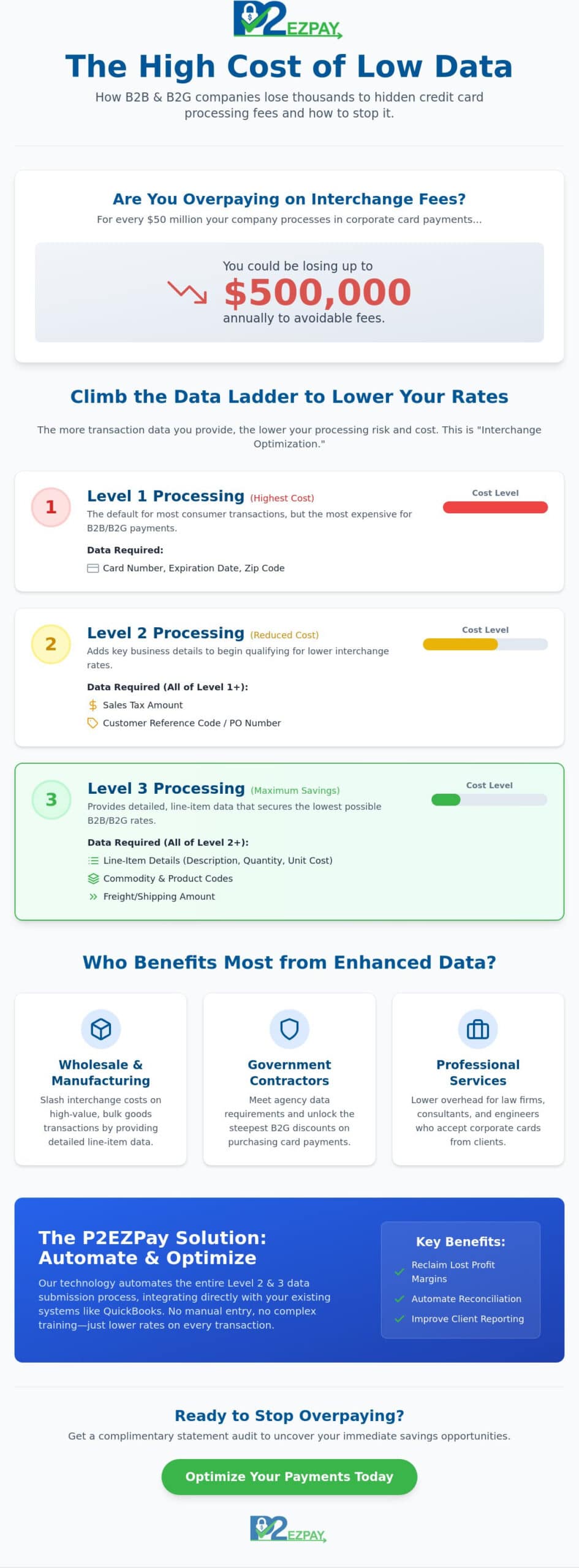
Credit card processing is not a one size fits all expense. In the commercial world, the cost of accepting a payment depends heavily on the amount of data you share with the card networks. This data hierarchy is categorized into three levels: Level 1, Level 2, and Level 3. While Level 1 is the default for consumer retail transactions, Level 2 and Level 3 processing are specialized frameworks designed for the business-to-business (B2B) and business-to-government (B2G) sectors. By providing more granular information about a sale, you demonstrate lower risk to the issuing bank, which in turn grants you access to lower rates.
This process is known as interchange optimization. Understanding interchange fees is the first step toward controlling your overhead. These fees represent the bulk of your processing costs and are non-negotiable at the network level. However, they are variable based on data quality. As we move through 2026, card networks like Visa have shifted toward mandatory data transparency. Their Commercial Enhanced Data Program (CEDP) now requires high quality, validated enhanced transaction data to qualify for the best rates. If your system isn’t set up to capture this information, you’re essentially leaving money on the table with every invoice.
Level 1 vs. Advanced Data Processing
Level 1 processing requires only basic information: the card number, expiration date, and billing zip code. It’s simple, but it’s also the most expensive way to process a commercial card. When a corporate or purchasing card is used without additional data, it often triggers a “downgrade.” This means the transaction is moved to a higher cost category because the network lacks the context to verify the legitimacy of the business purchase. Advanced B2B payment processing solves this by enriching the transaction with details like tax amounts and customer reference codes, ensuring you don’t pay consumer level premiums on corporate volume.
Who Benefits Most from Level 2 and 3?
Enhanced commercial-card data is most relevant to businesses that accept meaningful volumes of corporate, purchasing or government cards. The financial impact varies by card mix, transaction characteristics, merchant category, data quality and network rules. Businesses that commonly evaluate these programs include:
- Wholesale Distributors and Manufacturers: Companies moving bulk goods or specialized hardware—as seen with high-performance computing distributors like EMG2—often face high interchange costs that can be slashed by providing line item detail. Firms in this sector can find a detailed breakdown of these strategies in our guide to B2B payment processing for manufacturers.
- Government Contractors: Agencies often require Level 3 data for their own reporting, and B2G transactions may be eligible for commercial-card interchange programs when the applicable card, merchant, data and network requirements are met.
- Professional Service Firms: Law firms, engineering groups, and consultancies in Milwaukee and Madison often deal with corporate clients who pay via purchasing cards. These firms can significantly lower their overhead by optimizing their data capture.
The Data Hierarchy: Requirements for Level 2 vs. Level 3 Transactions
Qualifying for lower interchange rates requires more than just a valid card number. It involves meeting specific data thresholds set by the card networks. While Level 2 and Level 3 processing might seem complex, it’s helpful to view these requirements as a structured ladder of transparency. Before you begin, you must ensure your Merchant Category Code (MCC) is eligible. Most B2B and B2G industries qualify, but certain high-risk or consumer-facing categories are excluded from these enhanced data programs. Your MCC acts as the first gatekeeper in determining whether your business can access these discounted rates.
In the United States, these programs are primarily the domain of Visa and Mastercard. While American Express offers similar incentives through its OptBlue program, the most significant savings for corporate and purchasing cards come from these two major networks. It’s also vital to remember the 2026 shift in Visa’s policy. To see meaningful reductions on Visa commercial cards, you must now move past basic Level 2 fields and provide the comprehensive data required by their Commercial Enhanced Data Program (CEDP). This shift underscores the industry trend toward rewarding merchants who provide the highest level of transaction clarity.
Level 2 Data Requirements
Level 2 remains a familiar industry term for enhanced commercial transaction data, but Visa’s U.S. interchange incentives tied to Level 2 were phased out in April 2026. Businesses may still encounter Level 2 terminology in payment systems and discussions, while current Visa interchange qualification should be evaluated under the applicable CEDP and commercial-card rules.
- Customer Code (typically a unique invoice or PO number)
- Sales Tax Indicator (notifying the network if tax was applied)
- Sales Tax Amount (the specific dollar amount charged)
- Merchant Tax ID
- Merchant Postal Code (from where the goods are shipped)
Providing an accurate tax amount is non-negotiable. If you report a $0.00 tax on a taxable purchase without a valid exemption indicator, the transaction may be downgraded, resulting in higher fees. This level of data is often enough to secure moderate discounts on Mastercard commercial transactions.
The Level 3 Line-Item Deep Dive
Level 3 processing requires a much deeper level of granularity, mimicking the detail found on a traditional paper invoice. This “Line Item Detail” includes item descriptions, quantities, unit of measure, and commodity codes. It also requires specific freight or shipping codes and discount indicators. While this list looks extensive, modern B2B payment solutions can automate the capture and transmission of this data. If you aren’t sure if your current setup is capturing these fields correctly, you can reach out for a technical review of your processing environment to identify whether your current setup is capturing and transmitting the applicable enhanced-data fields correctly.
Why Enhanced Processing is Essential for B2B and B2G Cost Reduction
The financial logic behind Level 2 and Level 3 processing is rooted in a simple risk-reward model used by card networks. From the perspective of an issuing bank, a transaction with minimal data is a higher risk for fraud or disputes. When a business provides detailed line-item information, it’s essentially offering a digital audit trail that proves the legitimacy of the purchase. Because this transparency significantly reduces the likelihood of chargebacks, the networks reward the merchant with a lower interchange rate. This isn’t just a marginal gain; eligible commercial-card transactions may receive preferred interchange treatment when they meet the applicable network, card, merchant-category and enhanced-data requirements.
For a high-volume B2B merchant, improving qualification on eligible commercial-card transactions can affect total acceptance cost, but the financial impact depends on the merchant’s actual card mix, transaction data and processing configuration. Beyond the immediate financial savings, providing enhanced data offers a powerful competitive advantage. It streamlines the dispute resolution process because the network already has the itemized proof of what was purchased and shipped. This level of detail makes it much harder for a buyer to claim they didn’t receive the goods, protecting your revenue from unnecessary reversals.
Interchange Optimization and Your Bottom Line
Interchange fees make up the vast majority of your monthly processing statement, often accounting for 70% to 90% of your total costs. If you’re currently on a “Flat Rate” pricing model, you’re likely paying a premium that covers the processor’s risk across all card types. To truly benefit from data-driven savings, an Interchange Plus pricing model is essential. This structure can make network costs and processor markup easier to distinguish, which helps merchants evaluate how qualification changes affect their total processing cost. Interchange optimization is the alignment of transaction data and processing configuration with applicable card-network requirements; actual qualification and rates depend on the transaction and program rules.
Meeting the Needs of Corporate Procurement
Corporate and government buyers have rigorous internal auditing requirements. They often use purchasing cards (P-Cards) or fleet cards that specifically require Level 3 data to appear on their monthly statements. If you can’t provide this data, you create more manual work for their accounting teams, which might lead them to seek a vendor who can. By integrating Level 2 and Level 3 processing into your workflow, you become a preferred partner for large organizations. You’re not just selling a product; you’re providing the financial data they need to stay compliant with their own internal procurement policies. Manufacturing firms in particular can explore how this applies to their operations in our dedicated 2026 guide to B2B payment processing for manufacturers.
Implementing Level 3 Processing: QuickBooks Integration and Local Support
The most common hesitation we encounter when discussing Level 2 and Level 3 processing is the perceived administrative burden. Financial controllers often worry that qualifying for these lower rates requires their team to manually type dozens of extra fields for every single invoice. In a high-volume environment, this would be a non-starter. However, the reality of modern payment technology is that these data requirements are handled behind the scenes through intelligent automation. When your systems are properly configured, the line-item details already present in your accounting software are mapped directly to the transaction. This ensures you receive the best possible rate without any additional keystrokes from your staff.
By moving to an integrated model, your business becomes audit-ready and highly efficient. The detailed data transmitted to the networks serves as a permanent record, protecting you from disputes and simplifying your internal reporting. This transparency is exactly what card issuers look for to validate the legitimacy of a B2B transaction. It transforms your payment process from a cost center into a streamlined, strategic asset that supports your broader financial goals.
Automating the Workflow with QuickBooks
A robust QuickBooks payment integration acts as a bridge between your accounting records and the card networks. This integration pulls data from your existing invoices, including item descriptions, quantities, and tax amounts, and transmits them automatically during the authorization process. It eliminates human error and ensures that every eligible corporate card transaction qualifies for the steepest discounts. For firms in Waukesha and Brookfield, this level of automation facilitates seamless daily reconciliation. You no longer have to spend hours at the end of the month hunting down missing data or explaining why a transaction was downgraded to a more expensive tier.
Local Expertise for Wisconsin Manufacturers and Distributors
Implementing these advanced protocols often requires a steady hand and a deep understanding of your specific business model. This is where the value of a local partner becomes clear. A merchant services advisor who is familiar with the regional B2B landscape can provide the hands-on support that national processors often lack. Whether you’re a manufacturer in Madison or a distributor in Kenosha, having a local consultancy like P2EZPay ensures that your payment infrastructure is tailored to your unique operational needs. We don’t just provide a gateway; we act as a loyal ally in your financial growth. If you’re ready to see exactly how much your current system is costing you in missed optimizations, request a merchant statement review to evaluate your current processing costs, card mix and qualification patterns.
Strategic Partnership: Optimizing Your Corporate Payment Infrastructure
Adopting Level 2 and Level 3 processing is a commitment to the long-term financial health of your organization. It’s more than a one-time cost-cutting exercise; it’s about building a payment infrastructure that scales alongside your growth. For high-volume firms, even relatively small changes in qualification across eligible transactions can affect total payment acceptance cost, so the return on investment becomes clear. These reclaimed margins provide the capital necessary for reinvestment, whether that means expanding your fleet or upgrading your facility. This transition positions you as a sophisticated player in the corporate landscape, capable of meeting the rigorous data demands of the most prestigious global partners.
As your seasoned mentor in this complex field, we believe that every business relationship should be grounded in mutual success and transparency. This is why we encourage a comprehensive statement audit as your first step. By reviewing your current interchange levels, we can identify exactly where your data is falling short and where your current provider might be failing to pass through the discounts you’ve earned. It’s about moving from a generic processing model to a bespoke strategy that respects your bottom line.
Evaluating Your Current Processor
You need to ask direct questions of your current provider to ensure they’re acting as a loyal ally. Are they truly passing through the lower rates triggered by your enhanced data, or are they pocketing the difference? Many processors hide behind complex, tiered statements that make it nearly impossible to see if you’re actually receiving the benefits of Level 3 qualification. If your statements are opaque, it’s a clear sign that your provider isn’t optimized for B2B needs. A reliable merchant services advisor provides the independent advice required to spot these hidden costs. We prioritize clarity and removal of obstacles, ensuring your reporting is as streamlined as your transactions.
Next Steps for Milwaukee B2B Leaders
Preparing your team for this transition involves a methodical approach. You should start by educating your financial department on the importance of data accuracy, specifically regarding tax and commodity codes. You don’t have to transition every client at once. We often suggest starting with a pilot program for your largest corporate or government accounts where the volume is highest. This allows you to see the immediate impact on your margins without disrupting your entire workflow. As a leader in the Wisconsin business community, P2EZPay is here to provide the strategic guidance and constant accessibility you need. If you’re ready to streamline your B2B financial workflows, reach out for a personalized consultation today. Let’s work together to protect your profits and optimize your payment strategy for 2026 and beyond.
Future-Proof Your B2B Payment Infrastructure
Mastering your transaction data is no longer an optional technical task; it’s a fundamental strategy for protecting your margins in an increasingly complex financial landscape. By moving to Level 2 and Level 3 processing, you can improve the transaction data submitted for eligible commercial-card programs; qualification and interchange treatment still depend on the applicable network rules and transaction characteristics. Integrated solutions like QuickBooks automation ensure this happens without adding manual work for your accounting team. You gain both financial efficiency and a clearer digital audit trail for every corporate sale.
With over 30 years of industry experience and specialized QuickBooks integration expertise, P2EZPay acts as a seasoned mentor to businesses throughout Milwaukee and Southeast Wisconsin. We provide the local support and transparent reporting you need to navigate changing network requirements with confidence. It’s time to stop accepting high fees as a cost of doing business and start reclaiming your profit. We are committed to your success through every step of this transition.
Request a merchant statement review to evaluate your commercial-card mix, transaction data and processing configuration. You can also review our Visa CEDP guide for current enhanced-data terminology and requirements.
Important 2026 Visa CEDP Update
Visa’s U.S. commercial enhanced-data framework changed in 2025–2026. Product 3 replaced the former Commercial Level III interchange classification, and Level 2 interchange incentives for Small Business and Commercial Credit products were phased out in April 2026. “Level 2” and “Level 3” remain familiar industry terms, but merchants evaluating current Visa qualification should review CEDP and Product 3 requirements.
Related resources: Visa CEDP guide · B2B payment processing calculator · Merchant statement review
Frequently Asked Questions
What is the main difference between Level 2 and Level 3 processing?
The primary difference lies in the depth of data transmitted to the card networks. Level 2 processing requires basic details like a customer code and sales tax amount, while Level 3 requires comprehensive line-item detail. This includes item descriptions, quantities, unit prices, and commodity codes. This increased transparency allows the networks to verify the transaction more thoroughly, resulting in lower risk and lower fees.
How can enhanced commercial-card data affect processing costs?
Eligible commercial-card transactions may receive preferred interchange treatment when applicable network and enhanced-data requirements are met. For a company processing high volumes of corporate card payments, the resulting cost impact can vary materially from one merchant to another. Because interchange treatment varies by card product, merchant category, transaction characteristics and program qualification, P2EZPay evaluates potential savings using the merchant’s actual processing data rather than a generic rate example. These savings accumulate quickly across your annual volume.
Do I need special hardware to process Level 3 transactions?
No special physical hardware is required because Level 2 and Level 3 processing are handled through software gateways or virtual terminals. Standard credit card terminals aren’t designed to capture the extensive line-item data required for these programs. Instead, the information is transmitted through an integrated payment portal or directly from your accounting software, making the process entirely digital and more efficient.
Does QuickBooks Online support Level 2 and Level 3 data automatically?
QuickBooks Online doesn’t natively automate the submission of Level 3 data, but it supports this functionality through specialized third-party integrations. These tools act as a bridge, pulling the necessary line-item details from your invoices and mapping them to the payment gateway. This automation ensures your transactions qualify for the best rates without requiring your team to manually enter extra data for every sale.
What types of credit cards qualify for Level 3 rates?
Level 3 rates are reserved specifically for commercial, corporate, and government purchasing cards. Standard consumer credit cards, such as those used for personal retail shopping, don’t qualify for these programs regardless of how much data you provide. The card networks created these incentives to support the complex reporting and auditing requirements common in business-to-business and business-to-government procurement.
Is Level 3 processing only for government contractors?
Level 3 processing is available to any business that sells to other businesses or government agencies. While it’s a staple for B2G contractors due to strict reporting mandates, it’s equally beneficial for manufacturers, wholesalers, and professional service firms. If your client base uses corporate or business cards, you can likely use these protocols to lower your transaction costs and improve your profit margins.
How do I know if my current merchant account is set up for Level 3?
You can check your current status by reviewing your monthly merchant statements for “downgrade” messages or checking your transaction reports for line-item data. If you only see basic information like the card number and total amount, you probably aren’t set up for Level 3. Many standard processors default to Level 1, which means you might be paying higher rates than necessary for your commercial sales.
Are there fees associated with enhanced commercial-card programs?
Program and processing costs can vary by network, processor, gateway and merchant setup. For Visa CEDP, merchants should evaluate any applicable program costs alongside their eligible transaction mix, qualification results and actual interchange treatment rather than assuming that enhanced-data submission will produce a particular savings amount.