

With the ACH network processing over 35.2 billion payments in 2025, the shift toward electronic B2B transfers has evolved from a simple convenience into a critical infrastructure requirement. As your business scales, managing high volume ACH processing manually is no longer just a headache; it’s a significant financial risk. You’ve likely felt the frustration of reconciling manual data entry errors in QuickBooks or waiting far too long for high-value transfers to settle. It’s a common challenge for growing firms that must balance rapid expansion with the tightening Nacha fraud monitoring rules effective throughout 2026.
We understand that while credit cards offer speed, the processing fees are likely eroding your margins, and your current manual workflows simply can’t keep up with the volume. This guide will show you how to master the complexities of high-volume ACH processing to slash transaction costs, automate your reconciliation, and secure your corporate financial workflows. We’ll explore how to leverage same-day settlement capabilities and seamless API integrations to transform your payment department into a streamlined, automated powerhouse that supports your long-term growth.
Key Takeaways
- Define the 2026 thresholds that necessitate a transition from standard processing to a high-volume strategy focused on liquidity and Same Day ACH.
- Optimize your payment infrastructure using API-driven connectivity and smart batching to meet Nacha clearing windows with maximum efficiency.
- Secure your high volume ACH processing workflows by implementing non-negotiable risk mitigations like dual authorization and SEC code filtering.
- Remove the administrative burden of manual reconciliation through direct QuickBooks integration for automated, real-time ledger accuracy.
- Identify the strategic advantages of partnering with a local Wisconsin merchant service advisor to navigate the complex corporate payment landscapes in Milwaukee and Madison.
What Defines High Volume ACH Processing in 2026?
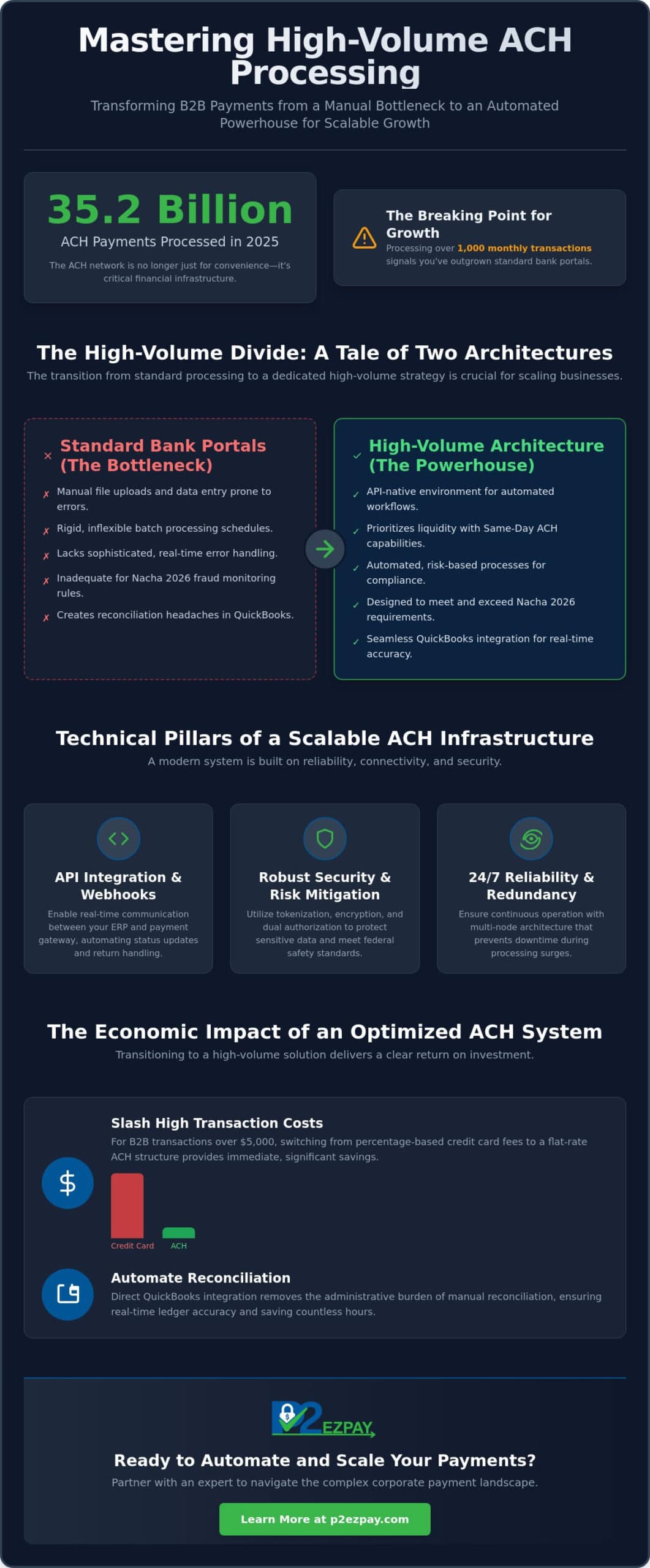
In the current financial environment, the definition of high volume has shifted from a simple transaction count to a measure of operational complexity. While the 2025 ACH network volume reached a staggering 35.2 billion payments, most businesses find their breaking point much earlier than the national averages suggest. If your organization processes more than 1,000 monthly transactions, you’ve likely outgrown the capabilities of standard business banking portals. These traditional interfaces often rely on manual file uploads and lack the sophisticated error-handling required for modern Automated Clearing House (ACH) workflows.
True high volume ACH processing in 2026 is characterized by API-native environments that prioritize liquidity and real-time data. With the Same-Day ACH transaction limit holding at $1,000,000 per transfer, large-scale B2B firms now use the network for significant capital movements that once required expensive wire transfers. This shift demands a move away from “set and forget” utility models toward strategic infrastructure that can handle rapid clearing windows without increasing administrative headcount.
As organizations manage these significant capital movements, Legacy Funding Advisors provides the fast and flexible funding solutions necessary to maintain liquidity during periods of rapid scaling.
Standard ACH vs. High Volume Architecture
Traditional business banking often forces users into rigid batch processing schedules that don’t align with modern cash flow needs. When you move to a dedicated high-volume environment, you gain access to stable merchant accounts designed to withstand the scrutiny of the 2026 Nacha rules. Crucially, the March 2026 fraud monitoring requirements specifically target high-volume originators with over 6 million entries, necessitating robust, automated risk-based processes that standard bank portals simply aren’t equipped to provide. If your volume is scaling, a bespoke architecture ensures your account remains in good standing even as Nacha compliance becomes more complex.
The Economic Impact of High Volume ACH
The financial incentive to prioritize ACH over credit cards is more pronounced than ever, especially when compared to the complex data requirements of Level 2 and Level 3 card processing. When processing B2B transactions over $5,000, the return on investment is primarily driven by the transition from high percentage-based credit card fees to a predictable flat-rate ACH structure. By integrating ACH and E-check Solutions, businesses also reduce “Non-Sufficient Funds” (NSF) friction through real-time account verification. This proactive approach identifies potential failures before they occur, preserving your professional reputation and ensuring that high-value transfers settle without the delays associated with traditional manual reconciliation.
Technical Requirements for Scalable ACH Infrastructure
Scaling your payment operations requires a move beyond the basic interfaces provided by retail banks. When your business handles thousands of transactions, the technical foundation must prioritize 24/7 reliability and multi-node redundancy. This architecture ensures that if one server node experiences a disruption, your payment engine automatically shifts to another, preventing costly delays in vendor payments or payroll. Without this level of redundancy, seasonal spikes or end-of-month processing surges can lead to system latency, putting your corporate reputation at risk.
A robust infrastructure also requires alignment with federal safety standards to protect your organization’s capital. Integrating ACH risk management guidance into your technical stack helps you build a system that is both fast and compliant. If you’re currently struggling with manual file uploads, it’s time to consider how a programmable environment can transform your high volume ACH processing from a bottleneck into a competitive advantage.
API Integration and Webhooks
Modern B2B payments rely on API-driven connectivity to facilitate real-time transaction monitoring. Unlike legacy systems that require you to wait for a daily report, RESTful APIs allow your ERP to communicate directly with the payment gateway. Webhooks then provide instant status updates, which automates the return-handling process and saves your accounting team hours of administrative work. To maintain security, these endpoints must utilize tokenization and advanced encryption, ensuring that sensitive routing and account numbers never reside on your local servers in an unencrypted state.
Same Day ACH and Settlement Windows
Liquidity management is a game of timing. By leveraging the three daily Nacha clearing windows, you can optimize your cash flow to meet specific business needs. This is particularly relevant for firms managing cycles across different time zones. For example, a late-day window is essential for West Coast business cycles, while Midwest firms can use earlier windows to ensure funds are available by the start of the next business day. You can learn more about our ACH payment services to see how we align these windows with your unique operational requirements.
Intelligent batching strategies are the final piece of the puzzle. By grouping transactions into optimized file transmissions, you can meet Nacha deadlines with precision while minimizing processing overhead. If you’re ready to modernize your payment stack, you might want to speak with a strategy expert about designing a tailored infrastructure that scales with your ambition.
Mitigating Risk in High-Volume Environments
Operating at scale introduces a larger surface area for potential errors and fraudulent activity. When your organization moves beyond basic transactional needs, the focus must shift from simple execution to rigorous control. In a high volume ACH processing environment, risk management isn’t a secondary consideration; it’s the framework that keeps your operations stable. Implementing a “Dual Authorization” workflow is a non-negotiable first step for large batches. This process requires one authorized user to initiate a payment file while a second, independent user approves it, effectively eliminating the risk of internal fraud or catastrophic “fat-finger” data entry errors.
Precision in transaction labeling is equally vital for maintaining network access. Utilizing specific Standard Entry Class (SEC) code filters, such as PPD for payroll, CCD for business-to-business transfers, and WEB for online entries, ensures your batches are processed under the correct regulatory guidelines. Mislabeling transactions doesn’t just lead to administrative delays; it can trigger unnecessary returns. You must also proactively manage your “Unauthorized Return” rates. Nacha maintains a strict threshold of 0.5% for unauthorized entries, and exceeding this limit can lead to significant fines or the suspension of your processing privileges.
Nacha Compliance and Security Standards
The regulatory landscape in 2026 has introduced heightened expectations for fraud monitoring. As of March 20, 2026, large-scale originators are required to implement risk-based processes to identify fraudulent entries, with these requirements extending to all originators by June 22, 2026. Encrypting bank account data at rest remains a foundational requirement to ensure that sensitive financial information is protected even in the event of a physical or digital security breach. Partnering with a high-volume provider ensures you have a steady hand to guide you through annual Nacha audits, providing the documentation and oversight necessary to prove your compliance.
Advanced Fraud Detection for B2B
Modern fraud prevention relies on velocity checks and anomaly detection to spot suspicious patterns before funds ever leave your account. AI-driven systems now analyze the frequency and size of transactions in real-time, flagging any activity that deviates from your established business norms. Verifying account ownership through instant validation tools is another critical layer of defense, especially when initiating large ACH debits from new vendors. For a deeper look at how these security measures apply to various payment formats, you can explore our Electronic Check Processing for Business: The 2026 B2B Guide. By combining tokenization with real-time monitoring, you create a bespoke security environment that protects your corporate capital without slowing down your growth.
QuickBooks Integration: The Secret to High-Volume Efficiency
Manual reconciliation is often the hidden cost of business growth. When your organization scales, the administrative burden of matching payments to open invoices can quickly become your primary operational bottleneck. For firms managing high volume ACH processing, relying on human data entry is a significant liability. It’s not just about the time lost; it’s about the compounding risk of errors that can lead to incorrect ledger balances, missed vendor payments, and strained client relationships. A direct integration between your payment gateway and QuickBooks transforms this chaotic process into a streamlined, automated workflow.
The secret to maintaining high-volume efficiency lies in real-time ledger updates. By bridging the gap between your financial transactions and your accounting software, you create a closed-loop system where every payment is automatically recorded and applied to the correct account. This level of automation ensures that your financial data is always current, providing your leadership team with the accurate insights needed to make informed liquidity decisions without waiting for end-of-month manual audits.
Automated Reconciliation Workflows
Integrated ACH solutions are designed to push data directly into QuickBooks Online or Desktop, effectively eliminating the need for “double entry.” When a payment clears the network, the system automatically matches the transaction to the corresponding invoice, marking it as paid without any intervention from your sales or accounting teams. This seamless data flow is essential for maintaining accuracy at scale. To understand the full scope of these capabilities, you can read our QuickBooks ACH Integration: The 2026 Guide to B2B Payment Automation. By removing the human element from repetitive tasks, you free up your staff to focus on high-level financial strategy rather than data entry.
Managing Multi-Entity Payments
Complex corporate structures require a sophisticated approach to fund management. Centralizing your ACH processing allows you to synchronize multiple bank accounts within a single QuickBooks environment, providing a unified view of your entire organization’s cash flow. This is particularly beneficial for multi-entity firms that need to manage intercompany transfers and diverse vendor lists from a central hub. You can explore our B2B payment processing solutions to see how we help businesses navigate these multi-layered financial environments with ease.
If your current reconciliation process is struggling to keep pace with your transaction volume, it’s time to modernize your accounting stack. You can contact our integration specialists to learn how a tailored QuickBooks setup can secure your financial workflows and support your next phase of growth.
Partnering with a High-Volume ACH Expert in Wisconsin
Wisconsin’s corporate landscape, stretching from the industrial hubs of Milwaukee to the growing tech sectors in Madison, requires a sophisticated approach to liquidity that national aggregators often overlook. While large, generic payment platforms offer quick setup, they frequently lack the depth of support required for high volume ACH processing at the enterprise level. For a mid-market firm in Brookfield or a large distributor in Waukesha, a “one size fits all” processing agreement can lead to restrictive fund holds and impersonal service that doesn’t account for specific industry cycles. Choosing a partner who understands the local B2B environment ensures your payment infrastructure is a strategic asset rather than a rigid utility.
The primary distinction lies in the difference between a standard “Aggregator” and a dedicated “Merchant Service Advisor.” Aggregators operate on a model of mass automation, which often results in automated account freezes when transaction volumes spike unexpectedly. In contrast, a merchant service advisor provides a bespoke processing agreement tailored to your specific risk profile and volume projections. This specialized oversight is essential for navigating the technical integrations and compliance audits that come with the 2026 Nacha fraud monitoring requirements. Firms looking to further protect their margins should also explore how to reduce transaction costs for B2B through data optimization and strategic payment automation.
The Value of a Local Merchant Advisor
Navigating the Milwaukee financial market requires a partner who understands the nuances of local industry and the specific needs of Wisconsin-based corporations. P2EZPay acts as a seasoned mentor for businesses throughout the state, providing the steady hand and technical leadership necessary to manage complex payment flows. We prioritize transparency and long-term partnership, ensuring that your transition to a high-volume environment is handled with white-glove care. When you connect with a merchant services advisor, you gain an ally who is deeply invested in your operational success and long-term stability.
Transitioning to High-Volume Processing
Switching providers or upgrading your current system doesn’t have to disrupt your cash flow. If you’re evaluating a partner’s ability to scale from 1,000 to 100,000 monthly transactions, consider this strategic checklist:
- Confirm the provider’s readiness for the 2026 Nacha fraud monitoring phases.
- Validate the depth of their QuickBooks integration to ensure automated reconciliation.
- Audit their API documentation for multi-node redundancy and webhook capabilities.
- Ensure they offer dedicated support for dual authorization and SEC code filtering.
A successful transition relies on a methodical approach that prioritizes security and administrative ease. By moving away from generic models and embracing a tailored strategy, you protect your margins and ensure your financial workflows are ready for the future. If you’re ready to optimize your payment stack, you can contact P2EZPay for a high-volume ACH consultation and discover how a local expert can transform your B2B operations.
Securing Your Financial Future Through Strategic Automation
Transitioning to a sophisticated payment infrastructure is no longer optional for firms aiming to maintain their competitive edge in 2026. By embracing API-driven connectivity and rigorous risk mitigation strategies like dual authorization, you protect your corporate capital while ensuring rapid liquidity. The shift toward high volume ACH processing requires more than just technical updates; it demands a partnership that understands the nuances of your specific business cycle and local market demands. Integrating these systems directly with your accounting software removes the burden of manual reconciliation, allowing your team to focus on high-level growth rather than repetitive data entry. Organizations that treat their payment infrastructure as a strategic asset rather than a simple utility — as outlined in our guide to corporate electronic payment services — consistently outperform those relying on outdated, manual workflows.
With over 30 years of industry experience and specialized QuickBooks integration expertise, we provide the steady hand you need to navigate these complexities. Our team offers dedicated local support for Wisconsin corporations, ensuring that your transition to automated, high-volume workflows is seamless and secure. You don’t have to manage these technical hurdles or compliance shifts alone. Optimize your corporate payments with P2EZPay today and build a scalable foundation for your long-term success. We’re here to guide you through every step of your financial journey.
Frequently Asked Questions
What is considered high volume ACH processing in 2026?
High volume is typically defined by Nacha thresholds, such as the 6 million annual entry mark that triggers specific fraud monitoring rules. For most B2B firms, however, the practical threshold is 1,000 monthly transactions. At this scale, standard banking portals often fail because they lack the API-native architecture required to manage complex liquidity needs and real-time status monitoring without excessive manual intervention.
How much can I save by switching from credit cards to high volume ACH?
Savings are primarily achieved by moving from percentage-based credit card fees to a flat-rate transaction structure. While specific costs depend on your provider, high volume ACH processing is significantly more cost-effective for B2B transfers exceeding $5,000. By avoiding the high interchange fees associated with corporate credit cards, you can preserve your margins while maintaining a more predictable monthly processing expense.
Is Same Day ACH available for high-volume B2B transactions?
Yes, Same Day ACH is fully available for high-volume transfers with a per-transaction limit of $1,000,000. This capability allows your business to leverage three daily clearing windows for rapid settlement. It’s an essential tool for modern liquidity management, providing the speed of a wire transfer with the lower administrative overhead and cost of the ACH network.
How does QuickBooks integration work with high volume ACH batches?
Integration works by establishing a direct API connection between your payment gateway and QuickBooks Online or Desktop. When you process a batch, the system automatically syncs transaction data to your ledger and matches payments to open invoices. This automation removes the need for manual data entry, which is the leading cause of reconciliation errors in growing B2B companies.
What are the Nacha compliance requirements for large-scale originators?
Large-scale originators must implement risk-based fraud monitoring processes as part of the 2026 Nacha rule updates. These requirements include maintaining an unauthorized return rate below 0.5% and ensuring all bank account data is encrypted at rest. High-volume providers help you meet these standards by offering automated reporting tools and security frameworks that simplify the annual audit process.
Can I process high volume ACH payments internationally?
The ACH network is primarily domestic, but you can handle cross-border payments using International ACH Transactions (IAT). These entries require specific formatting to comply with OFAC regulations and international banking standards. Most high-volume firms work with a specialized advisor to manage the additional data requirements and screening protocols necessary for secure and compliant international transfers.
How does P2EZPay secure high-volume corporate transactions?
We secure transactions through a multi-layered framework that includes tokenization, advanced encryption, and dual authorization workflows. By requiring two authorized users to approve large batches, we help you eliminate the risk of internal fraud or accidental entry errors. Our systems also utilize real-time velocity checks to identify and flag suspicious activity before funds leave your account.
What is the typical setup time for a high-volume ACH merchant account in Milwaukee?
Setup times generally span a few business days, depending on the complexity of your technical integration and underwriting needs. Our local Milwaukee team works directly with your staff to streamline documentation and test API connectivity before going live. We focus on a methodical transition to ensure your daily cash flow remains stable throughout the entire onboarding process.