

Are you unintentionally gifting a percentage of every corporate sale back to your processor simply because your transaction data isn’t structured correctly? Most financial leaders recognize that high interchange fees on corporate cards are a persistent drain on profit margins, yet they often feel stuck with big-box processors that offer little more than a generic help desk. Selecting the right B2B payment gateway providers is no longer just a technical necessity; it’s a strategic move to reclaim lost revenue and streamline your operations.
You deserve a financial partner that understands the nuances of high-volume merchant services. We’ll show you how to evaluate B2B payment gateway providers to reduce interchange fees through Level 2 and 3 data while finally automating your corporate financial workflows. This comparison guide breaks down the top 2026 solutions, focusing on seamless QuickBooks synchronization, faster ACH processing, and the reliable local support that Wisconsin businesses need to thrive. From Milwaukee to Brookfield, we’re here to help you move from manual data entry to meaningful, scalable growth.
Key Takeaways
- Learn why specialized B2B payment gateway providers are essential for handling the complex data requirements and interchange optimization needed for corporate and government transactions.
- Discover how direct merchant service models eliminate the hidden costs of flat-rate pricing, allowing high-volume businesses to retain more revenue through Level 2 and 3 data processing.
- Identify the critical features for 2026, including seamless QuickBooks integration and PCI-compliant vaults, to automate your financial workflows and secure recurring billing.
- Understand the strategic advantage of partnering with a local Wisconsin mentor who provides the personalized guidance and accessibility that global fintech conglomerates often lack.
Understanding the Landscape of B2B Payment Gateway Providers
A Payment gateway serves as a specialized bridge for corporate, government, and wholesale transactions. It ensures sensitive financial data moves securely between parties. While a consumer processor focuses on speed at a retail counter, B2B payment gateway providers must manage the heavy lifting of high-value transfers and complex data requirements. They act as the technical foundation for modern enterprise commerce.
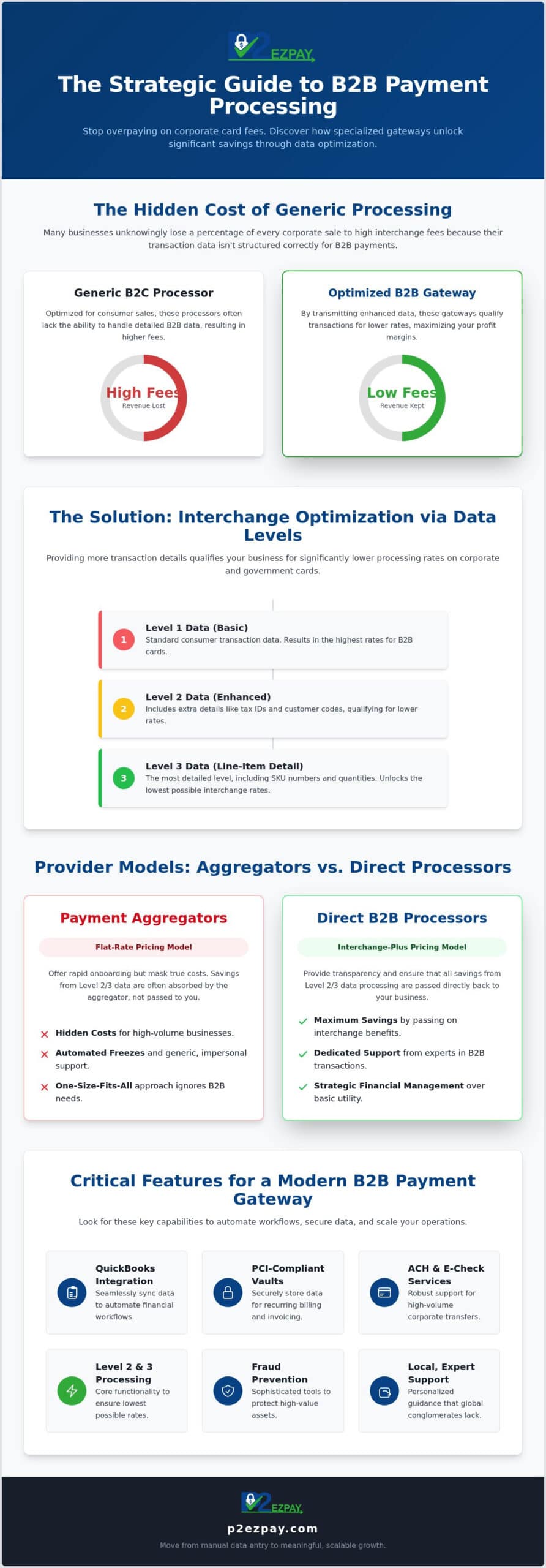
B2B payment gateways are the infrastructure that enables Level 2 and 3 data transmission to lower transaction costs. For corporate finance teams, the primary goal is Interchange Optimization. This strategy ensures every payment qualifies for the lowest possible rate by providing the card networks with the specific data they require. Without this specialized transmission, your business likely pays significantly more than necessary for every card processed.
To better understand this concept, watch this helpful video:
The Role of Level 2 and Level 3 Processing
Providing extra data points like tax IDs, zip codes, and line-item details qualifies transactions for significantly lower rates. This level of detail is a prerequisite for corporate cards and government purchasing cards. It’s a technical hurdle that many standard processors ignore, leaving money on the table. You can explore the technical nuances in our Level 2 and Level 3 Processing: The B2B Guide.
B2B vs. B2C Gateway Requirements
Retail processors often prioritize mobile-wallet compatibility and quick consumer checkouts. In contrast, B2B environments demand robust support for bulk ACH and e-check services. High-volume corporate transfers involve larger sums, so the security stakes are inherently higher. These systems require sophisticated fraud prevention and data vaulting to protect significant business assets. While B2C gateways focus on the user experience of a single shopper, B2B systems must integrate with complex ERP software to ensure data flows directly into your accounting books without manual intervention.
Comparing Provider Models: Aggregators vs. Direct B2B Processors
Choosing between payment aggregators and direct merchant service providers is a pivotal decision for any growing corporation. Aggregators offer rapid onboarding, but they often mask the true cost of business through rigid, flat-rate pricing. For firms with large average ticket sizes, these “simple” rates become a significant hidden expense. Recent data in the B2B Payments Market Report highlights how the complexity of modern transactions requires more than a one-size-fits-all approach. Working with an independent merchant services advisor allows you to look past the marketing and see the actual impact on your bottom line.
When to Choose an Enterprise-Grade Processor
Interchange-plus pricing typically becomes more profitable than flat rates once a business reaches a consistent monthly volume or handles high-value invoices. Manufacturers and wholesalers who manage recurring shipments find that direct B2B payment gateway providers offer the transparency needed to audit every cent. If your transactions qualify for Level 2 or 3 rates, a direct model ensures those savings stay in your accounts rather than being absorbed by the aggregator’s margin. This transition marks the move from basic utility to strategic financial management.
The Risks of Generic Payment Solutions
Generic solutions are designed for the masses, which often leads to automated account freezes and a frustrating lack of personalized support. When a high-value corporate transfer is flagged by an algorithm, you need a human partner, not a chatbot. Specialized B2B payment processing provides the risk management and dedicated oversight required to keep your capital moving. If you’re ready to move beyond basic tools toward a bespoke solution, it’s time to discuss your specific financial goals with a local expert who values your long-term success.
Critical Features to Evaluate in a B2B Payment Partner
Evaluating B2B payment gateway providers requires looking beyond the transaction window. In 2026, the primary differentiator is how well the system communicates with your existing software stack. The Atradius Payment Practices Barometer highlights that administrative friction and payment delays remain top concerns for US firms. Solving these issues starts with a gateway that offers PCI-compliant vaults for secure, recurring billing and reporting that mirrors your ERP outputs. You can find detailed insights on these efficiencies in our guide to Automated B2B Payment Systems.
QuickBooks Payment Integration and Automation
Manual data entry is a liability that your finance department shouldn’t have to carry. Modern B2B payment gateway providers solve this through direct QuickBooks synchronization, which eliminates the need for double entry. This integration enables an “auto-post” feature where payments are recorded directly into your ledger the moment they’re cleared. It effectively removes human error from the reconciliation process and ensures your books are always current without extra effort.
Support for ACH and E-check Solutions
While card processing is vital for interchange optimization, ACH payment services are often the preferred method for high-value corporate transfers. The lower flat fees offer significant relief compared to percentage-based rates on six-figure invoices. E-checks also play a critical role by allowing you to maintain traditional business workflows in a digital environment. These tools provide the flexibility needed to handle diverse client preferences without sacrificing security or speed. If you’re ready to modernize your financial stack, contact our team today to build a tailored solution for your business.
Selecting a Provider: Why Local Expertise Matters in Wisconsin
For businesses operating in Milwaukee, Brookfield, or Waukesha, the choice between B2B payment gateway providers often comes down to the quality of support and accountability. Global fintech conglomerates may offer sleek interfaces, but they frequently lack the personal touch of a local mentor. A local partnership provides a steady hand to guide you through complex financial transitions and technical integrations. Midwest corporations must adhere to specific industry standards, and having a partner who understands the regional economic climate ensures your business remains compliant and competitive. Selecting the right B2B payment gateway providers is about more than just software; it’s about building a relationship grounded in mutual trust and long-term stability.
The Advantage of a Local Payment Consultant
Imagine needing a technical adjustment or a strategy session and being able to request a face-to-face consultation in Pewaukee, Madison, or Racine. This level of accessibility is something a generic help desk simply can’t replicate. Local expertise ensures your gateway is perfectly tuned to the unique needs of Wisconsin’s manufacturing and professional service sectors. This grounded knowledge is especially vital when optimizing high volume merchant services for regional growth. We don’t just provide software; we provide the strategic leadership required to remove obstacles and streamline every transaction.
Moving Toward a Strategic Payment Partnership
The journey from viewing payments as an unavoidable cost to seeing them as a strategic advantage is a transformative shift for any finance team. By selecting a partner that prioritizes transparency and community, you protect your margins while simplifying your day-to-day operations. P2EZPay stands as a seasoned ally for Wisconsin businesses, offering decades of industry experience to help you navigate the 2026 financial landscape. It’s time to move beyond generic, rigid tools toward a bespoke solution that values your success. Contact P2EZPay for a custom B2B payment analysis and discover the strategic difference a local partner makes.
Strategic Growth Through Optimized Payments
Choosing among the various B2B payment gateway providers available in 2026 requires a shift in perspective. It’s no longer just about accepting a card; it’s about capturing the data necessary to lower your interchange fees and automating reconciliation to save your staff hours of manual work. By moving away from rigid aggregators toward a direct, enterprise-grade model, you gain the transparency and technical depth needed for sustainable corporate growth. We’ve seen how dedicated QuickBooks integration support and Level 3 data processing can transform a financial department from a cost center into a strategic asset.
At P2EZPay, we bring over 30 years of industry experience as an independent consultancy to help you navigate these choices. Our local Wisconsin-based partnership ensures you’re never just a ticket number in a global queue. If you’re ready to reclaim your profit margins and simplify your workflows, Request Your Custom B2B Payment Analysis today. Let’s build a more efficient future for your business together.
Frequently Asked Questions
What is the difference between a B2B payment gateway and a merchant account?
A merchant account is where funds are held before being settled into your business bank account, while a gateway is the secure software bridge that transmits transaction data. Think of the account as the destination and the gateway as the armored vehicle transporting the information. Both are required for digital B2B transactions. Effective B2B payment gateway providers often bundle these services to ensure seamless communication and reporting between the two systems.
How does Level 3 processing actually lower my B2B transaction fees?
Level 3 processing lowers fees by providing card networks with extensive line-item detail that reduces the perceived risk of the transaction. When you include tax amounts, product codes, and shipping information, Visa and Mastercard apply significantly lower interchange rates. This is specifically designed for corporate and government purchasing cards. Without this data, these transactions “downgrade” to much higher, standard retail rates that eat into your profit margins.
Can I integrate a B2B payment gateway with my existing QuickBooks Desktop or Online?
Yes, modern enterprise-grade gateways are designed to sync directly with both QuickBooks Desktop and Online versions. This integration allows for real-time data flow where payments are automatically posted and reconciled against open invoices. It’s a critical feature for reducing administrative overhead and eliminating the human error associated with manual entry. Ensuring your chosen provider supports your specific version of QuickBooks is a vital step in your evaluation process.
Are ACH payments safer than credit card payments for high-volume B2B transactions?
ACH payments offer a different security profile that is often preferred for high-value transfers because they involve direct bank-to-bank communication. While credit cards have robust fraud protection, ACH transactions aren’t subject to the same chargeback risks and often have lower processing costs. For high-volume businesses, utilizing both methods allows you to balance speed and security. Implementing e-checks and ACH provides a stable, cost-effective alternative to traditional card networks for large invoices.
What should a Milwaukee-based business look for in a local merchant service provider?
A Milwaukee-based business should prioritize a provider that offers on-site consultancy and a deep understanding of the Wisconsin manufacturing and professional service sectors. Look for a partner with decades of local experience who can provide face-to-face support in Waukesha, Brookfield, or Milwaukee. This accessibility ensures that technical hurdles are resolved quickly. Choosing among B2B payment gateway providers with a local presence means you gain a dedicated mentor invested in your regional growth.