
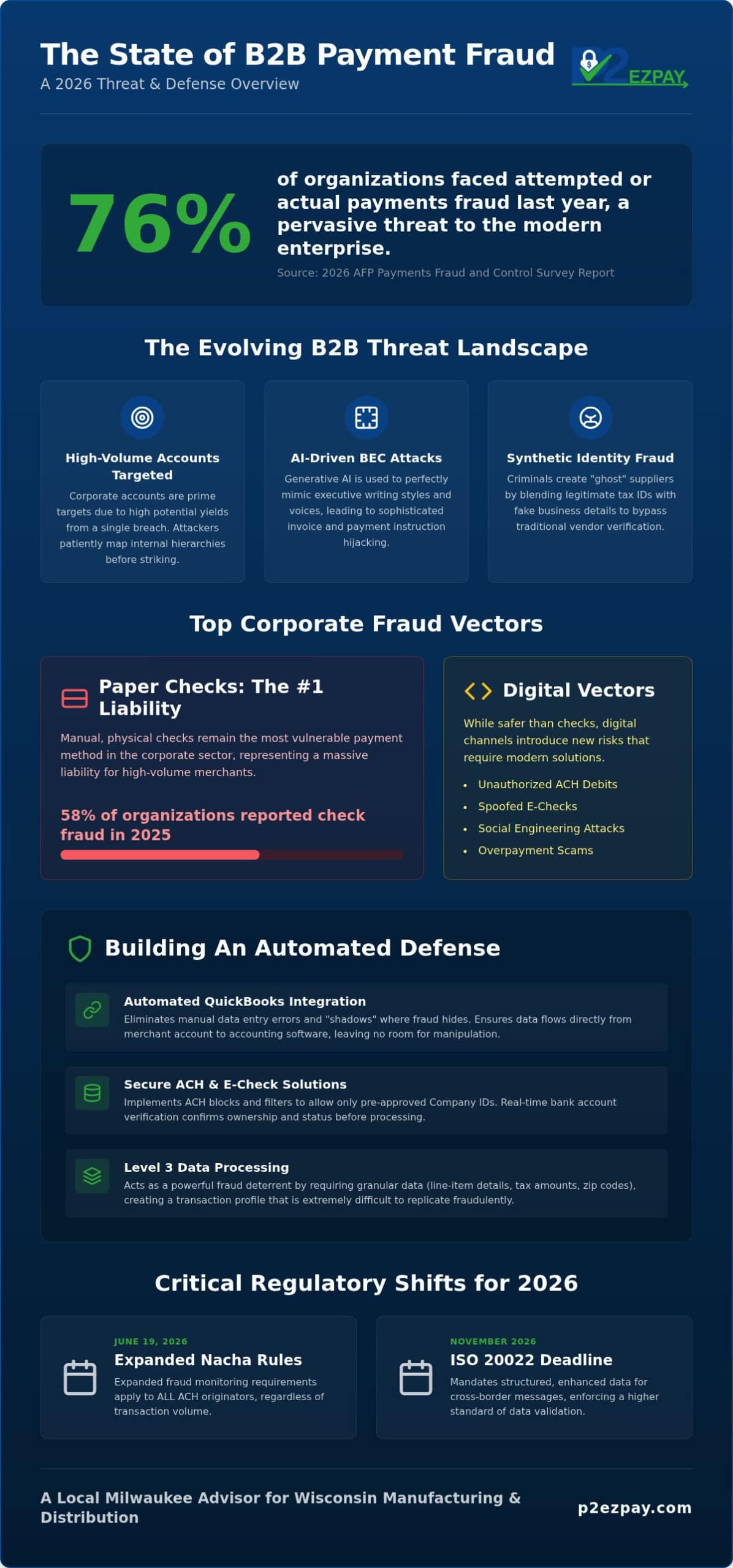
Did you know that 76% of organizations faced attempted or actual payments fraud last year? According to the 2026 AFP Payments Fraud and Control Survey Report, this threat is more pervasive than ever for the modern enterprise. You likely feel the pressure of protecting your company’s assets while navigating the constant fear of Business Email Compromise and the high costs of fraudulent chargebacks. We understand that effective B2B payment fraud prevention isn’t just about building a wall; it’s about creating a seamless, automated workflow that protects your revenue without hindering your operations.
In this article, you’ll learn how to safeguard your high-volume transactions using advanced QuickBooks integration, rigorous validation, and localized security strategies. We’ll explore how new Nacha operating rules and ISO 20022 standards are reshaping the financial landscape. By the end, you’ll see how a dedicated partner can help you reduce interchange fees through better data and gain the peace of mind necessary for long-term growth.
Key Takeaways
- Identify why high-volume corporate accounts are increasingly targeted and how 2026 digital supply chain vulnerabilities impact your bottom line.
- Master advanced B2B payment fraud prevention techniques to secure ACH, e-check, and paper check workflows against sophisticated unauthorized debits.
- Eliminate manual data entry errors and “shadows” by implementing automated, daily reconciliation through specialized QuickBooks integration.
- Learn the strategic advantage of working with a local Milwaukee advisor to tailor security settings for the unique needs of Wisconsin-based manufacturing and distribution.
The Evolution of B2B Payment Fraud in 2026
In 2026, B2B payment fraud prevention requires more than just a standard firewall. It demands a sophisticated understanding of how digital supply chains are targeted. High-volume corporate accounts are prime targets because a single successful breach can yield millions, unlike the low-value, high-frequency nature of B2C theft. Attackers play a patient long game, often spending weeks mapping out internal approval hierarchies before striking. Within corporate vendor onboarding, Synthetic Identity Fraud represents a growing threat where criminals blend legitimate tax IDs with fabricated business names to create “ghost” suppliers that bypass traditional verification.
The Rise of AI-Driven Business Email Compromise (BEC)
Sophisticated attackers now leverage generative AI to mimic the specific writing styles and even the voices of executives in Milwaukee firms. The threat has evolved from easily spotted fake invoices to the precision hijacking of payment instructions within established B2B payment processing workflows. These criminals often utilize overpayment scams, where they send a surplus payment from a compromised account and request the “balance” be returned to a different, fraudulent destination.
Regulatory Shifts and Compliance in 2026
Compliance serves as a critical framework for security. By June 19, 2026, Nacha expanded fraud monitoring requirements to all ACH originators, regardless of their transaction volume. Additionally, the November 2026 ISO 20022 deadline mandates structured data for cross-border messages, which forces a higher standard of data validation. By prioritizing B2B payment fraud prevention through these regulatory frameworks, Wisconsin corporations can ensure they remain resilient while reducing their overall financial liability.
Identifying and Neutralizing Common B2B Fraud Vectors
Paper checks remain a massive liability for high-volume merchants. In 2025, 58% of organizations reported check fraud, making it the most vulnerable payment method in the corporate sector. Prioritizing B2B payment fraud prevention means moving away from these manual systems. While shifting to digital channels reduces physical risk, it introduces new vectors like unauthorized ACH debits and spoofed e-checks. To combat the rising tide of B2B payment fraud, merchants must look beyond basic encryption and address the procedural gaps in their workflows.
Securing ACH and E-check Solutions
Unauthorized corporate withdrawals often occur when sensitive account details are exposed through social engineering. You can mitigate this risk by implementing ACH blocks and filters, which ensure that only pre-approved Company IDs can pull funds from your accounts. Utilizing robust ACH payment services that feature real-time bank account verification adds a crucial layer of defense. This process confirms account ownership and status before a transaction is ever processed, stopping fraudulent debits at the source.
The Security Power of Level 3 Processing
Level 3 processing is frequently discussed as a way to lower interchange fees, but it’s also a powerful asset for B2B payment fraud prevention. By requiring detailed data fields such as line-item descriptions, tax amounts, and merchant zip codes, you create a transaction profile that’s exceptionally difficult for attackers to replicate. This granular data validation acts as a natural deterrent against fraudulent credit card usage. When you optimize your B2B payment processing with Level 3 data, you’re building a defense that protects your margins while securing your transactions.
Even legitimate business partners can cause friction through “friendly fraud,” which involves disputes over delivery or pricing that manifest as chargebacks. Maintaining clear digital audit trails and using automated reconciliation tools helps resolve these disputes without costly losses. If you’re concerned about your current vulnerabilities, it’s helpful to consult with an advisor to audit your existing security filters.
Building an Automated Defense with QuickBooks Integration
Manual data entry creates “shadows” where inconsistencies often go unnoticed until it’s too late. When your team manually enters invoice details, simple typos or deliberate alterations can easily hide fraudulent activity. By contrast, an automated workflow ensures that data flows directly from your merchant account into your accounting software, leaving no room for manual manipulation. This transparency is a cornerstone of modern B2B payment fraud prevention, as it allows systems to flag duplicate or altered invoices the moment they appear. By utilizing tokenized payment links, you also remove the need for employees to handle sensitive data, further narrowing the window for social engineering.
Reconciliation as a Fraud Detection Tool
Strategic reconciliation transforms a back-office chore into a proactive security measure. Daily synchronization allows you to spot anomalies before they escalate into significant losses. To stay ahead of emerging threats in B2B payments, we recommend a logical three-step approach:
- Synchronize QuickBooks with your merchant account daily to maintain real-time visibility into every transaction.
- Set up automated alerts for any payment discrepancies, unauthorized changes, or unusual vendor activity.
- Review our QuickBooks ACH integration guide to understand how automated posting removes the risk of manual tampering.
Tokenization: Removing Sensitive Data from Your Servers
Storing sensitive credit card or bank information in your local Milwaukee offices is a significant liability. If your local servers are breached, that stored data becomes an open door for criminals. P2EZPay addresses this risk through advanced tokenization within our ecommerce payment processing gateways. Tokenization replaces actual financial data with unique digital identifiers, ensuring that even if an attacker accesses your internal system, they find nothing of value. This strategy effectively secures your digital supply chain while maintaining a smooth user experience. If you’re ready to modernize your workflow, contact our integration team to discuss a tailored solution.
Strategic Fraud Prevention for Milwaukee Corporations
For corporations in the Greater Milwaukee area, generic security protocols often fall short of addressing the specific risks inherent in local supply chains. A dedicated merchant services advisor provides the nuance needed to protect high-volume transactions without disrupting your daily operations. Whether you’re managing a manufacturing hub in Waukesha or a distribution center in Madison, your B2B payment fraud prevention strategy should be as unique as your business model. Big banks often offer rigid, one-size-fits-all tools, but an independent consultancy allows for bespoke adjustments that actually fit your specific workflow.
Establishing a “Culture of Verification” within your local accounting team is just as vital as the software you use. This involves training staff to double-check any change in payment instructions via a known, secondary contact method before funds are released. When combined with specialized fraud settings tailored for Wisconsin’s industrial sectors, this human-centric approach creates a multi-layered defense. Effective B2B payment fraud prevention isn’t just a technical hurdle; it’s a strategic commitment to organizational vigilance and long-term stability.
Local Support for High-Volume Merchants
P2EZPay understands the regional business landscape from the Menomonee Valley to the state capital. We don’t just provide a processing platform; we offer bespoke security audits that examine your specific vulnerabilities in the context of local industry standards. This community-oriented approach fosters long-term trust, ensuring your business has a steady, expert hand to guide it through the complexities of modern corporate finance and evolving digital threats.
Next Steps: Securing Your 2026 Revenue
- Audit your current B2B payment gateway to ensure it meets 2026 security and data validation standards.
- Schedule a consultation to review your high volume merchant services and identify potential gaps in your current defense.
- Protect your business and optimize your payments by contacting P2EZPay today.
Securing Your Corporate Future in 2026
The landscape of corporate finance is shifting rapidly, but your defense doesn’t have to lag behind. We’ve explored how sophisticated AI threats and manual process vulnerabilities can jeopardize your revenue. By embracing automated workflows and rigorous data validation, you transform your accounting department from a target into a fortress. Effective B2B payment fraud prevention is a continuous journey of adaptation and vigilance. It requires a proactive stance that balances technical innovation with human oversight.
P2EZPay brings over 30 years of industry experience and specialized QuickBooks integration expertise to your side. As a local Milwaukee-based partner, we’re committed to your success through bespoke security audits and direct support. You don’t have to navigate these complex regulatory shifts or technical threats alone. We act as a steady hand, ensuring your high-volume transactions remain secure and your operations stay efficient. Get a Professional B2B Security Audit from P2EZPay today to fortify your payment ecosystem. We look forward to building a secure future together.
Frequently Asked Questions
What is the most common type of B2B payment fraud in 2026?
Business Email Compromise (BEC) remains the most prevalent threat, accounting for nearly half of all wire transfer fraud incidents this year. Attackers utilize AI-driven deepfakes and social engineering to impersonate trusted vendors or high-level executives. While check fraud was historically dominant, the rapid shift toward digital channels has made BEC a primary concern for high-volume merchants. Protecting your organization requires a combination of employee training and multi-layered verification protocols.
How does QuickBooks integration help prevent corporate payment fraud?
QuickBooks integration creates a secure, automated link between your merchant account and your accounting records, which eliminates the security gaps created by manual data entry. This automation allows for daily, real-time reconciliation that instantly flags discrepancies or altered invoice amounts. By centralizing your payment data, you reduce the human attack surface and ensure that every transaction is accounted for within a transparent, auditable, and highly secure digital workflow.
Is ACH safer than credit card processing for high-volume B2B transactions?
Both methods offer distinct security advantages when managed through a professional gateway. ACH transactions are governed by strict Nacha operating rules that require robust fraud monitoring for all originators as of June 2026. Credit card processing, however, provides the benefit of Level 3 data validation, which acts as a powerful deterrent against unauthorized usage. Choosing the safest option depends on your specific integration and the use of real-time verification tools.
What should a Milwaukee business do if they suspect a fraudulent B2B transaction?
If you suspect fraud, immediately notify your local merchant services advisor and your financial institution to freeze the affected accounts. You should also report the incident to the FBI’s Internet Crime Complaint Center (IC3). For Wisconsin-based firms, contacting local law enforcement helps document the breach for insurance and recovery purposes. Swift action is critical to intercepting funds before they are moved through complex, international laundering networks.
Can Level 3 processing really reduce fraud and transaction costs simultaneously?
Yes, Level 3 processing achieves both goals by requiring more granular data fields for every transaction. This extra information, such as line-item details and tax codes, qualifies the payment for lower interchange rates while making it much harder for fraudsters to spoof. Implementing this data-rich approach is a core strategy for effective B2B payment fraud prevention, as it provides both financial incentives and enhanced security for high-volume merchants.