

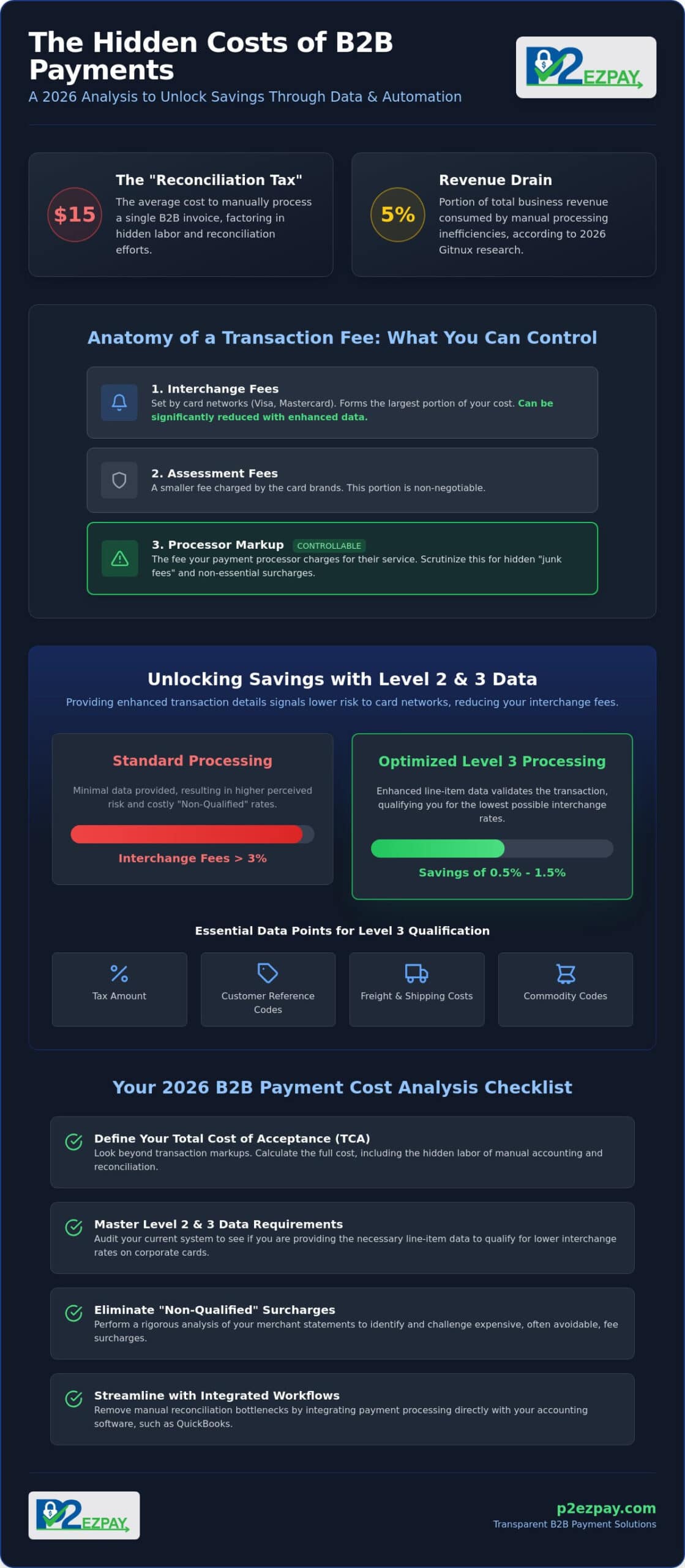
Did you know that manual processing still consumes nearly 5% of total business revenue, even as digital adoption grows? According to Gitnux research from June 2026, the average B2B invoice costs $15 to process when you factor in the labor required for reconciliation. This “reconciliation tax” often hides behind more obvious expenses, making a thorough B2B payment cost analysis essential for any corporation aiming for true efficiency.
You likely already feel the weight of these inefficiencies, especially when navigating opaque interchange fees that can climb above 3% for certain corporate cards. It’s challenging to manage high-volume transactions when you’re unsure if you’re missing out on lower rates or if your data is properly optimized. We’re here to help you master these complexities and identify significant hidden savings with our comprehensive cost analysis checklist.
This guide provides a logical framework for auditing your current fees and capturing the benefits of Level 2 and Level 3 data. You’ll learn how to implement automated workflows with QuickBooks and align your operations with the latest PCI DSS v4.0.1 standards to reduce costs and secure your bottom line through a partnership grounded in transparency.
Key Takeaways
- Define the Total Cost of Acceptance (TCA) to distinguish between visible transaction markups and the hidden labor costs of manual accounting.
- Unlock lower interchange rates by mastering the technical requirements of Level 2 and Level 3 processing for corporate transactions.
- Perform a rigorous B2B payment cost analysis using our 2026 checklist to identify and eliminate expensive “Non-Qualified” fee surcharges.
- Streamline high-volume workflows by integrating payment processing directly with QuickBooks to remove manual reconciliation obstacles.
Beyond the Percentage: The True Anatomy of B2B Payment Costs
Judging your financial health solely by the processing percentage is like judging an iceberg by its tip. In 2026, a sophisticated B2B payment cost analysis requires looking at the Total Cost of Acceptance (TCA). This metric encompasses every dollar spent to move money from your client’s account to yours. While hard costs like interchange fees are unavoidable, soft costs like manual reconciliation often drain more resources than the transactions themselves. Business-to-business (B2B) transactions often involve high-value orders that demand more than just a flat-rate pricing model. These “simple” models typically hide inefficiencies because they don’t account for the data-rich nature of corporate purchasing card requirements.
The “Reconciliation Tax”: Hidden Labor Costs
Manual data entry is a silent profit killer. Research from June 2026 indicates that the average cost to process a B2B invoice remains near $15 per transaction. For high-volume businesses, the hours your team spends manually keying data into QuickBooks represent a significant “reconciliation tax.” Human error in these environments doesn’t just cause headaches. It delays cash flow and creates friction with your most valuable partners. Milwaukee-area manufacturers often find that automating these workflows is the fastest way to reclaim lost margins and ensure that their B2B payment processing remains a competitive advantage rather than a burden.
Interchange vs. Markup: Knowing What You Can Control
A transparent merchant services advisor will show you that fees consist of three distinct layers. Interchange and assessment fees are set by card networks and are largely non-negotiable. However, the processor markup is where many “junk fees” hide. By identifying non-essential surcharges on your statement during a B2B payment cost analysis, you can reclaim control over your margins. Understanding these tiers is the first step toward moving beyond generic processing toward a bespoke, high-volume strategy. It’s about finding the balance between specialized technical support and clear, objective advice that protects your bottom line. For consultancies, law firms, and other professional service organizations facing similar fee structures, exploring dedicated B2B payment solutions for professional services can reveal additional cost-reduction opportunities unique to their billing models.
The Technical Lever: Level 2 and Level 3 Processing Optimization
If your B2B payment cost analysis focuses only on the processor’s markup, you’re missing the most powerful lever for cost reduction: interchange optimization. For corporate treasurers, Level 3 processing represents a data-validation standard for commercial cards that signals lower risk to card networks. By providing enhanced transaction details, you can unlock significantly lower rates that aren’t available to standard retail transactions. It’s a technical shift that moves your processing from a generic utility to a strategic asset.
Why Level 2 and Level 3 Data Matters for B2B
Card networks categorize transactions based on the depth of information provided. A transaction with minimal data is seen as higher risk, which triggers higher interchange fees. Conversely, data richness proves the legitimacy of a corporate purchase and justifies a lower rate. Learn more about Level 2 and Level 3 Processing Benefits to understand how these tiers protect your margins. In the current 2026 landscape, submitting this additional line-item data can reduce interchange rates by 0.5% to 1.5%, a margin that often determines the profitability of high-volume contracts.
Requirements for Level 3 Qualification
Achieving Level 3 status requires submitting specific line-item data with every transaction. While this sounds labor-intensive, modern AI-driven gateways now automate this process by pulling necessary fields directly from your digital invoices. This technology removes the manual burden while ensuring your transactions qualify for the best possible rates. Essential data points include:
- Tax amount and status: Verifying the exact tax applied to the order.
- Customer reference codes: Tracking specific purchase orders or project IDs.
- Freight and shipping costs: Breaking out logistical expenses from the product price.
- Commodity codes: Using standardized identifiers for the specific goods or services sold.
Relying on manual entry for these fields is no longer a viable strategy for growth-minded distributors. A thorough B2B payment cost analysis often reveals that missing data is the primary cause of “fee bloat.” If you’re ready to see how bespoke technical optimization can protect your revenue, you might consider reaching out to a specialized payment advisor for a comprehensive statement review.
Your 2026 B2B Payment Cost Analysis Checklist
Moving from theory to practice requires a methodical review of your financial statements and operational habits. While technical optimization provides the foundation, a consistent B2B payment cost analysis ensures that your savings don’t evaporate through fee creep or administrative bloat. It’s time to look beyond the headlines and scrutinize the line items that define your monthly overhead. Use this checklist to verify that your current setup aligns with 2026 efficiency standards.
Step-by-Step Fee Audit
The first step in any meaningful B2B payment cost analysis is reviewing your last three months of merchant statements. You should specifically look for “Non-Qualified” or “Mid-Qualified” surcharges. These labels often indicate that your transactions didn’t meet the data requirements for Level 3 rates, causing them to “downgrade” to a more expensive tier. If you’re on a tiered pricing model, you’re likely paying a premium that obscures the actual cost of the transaction. Switching to Interchange Plus pricing provides the transparency needed to see exactly what the card networks charge versus what your processor keeps. To navigate these complexities, you can Consult with a Merchant Services Advisor for a detailed audit to uncover hidden markups.
Workflow and Efficiency Review
Operational efficiency is just as critical as the transaction rate. If your team is still manually matching payments to invoices, you’re paying a “labor tax” on every dollar earned. In 2026, corporate efficiency depends on whether your payment data syncs automatically with QuickBooks. This integration removes the obstacle of manual data entry and reduces the risk of human error in high-volume environments. You should also evaluate your payment mix. While credit cards offer speed, ACH transactions typically cost between $0.20 and $1.50 per transaction, making them a superior choice for large-scale distributions. Finally, verify your security standing. As of March 31, 2025, PCI DSS v4.0.1 requirements became mandatory. Ensure your gateway handles this compliance automatically to avoid expensive non-compliance penalties. If you’re unsure where your current strategy stands, it’s a wise move to request a professional fee audit to protect your corporate margins.
Strategic Implementation: Scaling with Integrated Workflows
Execution is the final bridge between a successful B2B payment cost analysis and realized corporate savings. For high-volume manufacturers and distributors, scaling isn’t just about increasing sales; it’s about ensuring your financial infrastructure can handle that growth without a proportional increase in administrative headcount. Transitioning to integrated B2B gateways allows your business to move away from fragmented systems toward a unified environment where every transaction is optimized for both cost and speed. Understanding the full scope of scaling B2B payment operations is essential for corporations that want to grow transaction volume without adding overhead or sacrificing accuracy.
Local Expertise for Wisconsin Corporations
Many Milwaukee-area manufacturers are discovering that “big bank” models often lack the flexibility required for complex industrial supply chains. These rigid systems frequently fail to provide the bespoke technical support needed for the data optimization strategies discussed earlier. Choosing an independent partner like P2EZPay Merchant Services offers a distinct advantage: access to objective advice and a mentor who understands the local economic landscape. This partnership provides a steady hand during complex migrations, ensuring that your transition to a more efficient gateway is seamless and secure.
The Future of B2B Efficiency
As we move through 2026, the definition of success in the corporate sector is shifting toward “Zero Touch” accounting. Automated posting and reconciliation are no longer optional luxuries; they’re the standard for maintaining healthy cash flow. By removing the obstacles of manual data entry, your team can focus on strategic growth rather than correcting entry errors. If you’re looking to deepen your understanding of these technological shifts, explore The 2026 Guide to B2B Payment Automation for a detailed look at upcoming trends.
A professional B2B payment cost analysis is not a one-time event but the beginning of a long-term commitment to operational excellence. Ongoing optimization ensures that as card network regulations change, your business remains ahead of the curve and protected from unnecessary fee increases. If you’re ready to uncover the hidden savings within your current merchant statements and build a more resilient financial workflow, schedule your B2B payment cost analysis with P2EZPay Merchant Services today. Our team is here to provide the sophisticated guidance and reliable support your corporation deserves.
Securing Your Corporate Margins for 2026 and Beyond
Navigating the complex landscape of corporate finance requires a proactive stance on fee management and operational automation. By moving beyond basic processing and adopting the technical optimization strategies outlined in this guide, you ensure that your bottom line is protected from unnecessary erosion. A comprehensive B2B payment cost analysis serves as your roadmap; it turns complex data requirements into a distinct competitive advantage that supports your entire organization’s growth.
At P2EZPay Merchant Services, we act as a seasoned mentor for Wisconsin corporations seeking more than just a generic vendor relationship. With over 30 years of industry experience and a deep commitment to specialized QuickBooks integration, we provide the steady hand needed to navigate high-volume complexities. Our local Milwaukee and Wisconsin-based support team is dedicated to providing the objective, independent advice your business deserves. If you’re ready to secure your financial future and remove the obstacles of legacy processing, we invite you to Request a Professional B2B Payment Cost Audit today. We look forward to building a partnership grounded in your long-term success and community stability.
Frequently Asked Questions
How do I calculate the effective rate of my B2B payment processing?
You calculate your effective rate by dividing the total fees charged by the total dollar volume processed during a specific month. This single percentage provides the most objective view of your true costs because it accounts for interchange, assessments, and processor markups. It’s a vital metric in any B2B payment cost analysis, as it allows you to strip away statement complexity and compare different providers on a level playing field.
What is the difference between Level 2 and Level 3 processing for B2B?
The primary difference lies in the depth of data required and the resulting discount on interchange fees. Level 2 requires basic details like tax amounts and customer codes; however, Level 3 demands extensive line-item data such as freight costs and commodity codes. Providing this extra detail proves a transaction is a low-risk corporate purchase, which qualifies your business for the most aggressive rate reductions available from card networks.
Can QuickBooks integration really lower my transaction costs?
Yes, integration lowers your total costs by eliminating the labor-intensive “reconciliation tax” and reducing expensive human errors. While it might not change the base markup, it slashes the soft costs associated with manual data entry. Modern gateways also use this integration to automate Level 3 data submission. This ensures your transactions qualify for lower rates without requiring your team to manually key in line-item details for every invoice.
Is ACH significantly cheaper than credit card processing for high-volume B2B?
ACH is almost always the more cost-effective choice for large-scale corporate transactions because it avoids percentage-based interchange fees. While credit cards often carry fees that can exceed 3%, ACH typically involves flat-rate pricing between $0.20 and $1.50 per transaction. For high-volume distributors, moving even a small portion of large invoices from credit cards to ACH can result in substantial monthly savings and improved cash flow.
How often should a corporation perform a payment cost analysis?
A corporation should conduct a formal B2B payment cost analysis at least once every quarter. Card networks typically update their interchange tables twice a year; additionally, your own transaction volume or average ticket size may shift as your business grows. Regular audits allow you to catch “fee creep” early and ensure your processing strategy continues to align with your current operational goals and technical requirements.