

Scaling your business shouldn’t mean doubling your accounting department just to keep up with the paperwork. In fact, successfully scaling B2B payment operations in 2026 is less about adding headcount and more about removing the data friction between your sales and your ledger. You’ve likely felt the frustration of manual data entry errors in QuickBooks or watched high interchange fees eat into the margins of your largest corporate card transactions. It’s exhausting to manage inconsistent cash flow while waiting for slow ACH processing to clear.
We understand that growth often brings complexity, but it doesn’t have to bring chaos. You can grow your transaction volume without increasing overhead by automating workflows and optimizing B2B interchange costs. In this guide, we’ll show you how to achieve a seamless sync between your payment gateways and general ledgers. You’ll also learn how to reduce transaction costs through Level 3 data and why having a reliable, local partner is the steadiest way to navigate this transition. Let’s look at how to turn your payment infrastructure into a tailwind for growth.
Key Takeaways
- Learn why hiring additional staff for manual reconciliation creates a “growth trap” rather than a scalable foundation for your business.
- Discover how to achieve true efficiency when scaling B2B payment operations by synchronizing payment gateways directly with your QuickBooks ledger.
- Identify the specific steps required to implement Level 2 and Level 3 data processing, which can significantly reduce interchange costs on corporate card transactions.
- Find out how to audit your current financial workflows to uncover hidden bottlenecks and “fee leaks” that hinder your cash flow.
- Understand the strategic advantage of working with a local Wisconsin-based consultancy to receive the bespoke, high-touch support that national processors often overlook.
Understanding the Challenges of Scaling B2B Payment Operations
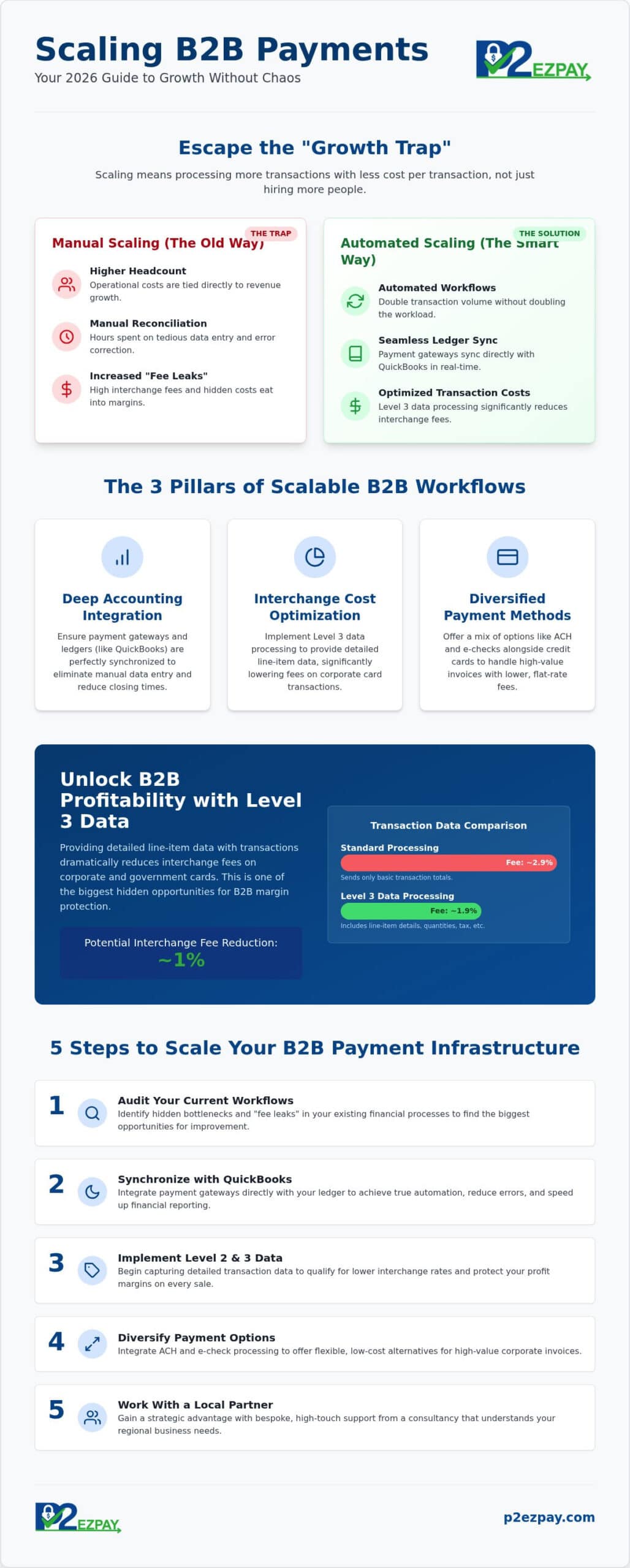
Scaling B2B payment operations is defined by your ability to process higher transaction volumes while maintaining or even reducing the cost per transaction. It’s a strategic shift from manual oversight to automated precision. Many businesses fall into the “Growth Trap,” believing that a surge in sales necessitates hiring more staff to handle manual reconciliation. This approach actually prevents true scaling because it ties your operational costs directly to your revenue growth. A scalable payment operation is one where transaction volume can double without increasing the accounting department’s workload.
Reliable growth relies on data integrity. If your data isn’t “clean” at the point of payment, your automated workflows will inevitably break. Modern payment systems are the backbone of scaling B2B payment operations, capturing detailed information upfront to ensure every entry flows correctly into financial records without human intervention. Without this foundation, you’re simply moving a bottleneck from one part of the business to another.
The Hidden Costs of Manual B2B Workflows
Manual data entry in QuickBooks isn’t just tedious; it’s expensive. When accounting teams spend hours correcting entry errors or chasing down payment details, your labor costs spike. These inefficiencies create slow processing cycles that can strain vendor relationships and tie up essential working capital. By transitioning to a dedicated B2B payment processing platform, you eliminate the friction that keeps your capital stagnant and your staff bogged down in administrative tasks.
Why 2026 Requires a Digital-First Approach
The shift toward real-time B2B payments is no longer a future prediction. In 2026, the decline of traditional paper checks is accelerating as businesses demand instant settlement and transparent tracking. Milwaukee-area manufacturers and distributors are increasingly adopting these digital-first strategies to compete on a national stage. If your infrastructure still relies on manual checks, you’re operating at a disadvantage compared to peers who use automation to ensure faster, more reliable cash flow and lower overhead.
The 3 Pillars of Scalable B2B Financial Workflows
To move beyond the growth trap mentioned earlier, you need a framework that prioritizes efficiency over manual effort. Scaling B2B payment operations effectively rests on three structural pillars. First, deep accounting integration ensures that your payment gateway talks directly to your ledger. Second, cost optimization focuses on capturing the right data to lower transaction fees. Third, a diversified mix of payment methods, such as ACH payment services and e-checks, provides the flexibility needed for high-value transactions. A truly scalable system balances speed and security with long-term cost-efficiency.
Diversifying your methods is a cornerstone of scaling B2B payment operations because it allows you to adapt to different client preferences without sacrificing your own margins. Relying solely on credit cards for large B2B invoices can be prohibitively expensive. Integrating ACH and e-check options allows you to process high-ticket items with much lower flat fees. This variety doesn’t just save money; it offers your clients the professional flexibility they expect in a corporate partnership.
QuickBooks Integration: The Heart of Automation
Reconciling accounts manually is a significant drain on your finance team’s time. By synchronizing your payment gateways directly with QuickBooks, you eliminate the need for manual posting and drastically reduce the “Time-to-Close” for monthly financial statements. This level of QuickBooks integration for B2B ecommerce ensures that every transaction is accounted for in real-time. If you’re looking to streamline these specific workflows, it’s often helpful to consult with a merchant services advisor who understands these technical nuances.
Level 3 Processing: The Secret to B2B Profitability
Cost-efficiency in the B2B sector often hinges on the quality of data transmitted during a transaction. Level 3 processing requires providing detailed line-item information, such as quantities, unit prices, and tax amounts. While this sounds complex, the financial reward is substantial. Level 3 processing can reduce interchange fees by up to 1% on corporate and government cards. By implementing these data-rich standards, you protect your margins even as your transaction volume grows. For a comprehensive look at how to structure these optimizations, our B2B merchant account optimization checklist walks through the exact steps needed to capture lower interchange rates in 2026. This technical optimization ensures that your growth is profitable, not just busy.
5 Steps to Scale Your B2B Payment Infrastructure
Scaling B2B payment operations demands a disciplined approach that shifts your focus from daily fire-fighting to high-level strategy. To build a foundation that supports rapid growth without proportional cost increases, follow these five essential steps:
- Audit your current workflow to identify manual bottlenecks and “fee leaks.”
- Transition from consumer-grade gateways to a dedicated B2B payment processing platform.
- Configure automated daily syncs between your payment gateway and QuickBooks.
- Educate your sales team on collecting Level 2 and Level 3 data at the point of sale.
- Review and optimize your ACH and e-check limits to accommodate larger contract values.
By following this roadmap, you ensure that scaling B2B payment operations leads to increased profitability, not just increased activity. Each step removes a layer of friction that would otherwise slow down your financial team as volume increases.
Conducting a Payment Workflow Audit
A successful audit begins with concrete data. You must track key metrics such as your average cost per transaction, total reconciliation time, and frequency of entry errors. These figures reveal exactly where your staff is losing productive hours to repetitive, manual tasks. Many businesses find that a merchant services advisor from P2EZPay Merchant Services provides the objective perspective needed to uncover hidden inefficiencies. This external review helps you spot fee structures that no longer serve your high-volume needs, allowing for a more strategic allocation of resources.
Managing the Transition Without Disruption
Stability is paramount when you’re upgrading your financial infrastructure. We recommend a phased implementation, starting with your highest-volume channel or most frequent customer type. This focused approach allows you to refine the new system before rolling it out across the entire organization. Throughout the move, prioritize security by utilizing PCI-compliant tokenization. This technology replaces sensitive corporate data with unique identifiers, protecting your clients while enabling seamless recurring billing. If you’re ready to modernize your financial infrastructure and eliminate the friction in your growth, contact P2EZPay Merchant Services today for a professional consultation.
The Local Advantage: Scaling with a Wisconsin Partner
National “plug-and-play” processors often struggle to address the specific nuances of Wisconsin’s B2B industries. While their software might look sleek, it frequently lacks the flexibility required for complex manufacturing supply chains or regional distribution networks. Scaling B2B payment operations isn’t just about software; it’s about having a partner who understands your specific business environment. A local, independent consultancy in Milwaukee, Waukesha, or Madison provides the high-touch support that large corporate call centers simply can’t match.
At P2EZPay Merchant Services, we act as a steady hand for local firms navigating the complexities of high-volume merchant services. We don’t just provide a gateway; we provide strategic leadership grounded in our community. Understanding the real-world impact of transaction fees on your bottom line is essential for long-term health. We recommend reviewing our B2B Payment Cost Analysis to identify where your current setup might be falling short of its potential.
Tailored Strategies for Milwaukee Corporations
We specialize in bespoke solutions for manufacturers in Racine and growing tech firms in Madison. Our approach is never rigid or generic because we know that every business has unique reconciliation needs. P2EZPay Merchant Services provides objective advice backed by 30+ years of local experience, ensuring that your transition to an automated workflow is seamless and tailored to your specific operational goals. For wholesale and distribution businesses in the region, our dedicated Milwaukee B2B merchant services guide outlines exactly how to capture lower interchange rates and automate your financial workflows. This local wisdom allows us to protect your interests while removing the obstacles that prevent efficient growth.
Next Steps for Your Business
Preparing your financial team for a workflow transformation is the first step toward a more scalable future. Clear communication about the benefits of automation, such as reduced manual entry and faster reconciliation, helps build essential internal buy-in. It’s about empowering your staff to focus on higher-value tasks rather than repetitive data entry. When you’re ready to move beyond the limitations of your current system, contact P2EZPay Merchant Services to audit and scale your B2B payment operations. We’ll work alongside you to ensure your payment infrastructure is a reliable engine for your business’s success.
Securing a Sustainable Path for Your Business Growth
The transition from manual reconciliation to a fully automated workflow is the single most important step you can take to protect your margins in 2026. By prioritizing deep accounting integration and capturing Level 2 and Level 3 data, you transform your payment system from a cost center into a strategic asset. You’ve seen that scaling B2B payment operations isn’t about working harder; it’s about building a system that works for you. When your infrastructure handles the data friction, your team can focus on the relationships that drive your revenue.
P2EZPay Merchant Services provides the steady hand you need to navigate these technical shifts. As an independent consultancy with over 30 years of industry experience, we offer tailored, objective advice that national processors often overlook. Our specialized support for Level 2 and Level 3 processing ensures you never overpay for high-volume transactions, while our local Wisconsin-based team remains accessible whenever you need guidance. We’re committed to your success through every stage of your journey.
Don’t let manual bottlenecks slow your momentum. Streamline your B2B financial workflows with a P2EZPay Merchant Services specialist and gain the clarity you need to grow with confidence. Your business deserves a financial foundation as ambitious as your vision for the future.
Frequently Asked Questions
What is the most effective way to scale B2B payment operations?
The most effective strategy for scaling B2B payment operations is to replace manual reconciliation with automated financial workflows. By synchronizing your payment data directly with your accounting software, you remove the need for additional staff as your volume grows. This approach ensures that your overhead remains stable even as your revenue increases, allowing your team to focus on strategic growth rather than administrative tasks.
How does QuickBooks integration help a business scale?
QuickBooks integration facilitates scaling by creating a real-time link between your sales and your ledger. This connection eliminates the hours your team would otherwise spend on manual data entry and error correction. When your payments post automatically, your time to close for monthly statements drops significantly. This efficiency allows your leadership to make faster, data-driven decisions based on current financial snapshots rather than outdated reports.
Can Level 3 processing really lower my B2B transaction fees?
Level 3 processing provides the line-item detail required by card brands to verify the legitimacy of corporate and government transactions. Because this detailed data reduces the risk of fraud, processors offer significantly lower interchange rates in return. For high-volume businesses, this technical optimization can reduce transaction costs by up to 1% on eligible cards, protecting your margins as your transaction volume increases. Businesses looking to maximize these savings should explore a structured approach to B2B merchant account optimization to ensure they are capturing every available reduction in interchange fees.
Is ACH better than credit cards for scaling high-volume B2B payments?
ACH is often superior for high-volume B2B payments when you’re dealing with large-ticket invoices. While credit cards offer speed, their percentage-based fees can become astronomical on five or six-figure contracts. ACH services typically utilize flat-fee structures, which average between $0.20 and $1.50 per transaction according to industry standards. This makes them a more cost-effective choice for maintaining profitability as your contract values grow.
Why should a Wisconsin business choose a local payment partner?
A local payment partner understands the specific operational challenges faced by Wisconsin-based manufacturers and tech firms. National “plug-and-play” processors often lack the flexibility to handle the bespoke integration requirements of regional industries. Choosing a local consultancy ensures you have a steady hand nearby to provide high-touch support and objective advice tailored to your specific community and industry needs. Wholesalers and distributors in the area can explore how specialized Milwaukee B2B merchant services can directly address the interchange fee challenges and reconciliation inefficiencies unique to their sector.