

Did you know that as of January 2026, Visa completely retired its Level 2 processing program, making Level 3 data the only way to secure interchange savings on commercial cards? For many growing companies, this shift means that standard high volume merchant services often fail to capture the 0.5% to 1.5% in potential savings available through the Commercial Enhanced Data Program. It’s frustrating to watch your hard-earned revenue disappear into “non-qualified” fee tiers just because your payment gateway isn’t communicating the right data to the networks.
You likely recognize that scaling a B2B enterprise requires more than just a bigger pipe for transactions; it requires precision. We understand the stress of sudden volume spikes triggering account freezes or the exhaustion of manual data entry between your gateway and QuickBooks. This guide will show you how to optimize your payment architecture to lower costs and automate reconciliation. We’ll examine the latest 2026 interchange updates and how a strategic consultancy approach can provide the stability your Milwaukee business needs to thrive.
Key Takeaways
- Understand the specific volume thresholds that trigger the need for specialized corporate processing and why standard flat-rate models often fail during rapid scaling.
- Learn how to capture Level 3 transaction data to qualify for the lowest possible interchange rates, protecting your margins on large B2B payments.
- Discover the strategic advantages of partnering with a Milwaukee-based merchant consultancy that offers bespoke underwriting and direct technical support.
- Explore how high volume merchant services integrate with QuickBooks to automate reconciliation and eliminate the errors associated with manual data entry.
- Gain a clear framework for evaluating providers based on fee transparency, integration depth, and their ability to handle sudden transaction spikes without account freezes.
Defining High Volume Merchant Services for B2B Enterprises
Scaling a B2B enterprise requires a fundamental shift in how you view transaction processing. While a startup might thrive on simple, flat-rate tools, a growing manufacturer or distributor quickly discovers that high volume merchant services are defined by more than just a dollar amount. True high-volume status is a blend of monthly processing capacity and the ability to handle significant, individual ticket sizes without triggering automated fraud alerts. Unlike high-risk retail sectors that deal with high chargeback rates, high-volume B2B companies typically face obstacles related to underwriting limits and technical throughput.
The Corporate Volume Threshold
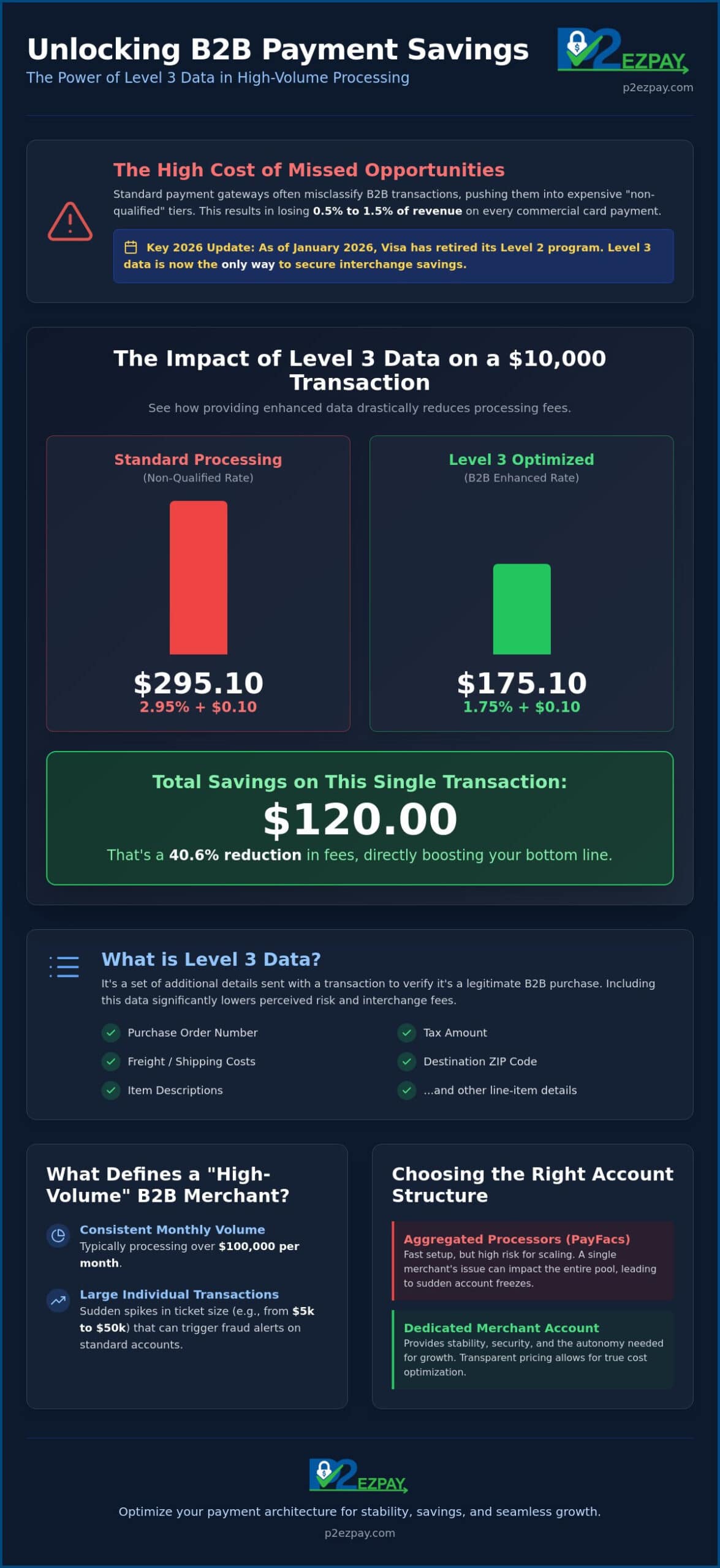
Most industry experts classify a business as high volume once it consistently processes over $100,000 per month. However, for many B2B firms, the challenge isn’t just the monthly total; it’s the individual transaction size. If your business suddenly processes a $50,000 invoice after a history of $5,000 sales, traditional banks often view this as a red flag. Specialized B2B payment processing solutions mitigate these risks through upfront underwriting. This proactive approach ensures that your account remains stable during peak fulfillment cycles or when landing major contracts.
Why Aggregated Processors Limit Scaling
Aggregated payment models, often called Payment Facilitators or “Payfacs,” place thousands of merchants into a single master account. This makes setup fast, but it creates a fragile environment for enterprise scaling. Because you don’t have a dedicated merchant account, the processor’s risk department may freeze your funds instantly if a transaction deviates from their rigid algorithms. Every interchange fee becomes a burden under flat-rate pricing, as these models lack the transparency needed to optimize costs. Transitioning to a dedicated account provides the autonomy and security required for long-term growth, ensuring your capital is always accessible when you need it most.
Interchange Optimization: Strategic Advantages of Level 2 and 3 Processing
Level 3 processing is a data-rich transaction method that slashes B2B interchange fees. For companies utilizing high volume merchant services, this optimization is no longer optional; it’s a financial necessity. Since Visa retired its Level 2 program in January 2026, submitting enhanced data is the only way for corporate entities to move away from expensive non-qualified rates. By providing the card networks with granular detail about each sale, your business proves the transaction is a legitimate B2B exchange, which significantly reduces the perceived risk and the associated costs.
Lowering B2B Transaction Costs
Qualifying for lower rates requires your gateway to transmit specific data fields that standard retail terminals ignore. These include purchase order numbers, tax amounts, freight codes, and destination zip codes. When these details are present, the savings are substantial. Consider a $10,000 corporate transaction: at a standard non-qualified rate of 2.95% plus $0.10, the fee is $295.10. By optimizing for Visa’s Product 3 (Level 3) rate of 1.75% plus $0.10, that same transaction costs only $175.10. This single adjustment saves your business $120.00. If you process hundreds of these transactions monthly, the impact on your bottom line is transformative. Law firms, consultancies, and other professional service providers can find a deeper breakdown of these cost-saving strategies in our guide to B2B payment solutions for professional services. You can also explore more about these specific cost-saving maneuvers through our dedicated B2B payment processing strategies.
Security Standards for Enterprise Gateways
Handling large volumes of sensitive data necessitates a robust security framework. High volume merchant services must utilize advanced tokenization and point-to-point encryption to ensure that corporate card data never touches your internal servers in an unencrypted state. This reduces your PCI compliance burden while protecting your reputation. Enterprises managing high-velocity B2B transactions should also review the advanced protocols outlined in our guide to high volume payment gateway security to stay ahead of the sophisticated threats targeting corporate infrastructure in 2026. For a comprehensive look at maintaining these rigorous levels of protection, we recommend reviewing our 2026 B2B payment security standards checklist. If you’re unsure if your current gateway supports these data-heavy requirements, it might be time to speak with a consultant who can audit your current interchange qualification levels.
Evaluating High-Volume Providers in the Milwaukee Metropolitan Area
For Wisconsin enterprises, selecting a partner for high volume merchant services often comes down to the choice between a distant call center and a local specialist. While national providers offer automated onboarding, they frequently lack the nuanced understanding of the regional manufacturing and distribution sectors that drive the local economy. Choosing a provider that offers dedicated merchant services advisory ensures that your business isn’t just another account number in a database, but a valued partner with a tailored risk profile.
The Value of Local Consultancy
Local knowledge significantly accelerates the underwriting process. When a consultant understands the typical seasonal cycles of a Waukesha manufacturer or the shipping logistics of a Madison distributor, they can advocate for higher processing limits more effectively than an algorithm. Firms in Brookfield, Wauwatosa, and New Berlin benefit from having a partner who can provide on-site support and regional expertise. This proximity allows for a more flexible approach to risk assessment, which is vital when your business experiences the sudden transaction spikes common in large-scale B2B contract fulfillments. Whether you’re operating out of Racine or Pewaukee, a local hand ensures your cash flow remains uninterrupted.
Transparency in High-Volume Pricing
Transparency is the cornerstone of a sustainable high-volume partnership. Many national providers hide costs within “Tiered” pricing models, which bundle various transactions into expensive buckets. For a scaling enterprise, “Interchange Plus” pricing is the only logical choice. This model passes the direct cost of the credit card processing through to the merchant with a small, fixed markup. According to 2026 industry benchmarks, high-volume merchants can often achieve markups as low as 0.10% to 0.20% over interchange. This level of clarity is essential for financial planning and internal audits, as it allows your CFO to track every penny of transaction cost with absolute precision. If your current monthly statements are difficult to decipher, it’s time to request a transparent rate review from a local expert.
Integrating High-Volume Payments with QuickBooks and B2B Workflows
Operational velocity is the true measure of success for any scaling B2B enterprise. While previous sections explored cost reduction and regional support, the final piece of the puzzle is how high volume merchant services interact with your existing financial ecosystem. Effective scaling requires a seamless bridge between your payment gateway and your accounting software. This ensures that every transaction is accounted for without manual intervention. It’s about creating a system that works for you, not one you have to work for.
Automating the B2B Reconciliation Loop
Traditional manual entry is a bottleneck that introduces risk as transaction counts climb. With a robust high volume transaction processing architecture, payments are automatically synchronized with QuickBooks. When a client pays an invoice, the system marks the record as “Paid” and updates your general ledger in real time. This automation significantly reduces Days Sales Outstanding (DSO) by eliminating the lag between payment receipt and record updates. It allows your finance team to shift from repetitive data entry to strategic analysis, providing a clearer picture of your cash position at any given moment.
Diversifying with ACH and E-Check
A comprehensive payment strategy shouldn’t rely solely on card networks. For high-ticket B2B settlements, offering ACH payment services is often the most cost-effective path. While standard card transactions in 2026 through native QuickBooks Payments often carry rates of 2.99%, ACH transfers typically remain at a 1% rate, capped at $10. This makes ACH an ideal choice for five-figure or six-figure invoices where even optimized interchange rates would result in high fees. Consultancies and professional service firms managing large retainer payments can learn how to structure these workflows effectively through our dedicated resource on B2B payment solutions for professional services. By providing multiple payment paths within your QuickBooks workflow, you offer clients flexibility while protecting your own margins on the largest transactions. It’s a balanced approach that supports both growth and stability.
Securing Your B2B Payment Infrastructure for the Future
Navigating the complexities of the 2026 payment landscape requires more than just a gateway; it demands a strategic alignment of data precision and operational automation. By prioritizing Level 3 data qualification and integrating your processing directly with QuickBooks, you protect your margins and reclaim valuable time. Choosing high volume merchant services shouldn’t feel like a compromise between security and speed. Precision drives profit.
With over 30 years of industry experience, P2EZPay Merchant Services provides the specialized Level 2 and Level 3 processing expertise necessary to lower your transaction costs. As a local Wisconsin-based consultancy, we offer the steady hand and accessibility that national call centers simply cannot match. We’re here to ensure your scaling journey is met with reliable support and transparent leadership. It’s time to move toward a model that values wisdom and community as much as technical proficiency.
Optimize your B2B processing with P2EZPay Merchant Services today. Your business deserves a partner that values your long-term success as much as you do.
Frequently Asked Questions
What qualifies a business for high volume merchant services?
A business typically qualifies when it consistently processes over $100,000 per month or manages individual transactions that exceed standard retail limits. For B2B manufacturers and distributors, this classification isn’t just about the total volume; it’s about the technical capacity to handle large-ticket invoices without disruption. If your growth trajectory suggests you’ll soon hit these thresholds, establishing a dedicated account now prevents future operational bottlenecks and fund holds.
How do high volume merchant accounts differ from standard small business accounts?
High volume merchant accounts provide a dedicated merchant ID (MID) rather than placing your business in a shared pool like standard aggregated models. This distinction is critical for stability. Dedicated accounts undergo rigorous upfront underwriting, which means the processor already understands your business model and expected transaction spikes. This setup offers greater control over funds and allows for bespoke pricing structures that standard small business accounts can’t accommodate.
Can I lower my B2B interchange fees if I process a high volume of transactions?
You can significantly lower costs by utilizing Level 3 data processing, which is now the primary method for interchange optimization following Visa’s 2026 program changes. By transmitting enhanced transaction details like tax IDs and line-item data, you qualify for the Commercial Enhanced Data Program rates. These specialized high volume merchant services can reduce fees by 0.5% to 1.5% compared to standard non-qualified rates, protecting your margins on every large corporate payment.
Why do some processors freeze high-volume accounts during large sales events?
Account freezes often occur because automated risk algorithms at aggregated processors flag sudden volume spikes as potential fraud. If your processor hasn’t conducted deep underwriting for your specific business, a large B2B contract fulfillment looks like an anomaly to their system. Specialized high volume merchant services mitigate this by establishing clear processing parameters beforehand. This proactive communication ensures that your capital remains accessible even during your most successful sales periods.
How does QuickBooks integration work with high-volume payment gateways?
Integration works by creating a direct, real-time sync between your payment gateway and your QuickBooks ledger. When a transaction is processed, the system automatically identifies the corresponding open invoice and marks it as paid. This eliminates the need for manual reconciliation and reduces human error in large-scale operations. It’s a sophisticated loop that lowers your Days Sales Outstanding and ensures your financial reporting is always current and accurate for better cash flow management.