

With an 89% increase in attempted fraud recorded across the payments sector in 2025, the margin for error in corporate finance has effectively vanished. You’ve likely felt the pressure of keeping pace with the mandatory transition to PCI DSS 4.0 while managing the fear that a single manual reconciliation error in QuickBooks could trigger a catastrophic breach. It’s a complex environment where traditional safeguards often fall short of protecting high-volume ACH and card transactions. We understand that maintaining B2B payment security standards shouldn’t feel like a constant battle against shifting regulations.
This checklist provides the professional clarity you need to master essential security protocols and safeguard your corporate data with confidence. We’ll show you how to navigate the 2026 regulatory environment, including the GENIUS Act rulemaking and the critical ISO 20022 structured address requirements. By the end of this guide, you’ll have a tailored roadmap for reducing fraud risk and integrating robust security directly into your existing financial workflows. We’re moving beyond simple compliance to establish a foundation for long-term transactional integrity and collaborative growth.
Key Takeaways
- Understand why high-value B2B transactions require more rigorous verification than consumer payments to protect sensitive corporate data.
- Navigate the transition to PCI DSS 4.0 by leveraging the “Customized Approach,” allowing your business to meet security requirements with greater operational flexibility.
- Learn how to deploy point-to-point encryption and tokenization to neutralize the risk of data breaches within your existing financial workflows.
- Implement a structured 2026 checklist for B2B payment security standards, starting with comprehensive data discovery audits and multi-factor authentication.
- Discover how specialized merchant services guidance can help your organization capture Level 2 and Level 3 data for lower interchange rates while maintaining peak security.
Understanding the B2B Payment Security Landscape in 2026
B2B payment security is the multi-layered defense of corporate financial data against unauthorized access and fraudulent activity. It’s a comprehensive strategy that protects the entire lifecycle of a transaction, from initiation to final reconciliation. While B2C security often prioritizes a frictionless checkout for small purchases, B2B environments deal with high-value transfers that require robust verification. A single compromised corporate account can lead to losses in the millions, making the stakes significantly higher. By 2026, companies that treat security as a core value rather than a technical hurdle find themselves with a distinct market advantage.
The 2026 threat environment is characterized by an 89% increase in attempted fraud within the payments sector recorded just last year. High-volume merchants are prime targets because their transaction patterns are often predictable and their payouts are substantial. Establishing modern B2B payment security standards allows your organization to move away from reactive fixes and toward a proactive, resilient posture. When security is woven into the culture, it becomes a tool for building long-term trust with your most valuable partners.
Why B2B Fraud Trends Demand Better Standards
Fraudsters have shifted their focus toward Business Email Compromise (BEC), specifically targeting accounts payable workflows. They exploit the trust built into long-term vendor relationships to intercept payments or redirect funds to fraudulent accounts. Static security measures, like simple passwords or unverified email instructions, are no longer sufficient for high-volume merchants. According to the 2026 AFP Payments Fraud and Control Survey Report, 76% of organizations experienced attempted or actual payments fraud in 2025. This data proves that maintaining rigorous B2B payment security standards is a necessity for protecting your corporate reputation. Partners want to know their data is safe, and implementing dynamic security protocols is the only way to provide that assurance.
The Role of Regulatory Compliance
Navigating the regulatory landscape requires an understanding of various governing bodies. The PCI Council, NACHA for ACH transactions, and SSAE 18 for service organization controls all play vital roles in shaping how money moves. The Payment Card Industry Data Security Standard (PCI DSS) remains the global benchmark for protecting cardholder information. For Wisconsin-based firms operating out of Milwaukee or Madison, aligning with these national standards is essential for maintaining interstate and international trade relationships. Following these frameworks provides “Safe Harbor” benefits, which can limit liability and demonstrate a high level of due diligence. Integrating specialized B2B payment processing solutions ensures that these compliance requirements are met without disrupting your daily financial workflows.
The PCI DSS 4.0 Standard for Corporate Merchants
PCI DSS version 4.0 represents the most significant shift in compliance since the standard’s inception. While the previous version, 3.2.1, relied on rigid and prescriptive controls, 4.0 focuses on security as a continuous process rather than a point-in-time assessment. This transition became mandatory on March 31, 2025, meaning your organization must already be operating under these stricter guidelines to maintain compliance. One of the most beneficial changes for large-scale operations is the “Customized Approach.” This framework allows your IT team to design bespoke security controls that meet specific business objectives, providing the flexibility needed for complex ecommerce payment processing gateways that don’t fit a standard mold.
To uphold these B2B payment security standards, the council now requires continuous monitoring of security controls. Annual snapshots are no longer sufficient to prove your organization is safe. You must demonstrate that your defenses are active and effective every day of the year through automated logging and regular testing. Additionally, Multi-Factor Authentication (MFA) is now required for all access to the cardholder data environment (CDE). This isn’t just for remote employees anymore; it applies to anyone accessing the system from within the office. It’s a vital layer of protection that ensures stolen credentials alone aren’t enough to compromise your high-value transactions.
Building and Maintaining Secure Networks
Robust firewall configurations serve as the first line of defense for your corporate servers, filtering out malicious traffic before it reaches your sensitive data. You must ensure that vendor-supplied default passwords are changed immediately upon installation, as these are common entry points for automated attacks. Network segmentation acts as a method to isolate payment data from the rest of your corporate network. By keeping your accounting software and payment gateways on a separate sub-network, you significantly reduce the scope of your compliance audits and limit the lateral movement of potential intruders.
Protecting Stored Account Data
Protecting account data requires strong cryptography and updated security protocols during every transmission. Many firms realize the benefits of tokenization when trying to simplify this process. By replacing sensitive details with non-sensitive placeholders, you can avoid storing vulnerable information on local Wauwatosa or New Berlin office drives. Data minimization should be your primary goal. If you don’t need the data for a specific business purpose, don’t store it. This practice inherently reduces your risk profile and makes your audit process much smoother. If you’re looking for ways to streamline these requirements within your current setup, you can speak with a security specialist to review your configuration.
Advanced Encryption and Tokenization in B2B Workflows
Securing high-value corporate transactions requires a clear distinction between data in motion and data at rest. Point-to-point encryption (P2PE) focuses on the journey. It encrypts sensitive information from the moment it’s entered until it reaches the secure decryption environment of the processor. Tokenization, by contrast, focuses on the destination. It replaces sensitive card or account data with a non-sensitive equivalent known as a token. This token has no intrinsic value to an attacker; even if your internal systems were breached, the stolen tokens would be useless for fraudulent activity. For companies managing recurring B2B billing cycles, tokenization is a foundational element of modern B2B payment security standards. It allows you to maintain “cards on file” for seamless monthly invoicing without the liability of storing actual account numbers.
High-ticket corporate card transactions also benefit from the adoption of 3D Secure 2.0. This protocol provides a data-rich communication channel between the merchant and the card issuer. By sharing significantly more data points behind the scenes, issuers can authenticate transactions with much higher accuracy. This reduces the friction of false declines, which often plague legitimate high-value business purchases. Implementing these advanced layers ensures that your security doesn’t just block threats but also facilitates smoother commerce. For enterprises managing high-velocity transaction flows, understanding the full scope of high volume payment gateway security is essential to maintaining a zero-breach environment as you scale.
Tokenization and QuickBooks Payment Integration
Bridging the gap between payment processing and accounting is a common security hurdle. A secure QuickBooks payment integration utilizes tokenization to ensure that raw financial data never touches your general ledger. When a transaction occurs, the system passes a secure token to your accounting software for automated reconciliation. This eliminates the need for manual data entry, which is a frequent source of security gaps and human error. If you’re looking to streamline your order-to-cash cycle while maintaining peak protection, our QuickBooks integration for B2B ecommerce guide offers a detailed roadmap for 2026 efficiency.
ACH and E-Check Security Standards
ACH remains the backbone of B2B commerce, but it requires specific validation steps to prevent fraud. Current NACHA requirements mandate that businesses verify the validity of bank accounts before initiating ACH payment services. While some firms still use traditional micro-deposits, most high-volume merchants have moved toward instant bank verification to confirm account ownership in real time. ACH tokenization prevents unauthorized routing number exposure by masking bank details throughout the entire settlement process. These measures are critical because ACH transactions lack the same chargeback protections as credit cards, making upfront verification your best defense against loss.
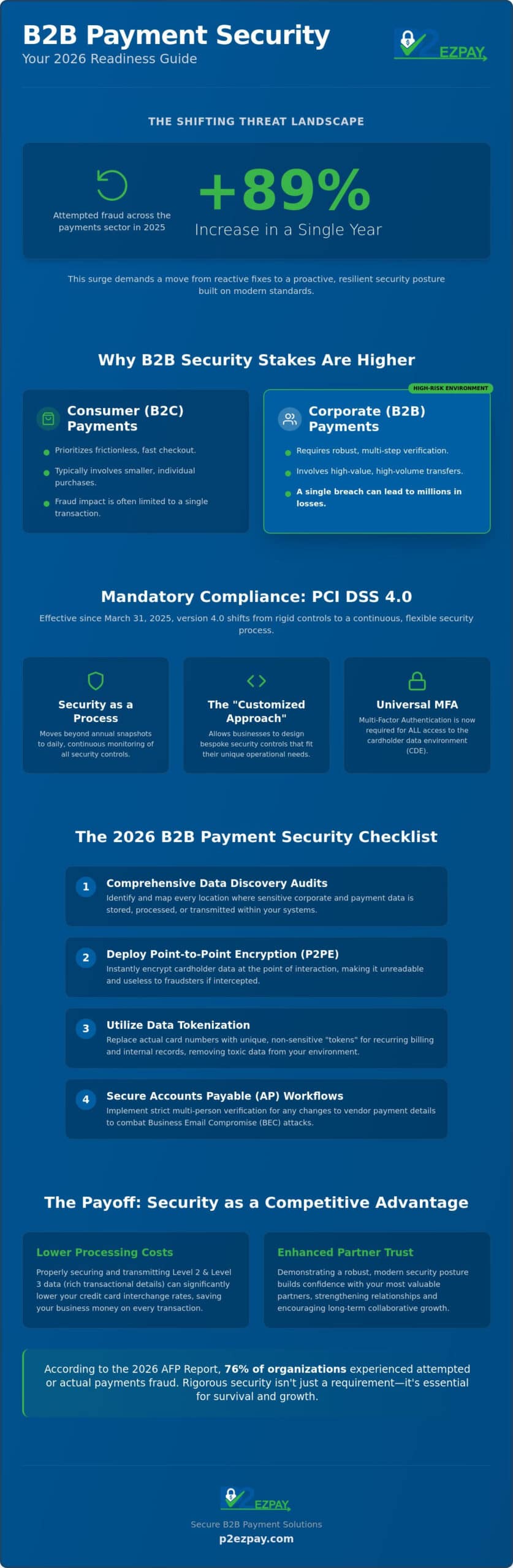
The 2026 B2B Payment Security Checklist
Maintaining high B2B payment security standards requires a shift from passive compliance to active, daily management. This checklist serves as a practical roadmap for your internal teams to ensure every transaction remains protected. By following these five steps, you can build a resilient environment that safeguards both your corporate assets and your professional reputation.
- Step 1: Data Discovery Audit. You can’t protect what you haven’t identified. Conduct a comprehensive audit to locate every instance of payment data, including hidden entries in email archives, legacy backup drives, and unencrypted spreadsheets.
- Step 2: Multi-Factor Authentication (MFA). Deploy MFA across all financial software and administrative portals. This single step provides a critical barrier against the vast majority of credential-based attacks.
- Step 3: Gateway Maintenance. Regularly update and patch all ecommerce payment processing gateways to neutralize known vulnerabilities. Outdated software is often the primary entry point for automated exploits.
- Step 4: Least Privilege Access. Establish a strict access control policy where employees only have the minimum permissions necessary for their specific roles. This limits the potential damage if a single account is compromised.
- Step 5: Continuous Testing. Schedule quarterly vulnerability scans and conduct annual penetration tests with a qualified third party. These tests reveal the gaps that internal audits might overlook.
Administrative and Physical Security Controls
A secure environment starts with a formal information security policy tailored to your Wisconsin office. This document should outline clear protocols for data handling, password management, and incident response. Staff training remains your most effective defense against phishing and social engineering attacks that specifically target B2B accounts payable departments. Additionally, you must restrict physical access to servers or workstations used for credit card processing. Simple measures, like locking server racks and monitoring office entry points, prevent unauthorized physical tampering with your hardware.
Vendor and Third-Party Management
Your security is only as strong as your weakest partner. Always verify the current PCI compliance status of your merchant service provider to ensure they meet 2026 requirements. If you handle significant transaction volumes, your high volume transaction processing partner must utilize Level 1 PCI data centers for maximum protection. Reviewing SSAE 18 reports for any third-party software integrations helps you understand how your vendors manage their own internal controls. If you’re ready to strengthen your defensive posture, you can reach out for a comprehensive security review of your current payment workflows.
Partnering for Secure Corporate Payment Excellence
Securing your organization’s financial future requires more than just following a checklist. It demands a partnership with experts who understand the nuances of your specific industry and regional environment. An independent merchant services advisor from P2EZPay Merchant Services in the Milwaukee metro area provides a layer of personalized oversight that national, automated processors simply cannot match. This relationship focuses on establishing a steady hand to guide your firm through technical transitions and regulatory shifts. We believe that true security is built on a foundation of mutual success and transparent communication, moving beyond a clinical vendor relationship toward a loyal, long-term alliance.
Beyond basic protection, specialized B2B partners help your team navigate the complexities of Level 2 and Level 3 data requirements. By providing this enhanced information to card networks, you can significantly lower your interchange rates while simultaneously meeting the most rigorous B2B payment security standards. This dual benefit is particularly valuable for manufacturing and distribution firms in Brookfield and Waukesha. These businesses often manage large, complex supply chains where transaction integrity is paramount. For growing enterprises managing significant transaction volumes, working with dedicated high volume merchant services specialists ensures your payment architecture is optimized for both security and cost efficiency as you scale. We view our role as a transition from a service vendor to a long-term strategic security partner, ensuring your financial workflows are both lean and impenetrable.
Bespoke Security Solutions for Wisconsin Businesses
A “one-size-fits-all” security model typically fails complex corporate structures because it ignores the specific internal workflows that define your business. Local support in Racine, Kenosha, and Oshkosh provides your team with rapid incident response and the peace of mind that comes from working with a regional ally. If your operations are based in the Lake Country area, reviewing our guide to Merchant Services in Hartland, WI will help you align your local presence with broader B2B optimization goals. We prioritize a tailored approach that removes obstacles and fosters a sense of reliability in every transaction.
Next Steps: Securing Your 2026 Financial Roadmap
Securing your 2026 financial roadmap begins with a thorough audit of your current payment stack to identify latent vulnerabilities. By aligning your internal processes with recognized B2B payment security standards, you protect your bottom line from the rising tide of sophisticated fraud. Investing in high-standard security today yields a significant long-term ROI by preventing the catastrophic costs associated with data breaches and compliance failures. Our approach ensures that security becomes a seamless part of your growth strategy rather than an obstacle. If you are ready to establish a more resilient foundation for your corporate transactions, you can consult with P2EZPay Merchant Services for a secure B2B payment strategy tailored to your unique requirements.
Establishing a Resilient Future for Your Corporate Payments
The evolution of B2B commerce requires moving beyond basic compliance toward a holistic security architecture that protects every layer of your financial operations. By adopting the protocols discussed, such as the Customized Approach of PCI DSS 4.0 and advanced tokenization, your organization builds a significant moat around its high-value assets. Adhering to modern B2B payment security standards is no longer just a technical requirement; it’s a declaration of your company’s reliability to every vendor and client in your network. This commitment to data integrity fosters the long-term trust necessary for collaborative growth in an increasingly digital marketplace.
With over 30 years of industry experience, P2EZPay Merchant Services offers the specialized QuickBooks integration expertise and local Milwaukee-area consultancy needed to bridge the gap between complex security and daily operational ease. We provide the steady hand and seasoned wisdom required to protect your bottom line while removing the obstacles that hinder efficient processing. Secure Your Corporate Payments with a Professional Audit from P2EZPay Merchant Services to ensure your financial roadmap remains clear and protected. Together, we can establish a foundation of security that supports your business goals for years to come.
Frequently Asked Questions
What is the primary difference between PCI DSS 3.2.1 and 4.0 for B2B companies?
The primary difference is the shift from point-in-time compliance assessments to a model of continuous security monitoring. While the older 3.2.1 standard focused on annual snapshots, version 4.0 requires organizations to demonstrate active protection through automated logging and regular testing. This update also introduces the “Customized Approach,” which provides corporate entities the flexibility to design unique security controls that meet B2B payment security standards while fitting their specific operational workflows.
How does tokenization improve B2B payment security compared to standard encryption?
Tokenization provides superior protection by replacing sensitive data with non-sensitive placeholders that have no value to an attacker. Unlike encryption, which uses a mathematical key to mask data that can later be decrypted, a token cannot be reversed to reveal the original information. This approach ensures that even if your internal systems are compromised, the stolen tokens are useless for fraudulent transactions. It significantly reduces your compliance scope by keeping raw data off your servers.
Are local Wisconsin businesses required to follow international payment security standards?
Yes, local Wisconsin firms must adhere to international standards if they process, store, or transmit cardholder data. Standards like PCI DSS 4.0 are global mandates that apply to every merchant, regardless of their physical location in Milwaukee, Madison, or beyond. Aligning with these frameworks is essential for maintaining your ability to accept payments and ensures your business remains a reliable partner when engaging in interstate or international commerce.
Can QuickBooks payment integration be made fully PCI compliant?
QuickBooks payment integration can achieve full compliance by utilizing secure, third-party gateways that handle sensitive data outside of the accounting software. By using tokenization, the integration passes a secure placeholder to your general ledger instead of raw cardholder information. This configuration allows your team to enjoy automated reconciliation and seamless workflows without the liability and risk of storing sensitive financial details within your local accounting environment.
What are the risks of using ACH for high-volume B2B payments without tokenization?
The primary risk is the exposure of raw routing and bank account numbers within your internal databases and email archives. Because ACH transactions don’t offer the same chargeback protections as credit card networks, a single breach can lead to significant and often irreversible financial loss. Utilizing B2B payment security standards like ACH tokenization ensures that these sensitive banking details are masked, protecting your organization from the rising threat of unauthorized fund transfers.
What should a B2B company do immediately after a suspected payment data breach?
Your first step is to isolate the affected systems to prevent any further data exfiltration from your network. You should immediately activate your formal incident response plan and notify your merchant service provider, legal counsel, and insurance carrier. Promptly documenting every action taken and the timeline of the suspected event is critical for the forensic investigators who will need to determine the extent of the compromise and help you meet regulatory reporting deadlines.
How often should a corporate merchant perform a security vulnerability scan?
Corporate merchants are required to perform vulnerability scans at least once every quarter to remain compliant with current security standards. However, it’s a best practice to run additional scans whenever you make significant changes to your network configuration or update your payment software. Regular scanning helps you identify and patch new vulnerabilities before they can be discovered and exploited by the automated scripts commonly used by modern fraudsters.
Does Level 3 processing require additional security measures?
Level 3 processing doesn’t require entirely new security protocols, but it does demand more disciplined data hygiene due to the additional line-item information being transmitted. Because you’re sharing more detailed transaction data to secure lower interchange rates, ensuring that your transmission channels are encrypted and your storage is tokenized becomes even more vital. Maintaining high standards across these data-rich transactions allows you to capture significant savings without compromising your corporate security posture.