

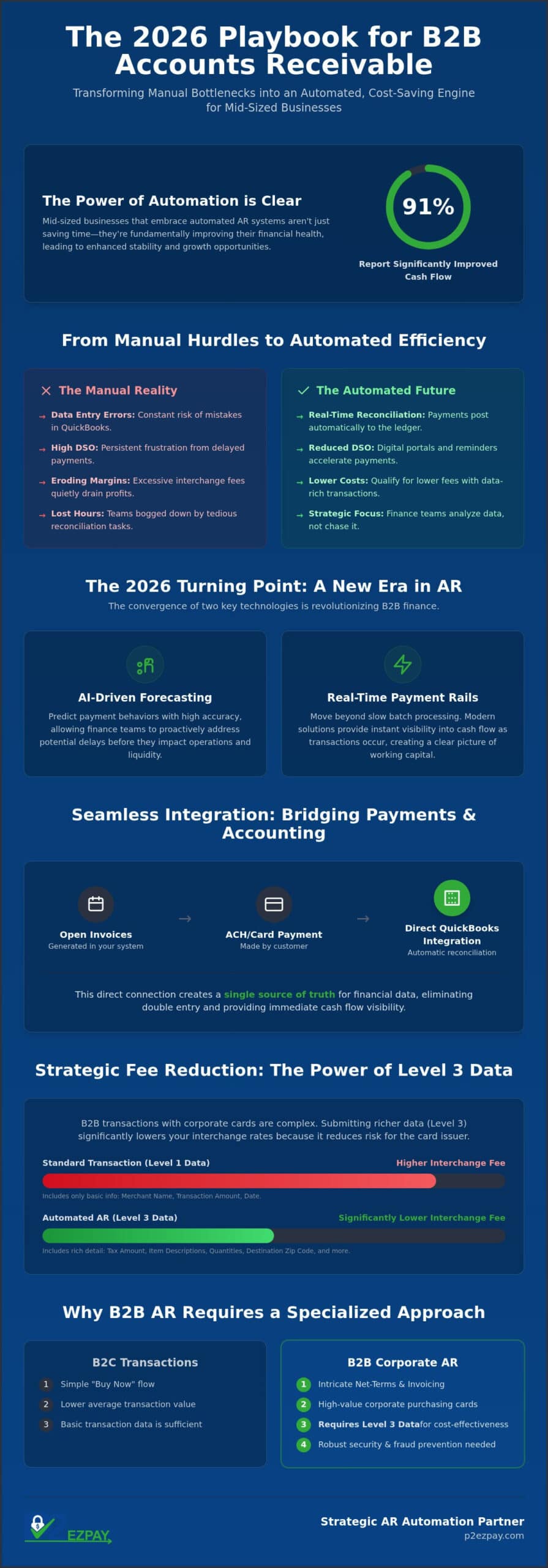
Did you know that 91% of mid-sized businesses using automated systems report significantly improved cash flow? For many finance leaders, the daily reality is far less efficient, often involving manual data entry errors in QuickBooks and the persistent frustration of high Days Sales Outstanding. You’ve likely noticed that excessive interchange fees on corporate cards are quietly eroding your margins. It’s a common challenge, but it doesn’t have to be your standard operating procedure. By prioritizing the strategy of automating B2B accounts receivable, you can reclaim those lost hours and protect your bottom line.
We understand that your goal is a seamless transition from manual hurdles to a streamlined, automated reconciliation process. This article will teach you how to transform your accounts receivable from a manual bottleneck into an automated, cost-saving engine using modern integration and the latest Level 3 data standards. We’ll examine the 2026 shift toward the Commercial Enhanced Data Program (CEDP) and provide strategic insights on lowering transaction costs. You’ll discover how a local, expert partner can help you navigate these technical nuances to ensure your financial operations are both secure and highly efficient.
Key Takeaways
- Understand why 2026 marks a critical turning point for automating B2B accounts receivable by leveraging AI-driven forecasting and real-time payment rails.
- Learn how direct QuickBooks payment integration eliminates manual data entry and enables real-time reconciliation for all your open invoices.
- Discover the mechanics of Level 3 processing and how submitting data-rich transactions can help you qualify for significantly lower interchange rates.
- Identify the essential criteria for choosing a strategic partner who offers local Wisconsin expertise and a clear understanding of your total cost of ownership.
The Evolution of Automating B2B Accounts Receivable in 2026
The practice of accounts receivable has undergone a radical transformation. In the past, it was a clerical task of mailing invoices and waiting for paper checks. By 2026, automating B2B accounts receivable has evolved into a digital-first strategy that manages the entire lifecycle from invoice generation to final cash application. This shift isn’t just about digitizing paper; it’s about creating a responsive ecosystem where data flows without friction. When you move away from manual billing, you’re not just saving time; you’re building a more resilient financial foundation.
This year represents a significant turning point because of the convergence of AI-driven forecasting and real-time payment rails. While legacy systems rely on batch processing, modern solutions provide instant visibility into liquidity. AI now predicts payment behaviors with accuracy, allowing finance teams to address potential delays before they impact operations. In Milwaukee’s industrial sectors, where high-volume transactions are the norm, relying on manual-heavy processes leads to human error, delayed cash flow, and increased security risks. AR automation acts as the strategic synchronization of payment gateways with accounting software to eliminate manual reconciliation.
B2B vs. B2C: Why Corporate AR Requires a Specialized Approach
Corporate billing is inherently more complex than consumer transactions. B2B environments must navigate intricate net-terms and high-value corporate purchasing card transactions that require Level 3 data to remain cost-effective. High-volume merchant environments also face unique security challenges. Without robust fraud prevention and specialized B2B payment processing, companies risk exposing sensitive financial data while overpaying on interchange fees. A specialized approach ensures that these high-stakes payments are handled with the precision and protection they demand, moving beyond the simple “buy now” button found in retail.
Seamless Integration: Bridging the Gap Between Payments and Accounting
The bridge between receiving a payment and recording it in your ledger is where most accounting friction occurs. For mid-market firms, automating B2B accounts receivable isn’t just about the transaction itself; it’s about the data that follows. When your payment gateway and accounting system speak different languages, your team spends hours on manual reconciliation. A direct QuickBooks payment integration solves this by allowing payments to post automatically to the correct ledger. This creates a single source of truth for your financial data and eliminates the risk of double data entry errors.
Real-time matching of incoming ACH and credit card payments to open invoices removes the burden of hunting for transaction origins. This efficiency directly impacts your bottom line by reducing Days Sales Outstanding (DSO). By providing customers with digital portals and automated payment reminders, you lower the barrier to payment while maintaining a professional touch. If you’re looking to refine your financial stack, exploring a B2B payment integration with accounting software is a vital 2026 strategy for any growth-oriented company.
QuickBooks Payment Integration: A Strategic Necessity
Wisconsin controllers often face a significant month-end crunch due to disconnected systems. Synchronizing payment data directly into QuickBooks provides immediate cash flow visibility. It allows your team to focus on strategic financial analysis rather than tedious administrative tasks. This automation ensures that every dollar is accounted for as soon as it hits your bank account, providing a clearer picture of your working capital at any given moment.
Scaling with High-Volume Merchant Services
For growing corporations in Brookfield and Waukesha, gateway stability is non-negotiable. During peak transaction cycles, high-volume merchant services ensure that your payment processing doesn’t buckle under pressure. This reliability is essential for maintaining business continuity and professional trust with your clients. If your current system feels like a bottleneck during busy periods, you might benefit from a consultation on your current workflow to identify where integration can provide the most relief.
Strategic Fee Reduction: The Power of Level 2 and Level 3 Data
Interchange represents the largest portion of your processing costs. Many B2B companies in Milwaukee unknowingly pay the highest possible rates because their transactions lack the specific details required by card networks. When you prioritize automating B2B accounts receivable, you gain the ability to pass Level 2 and Level 3 data automatically with every payment. This isn’t just a technicality; it’s a calculated financial strategy. Level 3 processing can reduce B2B transaction costs by up to 1% per transaction compared to standard processing.
Automation handles the heavy lifting by capturing required data points like Tax IDs, freight costs, and commodity codes. In a manual environment, entering these fields for every corporate card payment is nearly impossible and prone to error. By integrating this step into your workflow, you qualify for the lowest possible interchange categories without adding to your team’s workload. This ensures that every high-value transaction is optimized for cost savings as soon as it’s processed.
ACH and E-check Solutions: The Low-Cost Backbone
While card payments offer convenience, ACH payment services remain an essential backbone for high-value B2B invoicing. Shifting from physical checks to secure electronic transfers significantly reduces the total cost of collection. It removes the labor involved in handling paper and the risks associated with mail delays or check fraud. For large-scale industrial orders, ACH provides a stable and cost-effective alternative that integrates perfectly with your automated systems.
Lowering B2B Interchange Fees Automatically
Processing corporate or government cards with the correct data level has a direct impact on your net margins. As of 2026, Visa’s Commercial Enhanced Data Program (CEDP) and Mastercard’s tiered rates reward merchants who provide “invoice-quality data” with significantly lower fees. Implementing robust B2B payment processing solutions ensures you aren’t leaving money on the table during every billing cycle. If you’re ready to see how much you could save on your high-volume transactions, request a fee analysis today to uncover hidden optimization opportunities within your current statements.
Selecting a Strategic AR Partner: Local Expertise for Wisconsin Corporations
Selecting the right partner is the final, most critical step in automating B2B accounts receivable. While global platforms offer significant scale, they often lack the nuanced understanding of Wisconsin’s specific industrial and distribution landscape. Moving from a mere vendor relationship to a consultative partnership with a merchant services advisor ensures your system is built for your specific workflow. For corporate entities in Madison, Kenosha, and the greater Milwaukee area, having a local mentor means your technical support is a phone call away, providing the steady confidence required to manage high-volume transactions.
When evaluating potential partners, look beyond the initial transaction rate. A true assessment requires understanding the total cost of ownership, which includes equipment, gateway fees, and those hidden surcharges that often inflate monthly statements. Transparency is the hallmark of a reliable partnership. To help you navigate this complex selection process, we’ve developed a comprehensive resource: Corporate Payment Processing: A 2026 Guide to Selecting the Right Partner.
Security and Compliance Standards for 2026
Security remains a moving target that requires constant vigilance. As of 2026, all organizations must strictly adhere to PCI DSS 4.0 standards, which demand continuous monitoring and advanced authentication protocols. In a high-volume environment, maintaining compliance is about more than a yearly audit; it’s about protecting your cash flow. Implementing advanced tokenization and encryption protects Milwaukee’s distribution and manufacturing data, ensuring that sensitive financial information stays secure throughout the entire lifecycle of a transaction.
Next Steps: Optimizing Your AR Strategy
The journey toward a more efficient financial department begins with a clear view of your current state. Conducting a thorough B2B payment cost analysis helps identify where fees are leaking due to unoptimized data levels or inefficient gateways. Once these gaps are closed, transitioning to a secure ecommerce payment processing gateway allows for 24/7 collections, providing your customers with the flexibility they expect. By automating B2B accounts receivable today, you’re investing in the long-term agility and profitability of your organization.
Securing Your Financial Future Through Strategic Automation
The landscape of corporate finance is shifting toward a model where efficiency and data accuracy are the primary drivers of profitability. By automating B2B accounts receivable, you’re not just upgrading your software; you’re transforming your entire approach to cash flow management. We’ve explored how seamless QuickBooks integration eliminates manual errors and how leveraging Level 3 data can significantly protect your margins from excessive interchange fees. These strategic shifts ensure your business remains agile in an increasingly digital marketplace.
At P2EZPay Merchant Services, we bring over 30 years of industry-leading experience to help you navigate these technical transitions. As a specialized Wisconsin-based consultancy, we provide the localized support and deep expertise in Level 3 interchange optimization that global providers often overlook. We’re committed to acting as your steady mentor through every step of this evolution, ensuring your financial operations are both secure and optimized for growth.
If you’re ready to identify hidden fee leaks and streamline your reconciliation process, we invite you to Request a B2B Payment Cost Analysis from a P2EZPay Merchant Services Advisor. Taking this step today will position your firm for sustained stability and financial clarity throughout 2026 and beyond. We look forward to partnering with you on this journey toward a more efficient future.
Frequently Asked Questions
What is the primary difference between B2B and B2C accounts receivable?
The primary difference lies in the complexity of credit terms and the specific data requirements for corporate card transactions. B2B transactions often involve net-30 or net-60 terms and high-value purchasing cards that require enhanced data to avoid elevated interchange fees. Unlike the simple retail model, corporate AR requires a system capable of handling line-item details and multi-stage reconciliation to manage these professional relationships effectively.
How does Level 3 processing data actually lower my transaction fees?
Level 3 processing lowers your transaction fees by providing card networks with “invoice-quality” data, such as tax IDs and freight costs, which reduces the perceived risk of the transaction. When this extra information is submitted, Visa and Mastercard award a lower interchange rate. By automating B2B accounts receivable to capture these details automatically, you ensure every qualifying corporate card transaction reaches the lowest possible cost tier without manual intervention.
Can I automate my AR if I use QuickBooks Desktop instead of Online?
You can absolutely automate your AR processes using QuickBooks Desktop through specialized integration tools. While QuickBooks Online is cloud-native, Desktop versions are frequently used by industrial firms in Wisconsin that require robust, local data management. The right payment integration syncs your Desktop ledger with your payment gateway, allowing for automated reconciliation and real-time posting of payments just like a cloud-based system.
Is ACH processing more secure than paper checks for corporate payments?
ACH processing is significantly more secure than paper checks because it eliminates the physical handling of sensitive bank information. Paper checks are vulnerable to mail theft, forgery, and manual processing errors that can expose your account details. Electronic transfers use encrypted channels and tokenization to move funds directly between institutions, providing a secure and reliable audit trail that protects your organization’s working capital from fraud.
What are the first steps to automating B2B accounts receivable for a high-volume merchant?
The first step in automating B2B accounts receivable for a high-volume merchant is conducting a comprehensive payment cost analysis to identify current fee leaks. Once you understand where you’re overpaying on interchange, you should map your existing accounting workflow to identify manual bottlenecks. Partnering with a specialized consultancy allows you to implement a tailored gateway that integrates with your ERP while ensuring compliance with the latest security standards.