

Did you know that by the end of 2026, nearly one-third of B2B payment workflows are expected to be managed by autonomous AI agents? If you’re currently battling manual data entry errors in QuickBooks or watching high interchange fees erode your corporate margins, you’ve likely realized that traditional methods are no longer sustainable. It’s frustrating to manage complex transaction cycles when slow reconciliation clouds your cash flow visibility and drains your administrative resources.
We believe that your financial operations should empower your growth, not hinder it. This guide explores how modern automated B2B payment systems transform fragmented financial tasks into a seamless, cost-effective engine for corporate success. You’ll discover how to leverage Level 2 and Level 3 data to significantly lower your per-transaction costs; we also examine the strategic integration of real-time payment rails to ensure your accounting and payments remain in perfect sync. By shifting from reactive processing to a proactive, automated strategy, you can protect your bottom line and reclaim the time needed for high-level strategic leadership.
Key Takeaways
- Transition from legacy paper checks to integrated digital environments to eliminate manual bottlenecks and improve cash flow visibility.
- Implement automated B2B payment systems to create a seamless link between your sales channels and accounting software, reducing administrative overhead.
- Reduce processing fees on large corporate transactions by leveraging Level 2 and Level 3 data through specialized payment gateways.
- Enhance data protection and simplify compliance by utilizing PCI-compliant vaulting within your automated workflows.
- Learn a step-by-step approach to auditing your current manual touchpoints and establishing a direct sync with platforms like QuickBooks.
Understanding Automated B2B Payment Systems in the Modern Corporate Landscape
Think of automated B2B payment systems as more than just a software upgrade; they represent the end-to-end digitization of your entire accounts receivable and payable cycle. While a standard consumer e-commerce payment system focuses on a “one-click” checkout, corporate cycles involve multi-step approvals, credit terms, and complex reconciliation. Moving away from legacy paper checks to integrated digital environments allows businesses to manage these complexities without the friction of physical mail or manual entry. As we move through 2026, automation has become a necessity rather than a luxury. Rising labor costs and increasingly sophisticated security requirements have created a tipping point where manual handling is no longer viable for sustainable growth.
The Anatomy of an Automated Workflow
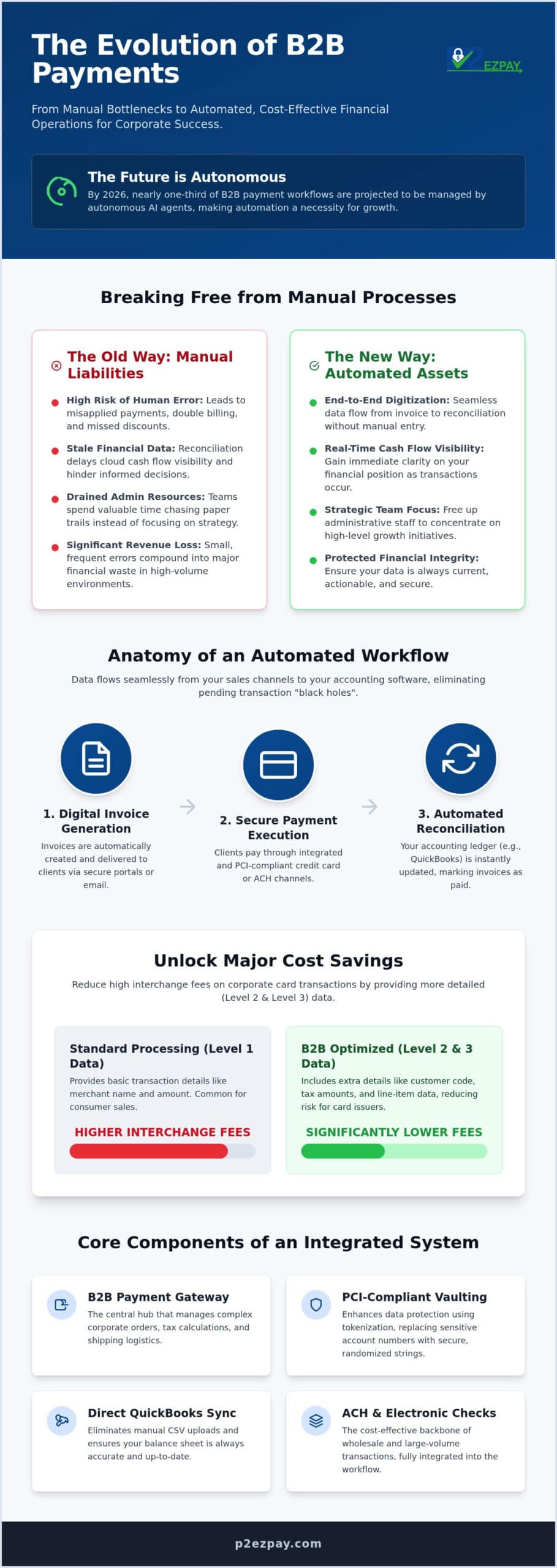
A truly integrated workflow begins the moment an invoice is generated. If your system is configured correctly, data flows seamlessly from your merchant gateway directly into your ERP system, ensuring that every transaction is tracked in real time. This cycle typically includes:
- Digital invoice generation and delivery via secure portals.
- Secure payment execution through integrated card or ACH channels.
- Automated reconciliation that updates your ledger instantly.
When these stages are connected, you eliminate the “black hole” of pending transactions and gain immediate clarity on your financial position. This transparency allows your team to focus on strategic growth rather than chasing paper trails.
Why Manual Processes are a Liability for High-Volume Merchants
If your team still relies on manual data entry, you’re carrying a significant operational risk. Human error in B2B payment processing often leads to misapplied payments, double billing, or missed discounts. Beyond simple mistakes, manual systems create “stale” financial data. When reconciliation happens days or weeks after a transaction, leadership lacks the real-time visibility needed to make informed cash flow decisions. In a high-volume environment, even a small error rate can translate into significant revenue loss and administrative waste. Transitioning to automated B2B payment systems isn’t just about efficiency; it’s about protecting your company’s financial integrity and ensuring your data is always current and actionable.
Key Components of an Integrated B2B Payment Infrastructure
Building a resilient financial foundation requires more than just a single piece of software. It demands a cohesive ecosystem where every tool works in harmony. At the center of this strategy is a robust B2B ecommerce payment gateway. These gateways serve as the primary entry point for automated B2B payment systems, managing the heavy lifting of corporate orders such as complex tax calculations and shipping logistics. High-volume merchants also rely on tokenization to secure sensitive corporate data. By replacing actual account numbers with randomized strings, you protect your partners and ensure your business remains a trusted ally in the supply chain.
The industry is rapidly shifting toward “invisible” payments. This is a concept where the transaction and the reconciliation happen simultaneously without manual intervention. According to recent insights on the Future of B2B Payments, this real-time synchronization is becoming the standard for firms looking to maintain a competitive edge. Before committing to any single solution, reviewing a detailed comparison of top B2B payment gateway providers can help you identify which platform best aligns with your volume, integration needs, and cost reduction goals. If you’re ready to modernize your stack, you can speak with a consultant to identify which components best fit your current volume.
The Role of QuickBooks Payment Integration
One of the most significant benefits of automated B2B payment systems is the ability to eliminate manual CSV uploads. A direct sync between your gateway and your ledger ensures that every invoice is marked as paid the moment funds are captured. This transparency is vital for maintaining an accurate balance sheet. For technical details on setting up this connection, our guide on QuickBooks integration for B2B ecommerce provides a clear roadmap for your IT and accounting teams.
Electronic Checks and ACH: The Backbone of Wholesale
While credit cards offer convenience, ACH payment services remain the backbone of wholesale trade. Modern e-check processing is now faster and more cost-effective than traditional wire transfers. By using automated ACH batching, manufacturers and distributors can significantly improve their liquidity. This approach reduces the per-transaction cost of large orders, ensuring that high-value sales aren’t diluted by excessive processing fees. It’s a logical, methodical way to protect your margins while providing a reliable payment option for your long-term corporate clients.
Navigating Security and Cost Efficiency in Automated Workflows
Many corporate leaders worry that moving away from manual oversight increases their vulnerability to data breaches. In reality, modern automated B2B payment systems actually strengthen your security posture. By utilizing PCI-compliant vaulting, sensitive account data is stored in secure, off-site environments rather than on your local servers. This approach significantly reduces your compliance burden and protects your partners from exposure. Beyond simple protection, automation serves as a catalyst for interchange optimization. When your system automatically collects and transmits detailed transaction data, you qualify for lower processing rates that are typically unavailable to those using manual methods. High-volume ecommerce environments further benefit from advanced fraud filters that analyze transaction patterns in real-time. As a dedicated merchant services advisor, we help you configure these settings to ensure your security stack works for your bottom line.
Leveraging Level 2 and Level 3 Processing to Reduce Fees
Manual data entry often skips the granular details required by card networks for the best possible rates. However, automated platforms can be programmed to pass the extra data required for Level 2 and Level 3 processing without adding work for your staff. By capturing specific line-item details such as tax IDs and commodity codes, your business can slash interchange rates by up to 1.5% on qualifying corporate and government card transactions. This reduction is a direct result of providing the transparency that card issuers demand for high-value B2B exchanges.
Compliance and Risk Mitigation in 2026
The regulatory landscape for financial data is constantly evolving, making it difficult for internal teams to keep pace. In 2026, automated systems are designed to stay ahead of these shifts through cloud-based updates that reflect the latest B2B security standards. Working with an independent consultant allows you to choose a security stack tailored to your specific industry risks rather than accepting a generic model. This bespoke approach ensures your risk mitigation strategy is as flexible as your business. If you want to ensure your current setup is optimized for both safety and cost, you can reach out for a strategic consultation.
Strategic Implementation: Transitioning Your Wisconsin Business to Automated Payments
Moving your operations toward automated B2B payment systems is a deliberate process that requires a clear roadmap. To begin, you must audit every manual touchpoint within your current B2B payment processing workflow. Look for areas where data is manually transcribed or where physical checks sit on a desk awaiting signatures. Once you’ve identified these bottlenecks, ensure your primary accounting software, such as QuickBooks, is ready for a direct integration. The goal is to create a single source of truth where your ledger and your bank account reflect the same data without human intervention. Selecting a gateway that supports high-volume ACH and Level 3 data capture is the next logical step; this ensures you’re prepared for the technical demands of corporate and government clients. To make an informed decision at this stage, consulting a current comparison of leading B2B payment gateway providers for 2026 can help you evaluate which solution best matches your integration requirements and transaction volume. Finally, pilot the system with a small group of high-frequency vendors to refine the reconciliation process before a full-scale rollout.
Why Local Expertise Matters for Milwaukee and Madison Enterprises
For firms in Milwaukee or Madison, the manufacturing and distribution landscape has unique requirements that “Big Tech” support queues often fail to grasp. Working with a Wisconsin-based partner provides a steady hand and a consultative approach that generic software vendors simply cannot offer. We understand the local industry standards and the specific logistical challenges faced by Midwest distributors. This regional insight allows us to act as a mentor, guiding you through the transition with a focus on long-term stability and community-oriented support. Having a partner who understands the local economic climate ensures your payment strategy remains resilient as your business scales.
Preparing Your Team for the Shift
It’s natural for accounts receivable staff to feel uncertain when automation is introduced. However, this transition actually elevates their role from repetitive data entry to high-level data management and strategic oversight. By removing the burden of manual transcription, your team can focus on resolving complex discrepancies and improving vendor relationships. We believe that a successful implementation is as much about people as it is about technology. If you’re ready to evolve your financial infrastructure with a partner who values your long-term success, you can contact P2EZPay for a professional payment processing consultancy to begin your journey toward greater efficiency.
Future-Proofing Your Corporate Financial Strategy
The transition toward automated B2B payment systems is a strategic commitment to your company’s long-term health. By moving away from manual bottlenecks and embracing real-time data synchronization, you’ve seen how a business can reduce processing fees and eliminate administrative waste. This evolution isn’t just about adopting new software; it’s about aligning your workflows with the high-speed requirements of the 2026 corporate landscape. Whether you’re optimizing for Level 3 interchange rates or securing your supply chain through tokenization, the result is a more resilient and agile organization.
At P2EZPay, we act as a steady hand to guide you through these technical transitions. With over 30 years of payment processing expertise and specialized QuickBooks integration support, our local Wisconsin-based consultancy provides the bespoke guidance that generic platforms lack. We’re here to help you turn your payment cycle into a driver of corporate growth. You can optimize your B2B financial workflows with a P2EZPay expert today and begin building a more efficient future. Let’s work together to protect your margins and empower your team.
Frequently Asked Questions
What is the difference between B2B and B2C automated payment systems?
B2B systems handle the inherent complexity of trade credit, multi-stage approvals, and large transaction volumes that B2C models don’t require. While B2C focuses on a fast, one-click checkout for an individual, B2B workflows must sync with Enterprise Resource Planning (ERP) systems and manage longer billing cycles. This specialized infrastructure ensures that complex corporate relationships remain stable and transparent throughout the entire transaction cycle.
How does QuickBooks payment integration improve my cash flow?
QuickBooks integration improves cash flow by providing real-time visibility into your receivables and eliminating the lag caused by manual reconciliation. When you use automated B2B payment systems, payments are recorded the moment they are settled in the gateway. This immediate data sync allows leadership to make informed decisions based on current liquidity rather than waiting for weekly or monthly manual ledger updates.
Is automated B2B payment processing secure for high-volume transactions?
Modern automated processing is exceptionally secure because it utilizes PCI-compliant vaulting and tokenization to keep sensitive account data off your local servers. For high-volume transactions, these systems also incorporate advanced fraud filters that analyze patterns in real time to prevent unauthorized activity. These layers of protection ensure that your corporate assets and your partners’ account details remain shielded from evolving digital threats.
Can automated systems help me lower my credit card processing fees?
Yes, automated B2B payment systems help lower fees by automatically transmitting the Level 2 and Level 3 data required by card networks for reduced interchange rates. By providing line-item details that manual entries often miss, you qualify for the lowest possible processing costs on corporate and government cards. This optimization turns your payment infrastructure into a strategic tool for margin protection rather than just a cost of doing business.
How long does it typically take to implement an automated B2B payment system?
The timeline for implementation typically ranges from two to six weeks, depending on the complexity of your existing accounting software and current transaction volume. A straightforward sync with QuickBooks can often be established relatively quickly; however, a custom integration for a larger manufacturing enterprise might require more deliberate testing. We focus on a methodical rollout to ensure your daily operations remain stable and secure during the transition.