

The standard corporate checkout is no longer just a digital cash register; it’s a strategic lever that determines whether your margins thrive or erode under the weight of interchange fees. If you’re managing high-volume transactions, your B2B ecommerce payment gateway should be doing more than just moving money. It should be actively reducing your overhead and protecting your bottom line through intelligent data handling.
You’ve likely felt the friction of manual data entry or the unnecessary costs associated with unoptimized corporate card processing. It’s frustrating when complex approval workflows slow down high-value orders that should move with ease. This guide provides a professional path to selecting and optimizing a system that slashes processing costs through Level 2 and Level 3 data while automating your most tedious financial tasks. We believe that your payment infrastructure should be a bespoke asset, not a generic obstacle.
We’ll examine how to achieve seamless QuickBooks integration to eliminate reconciliation errors and how to build a secure environment tailored for the specific demands of 2026 corporate processing. You’ll learn how to transform your payment processing into a streamlined, automated engine that supports your long-term growth and operational independence.
Key Takeaways
- Understand why a specialized B2B ecommerce payment gateway is essential for managing the complex security and high-volume demands of corporate transactions.
- Learn how to leverage Level 2 and Level 3 processing data to significantly reduce interchange fees on corporate credit card transactions.
- Discover how integrating your payment processing with QuickBooks or your ERP system eliminates manual data entry and streamlines your financial reconciliation.
- Identify the critical security protocols and API capabilities necessary to protect your enterprise and facilitate custom workflows.
- Gain a clear, step-by-step strategy for auditing your current payment volume and implementing a solution that scales with your business.
Understanding B2B Ecommerce Payment Gateways in 2026
A B2B ecommerce payment gateway serves as a specialized transaction bridge that facilitates high-value corporate transactions. While many businesses start with consumer-grade tools, they quickly find that a standard payment service provider built for retail fails to address the nuances of wholesale trade. These systems must manage complex net terms, custom pricing tiers, and the rigorous security protocols required for enterprise-level data protection. In a landscape where efficiency is paramount, your gateway shouldn’t just move money; it should act as a strategic asset that streamlines the entire order-to-cash cycle.
To gain a deeper perspective on how modern gateways handle these complexities, watch this overview on extending credit terms and B2B payment methods:
The Core Differences Between B2B and B2C Payments
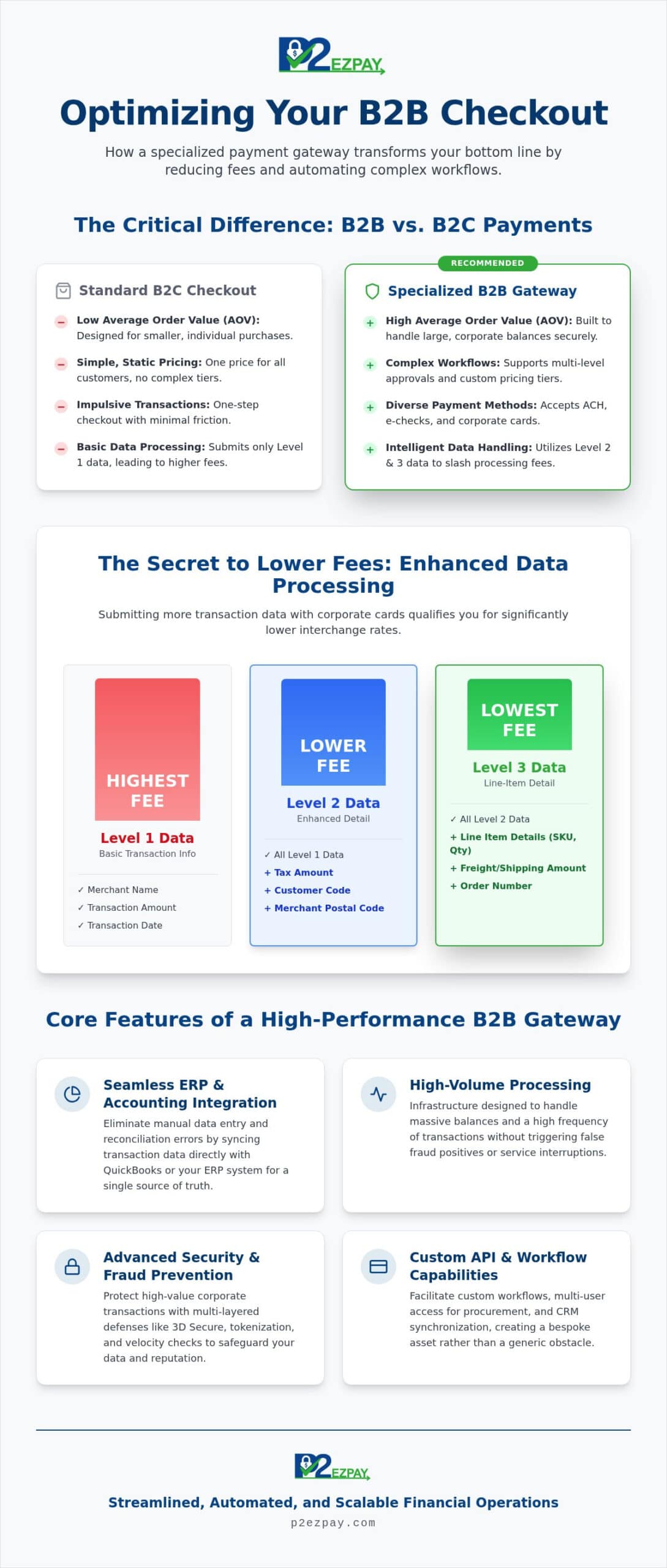
The primary distinction lies in the complexity and scale of the transaction. While B2C purchases are typically impulsive and low-value, B2B orders involve high average order values (AOV) and multi-step approval workflows. A dedicated B2B ecommerce payment gateway allows for these specific friction points by supporting organizational needs that consumer platforms ignore. These include:
- Multi-level Approvals: Systems that allow for internal procurement checks before a transaction is finalized.
- High-Volume Processing: Infrastructure capable of handling massive balances without triggering generic fraud false positives.
- Diverse Payment Methods: Support for ACH and e-checks, which are often preferred over credit cards for large-scale corporate balances.
Why Your Business Needs a Dedicated B2B Gateway
In a corporate environment, pricing is rarely static. Your gateway must handle wholesale pricing tiers and complex tax exemptions that vary by region or customer type. It also needs to support recurring billing for subscription models, ensuring that long-term contracts are managed without manual intervention. By integrating your ecommerce payment processing with a specialized gateway, you create a seamless digital sales environment that respects the unique logic of B2B commerce. This approach moves beyond simple payment collection. It establishes a foundation for automated, secure, and scalable financial operations that grow with your company.
Critical Features of a High-Performance B2B Gateway
A robust B2B ecommerce payment gateway serves as the backbone of your digital infrastructure, requiring features that go far beyond simple transaction processing. Aligning with the Gartner definition of B2B Payments Software, these systems must facilitate complex workflows like multi-user access for procurement departments and advanced API capabilities for ERP and CRM synchronization. This ensures that every department, from sales to accounting, operates from a single source of truth. As your operations expand, having a foundation that supports high volume merchant services becomes critical for maintaining performance without service interruptions.
Security Standards and Fraud Prevention for High-Volume Transactions
Protecting large-scale corporate balances requires a multi-layered defense strategy. Modern gateways implement 3D Secure protocols and biometric authentication to verify the identity of purchasing agents, significantly reducing the risk of unauthorized transactions. Beyond identity, advanced velocity checks and geographic filtering help identify anomalous patterns that might indicate wholesale fraud. By utilizing end-to-end encryption and advanced tokenization, your business ensures that sensitive payment data never touches your internal servers, simplifying your PCI compliance journey while safeguarding your reputation.
Level 2 and Level 3 Processing: The Secret to Lower Fees
One of the most overlooked advantages of a specialized B2B ecommerce payment gateway is the ability to capture and transmit enhanced transaction data. By including specific details like tax IDs, item codes, and freight amounts, your business qualifies for lower interchange rates. This is known as Level 2 and Level 3 processing, a technical requirement that most standard gateways simply ignore. Capturing this data can slash your overhead on corporate card transactions, directly improving your margins. For industries operating at scale, such as wholesale distributors and fabricators, understanding B2B payment processing for manufacturers reveals how these same data strategies apply to high-volume production environments. You might consider requesting an audit of your current processing profile with an expert who understands the nuances of corporate fee structures to see where these savings can be applied.
Streamlining Workflows with Accounting and ERP Integration
Manual reconciliation is a hidden drain on corporate resources, often siphoning away hours that your finance team should spend on high-level strategy. When your B2B ecommerce payment gateway operates in a silo, your accounting team must manually match bank deposits to open invoices, a process that invites costly mistakes. This manual work isn’t just slow. It’s a breeding ground for human error that complicates high-value transaction records and delays month-end closing. Utilizing automated B2B payment systems can reduce reconciliation time by up to 80%, allowing your team to focus on growth rather than data entry.
QuickBooks Payment Integration for Automated Reconciliation
For many mid-market firms, QuickBooks functions as the financial heart of the business, requiring precise and timely data to remain effective. A sophisticated integration ensures real-time synchronization between your digital storefront and your ledger, creating a unified financial ecosystem. When a customer settles an invoice online, the payment posts automatically to the corresponding record, updating your accounts receivable instantly. This “embedded payments” approach allows for one-click invoice settlement, removing the administrative friction that often delays corporate cash flow and frustrates procurement departments. You can explore our specialized solutions for QuickBooks integration for B2B ecommerce to see how these specific workflow steps enhance daily efficiency.
Beyond Credit Cards: ACH and E-check Solutions
Large-scale transactions often require more flexibility and lower overhead than a standard credit card can provide. Many corporate clients prefer ACH payment services for large balances because they offer significant cost savings and enhanced security compared to traditional paper checks. Electronic check processing provides a more reliable audit trail, reducing the risk of lost payments or mail fraud. Implementing a unified system offers several advantages:
- Reduced Processing Costs: Flat-fee ACH transactions are often more economical for five-figure orders than percentage-based card fees.
- Enhanced Security: Encrypted data transmission minimizes the risk associated with physical check handling.
- Consolidated Reporting: Managing various B2B payment processing methods through a single interface simplifies your back-office operations.
To see how these integrations can transform your financial workflows, contact the specialist team at P2EZPay Merchant Services for a tailored efficiency audit.
Selecting and Implementing Your B2B Payment Strategy
Choosing the right B2B ecommerce payment gateway is a decision that shapes your financial efficiency for years to come. It’s not just about finding a tool that works; it’s about building a framework that supports your specific volume and technical requirements. A successful implementation begins with a thorough audit of your current transaction landscape, identifying which card types dominate your sales and where fees are most prevalent. Once you understand your data, you can map out your integration needs, ensuring your gateway speaks fluently to QuickBooks or your chosen ERP.
Your strategy must also prioritize cost optimization and professional support. Evaluate fee structures with a critical eye toward Level 2 and Level 3 data potential, as this remains the most effective way to lower corporate interchange costs. Finally, assess the level of technical consultancy available. In a field as complex as high-volume processing, having a partner like P2EZPay Merchant Services who understands the nuances of your industry is far more valuable than a generic help desk or an automated ticket system.
The Value of a Local Merchant Service Advisor in Wisconsin
For firms operating in Milwaukee, Madison, or Waukesha, the benefits of local expertise cannot be overstated. While global platforms offer scale, they often lack the accountability and tailored advice that a local merchant services advisor provides. Having a partner who can visit your office in Brookfield or New Berlin to troubleshoot a complex integration or audit your statements in person creates a level of trust that faceless call centers can’t replicate. This local presence ensures your business isn’t just another ticket in a global queue, providing a steady hand in an increasingly digital world.
Future-Proofing Your B2B Payments for 2026
As we move toward 2026, the landscape is shifting toward AI-driven fraud detection and more flexible financing options. Preparing your infrastructure now for the rise of B2B “Buy Now, Pay Later” (BNPL) models will give you a competitive edge in attracting wholesale buyers who expect consumer-like flexibility. It’s also vital to maintain strict compliance with evolving corporate payment processing regulations. By staying ahead of these trends and choosing a B2B ecommerce payment gateway that adapts to new standards, you ensure your payment ecosystem remains secure, efficient, and ready for the next decade of growth.
Strengthening Your Financial Foundation for 2026
Transforming your payment infrastructure into a strategic asset requires a shift toward specialized data handling and deep accounting integration. By prioritizing a B2B ecommerce payment gateway that supports the technical nuances of corporate trade, you reclaim margins previously lost to unoptimized interchange fees. When this technology is paired with the automation strategies discussed, your back office moves from reactive manual entry to a proactive, streamlined operation that scales with your corporate ambitions.
With over 30 years of industry experience, the team at P2EZPay Merchant Services provides the seasoned mentorship needed to navigate these technical complexities. We combine specialized QuickBooks automation support with the personalized touch of a local Wisconsin-based advisory team to ensure your transition is both secure and efficient. We invite you to optimize your B2B payments with a free P2EZPay Merchant Services consultancy session to discover how a tailored approach can remove obstacles and foster long-term growth. We’re ready to help you build a more resilient and profitable financial future.
Frequently Asked Questions
What is the main difference between a B2B and B2C payment gateway?
A B2B ecommerce payment gateway is designed to handle complex organizational hierarchies and specialized data requirements that consumer-grade tools ignore. While B2C systems focus on simple, instant checkouts, B2B gateways support multi-user approval workflows, net-term invoicing, and the transmission of enhanced data fields. These systems are built to manage the high transaction volumes and rigorous security protocols required in a corporate environment.
How much can Level 3 processing actually save my B2B business?
Level 3 processing allows you to access significantly lower interchange rates by providing detailed transaction data to the card brands. By including line-item details, tax IDs, and freight codes, the transaction is classified as lower risk. For companies processing high volumes of corporate or government cards, these technical optimizations can result in substantial annual savings that directly improve your bottom line.
Can I integrate my B2B gateway with QuickBooks Desktop and Online?
Yes, professional B2B gateways are built to synchronize seamlessly with both QuickBooks Desktop and QuickBooks Online. This integration allows for the automatic posting of payments to open invoices, which effectively eliminates the need for manual reconciliation. Our team specializes in configuring these connections to ensure your ecommerce sales and financial records remain accurate and up to date without administrative friction.
Is ACH safer than credit card processing for large B2B orders?
ACH is often preferred for large-scale corporate orders because it utilizes direct bank-to-bank transfers, which are less susceptible to the fraud vectors common with credit cards. While cards can be lost or stolen, ACH transactions rely on verified bank account details and provide a stable, encrypted audit trail. This method is not only secure but also more cost-effective for transactions involving five or six-figure balances.
What security certifications should I look for in a B2B gateway provider?
You should prioritize providers that maintain PCI DSS Level 1 compliance and offer advanced tokenization services. These certifications ensure that sensitive payment data is handled according to the highest industry standards. Additionally, look for a B2B ecommerce payment gateway that supports 3D Secure 2.0. This protocol provides an extra layer of authentication for corporate purchasing agents, shielding your business from unauthorized transactions and potential disputes.