

Why are you still paying retail-level interchange fees on wholesale-sized manufacturing orders? It’s frustrating to watch your hard-earned margins erode because of standard processing rates that don’t account for the scale of your operations. If you’ve noticed a spike in transaction costs since Visa retired its Level 2 program in January 2026, you’re certainly not alone. Many firms are finding that their legacy systems simply can’t keep up with the new Commercial Enhanced Data Program requirements.
Modern B2B payment processing for manufacturers requires more than just a digital gateway. It demands a strategic approach to data that protects your bottom line. You deserve a system that works as hard as your shop floor. In this guide, we’ll show you how to slash transaction costs through Level 3 processing and automate your entire workflow with seamless QuickBooks integration. We’ll also examine the latest 2026 interchange updates and explain why having local, expert support in the Milwaukee area is the key to maintaining a reliable, high-volume payment environment.
Key Takeaways
- Discover why standard consumer processors fail to meet the high-ticket demands of industrial sales and how a specialized ecosystem protects your margins.
- Learn the technical requirements for Level 3 data to capture lower interchange rates on corporate and government cards, especially following 2026 network updates.
- See how seamless QuickBooks integration eliminates manual data entry and automates the reconciliation of high-volume invoices.
- Optimized B2B payment processing for manufacturers transforms your back office from a bottleneck into a strategic asset through enhanced data reporting.
- Understand the unique advantages of working with a local Milwaukee-based partner who offers bespoke consultancy rather than a generic, “big box” service.
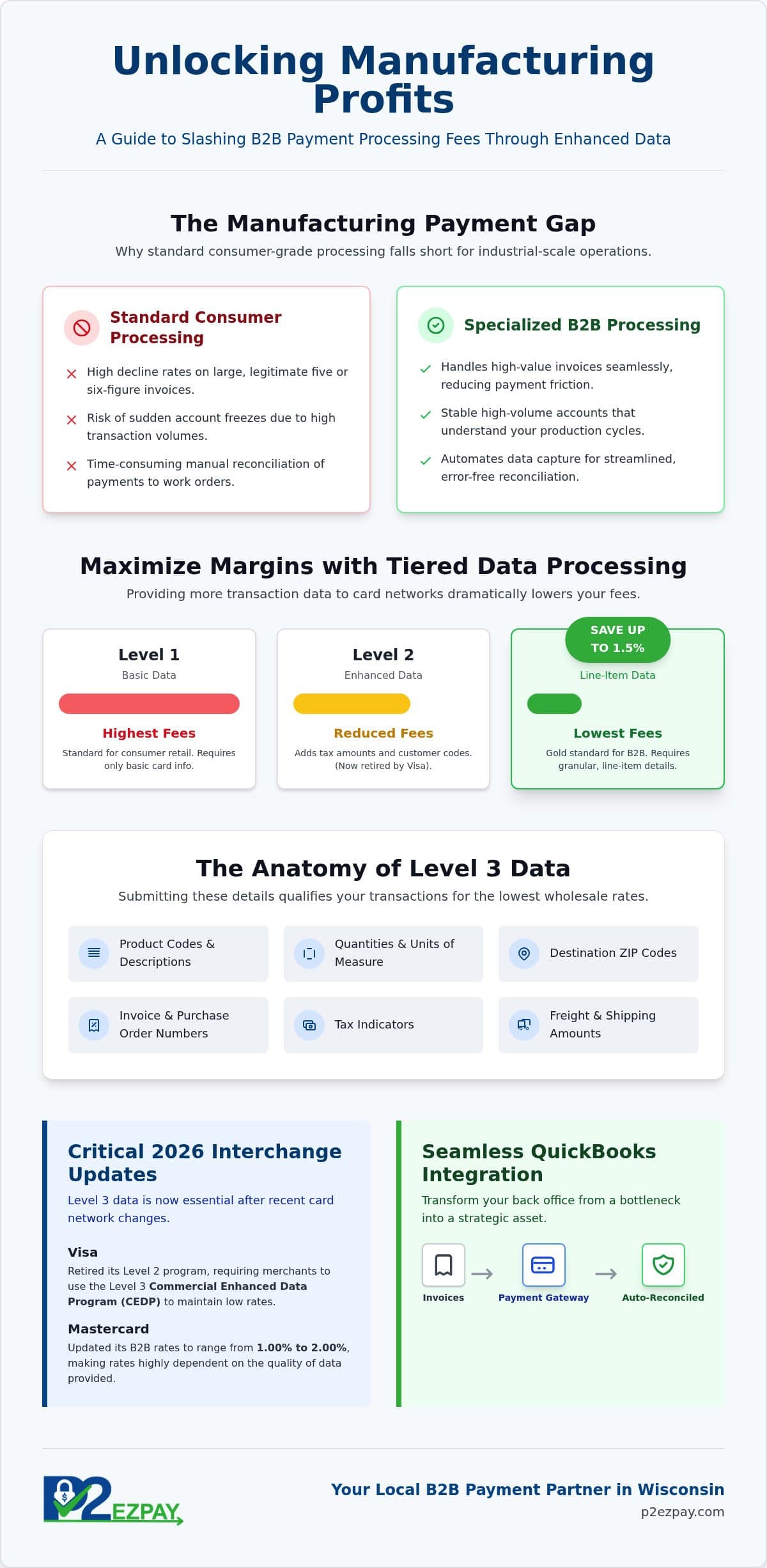
The Manufacturing Payment Gap: Why Standard Processing Falls Short
Many manufacturers treat their back office payments as an afterthought, but B2B payment processing for manufacturers is actually a specialized high-volume ecosystem. It’s distinct from retail because industrial sales often involve five or six figure invoices. Consumer grade processors, designed for small ticket coffee shops or boutiques, often struggle with these amounts. They lack the sophisticated logic required to handle the nuances of industrial commerce, which can lead to unnecessary transaction declines and administrative headaches.
When a processor flags a legitimate $50,000 transaction as suspicious, it creates payment friction. This friction delays cash flow and can strain relationships with critical suppliers who depend on timely settlements. Beyond the immediate delay, there’s the silent drain of manual reconciliation. If your team is still spending hours matching paper checks or generic credit card receipts to specific work orders, you’re losing money on labor that could be better spent on production. A modern e-commerce payment system tailored for B2B needs should bridge this gap seamlessly by providing detailed reporting that aligns with your internal ledger.
Unique Challenges in Industrial B2B Payments
Manufacturing isn’t a simple point of sale interaction. Custom runs often require partial payments upfront followed by the balance upon delivery. Managing net-30, 60, or even 90 day terms within a digital gateway requires a flexible platform. Standard tools aren’t built to track these staggered obligations, leading to errors in your accounts receivable. Standardizing your B2B payment processing for manufacturers ensures that your financial infrastructure is as robust as your assembly line, allowing for automated tracking of long lead times and complex payment schedules.
The Risk of High-Volume Merchant Accounts
Operating at scale brings scrutiny. Without dedicated high volume merchant services, a manufacturer risks sudden account freezes during peak production cycles. These freezes happen when “big box” processors perceive a spike in transaction volume as a security risk. You need a partner who understands your typical throughput and balances rigorous security with the need for rapid, uninterrupted processing. This stability is vital for maintaining a healthy cash position and ensuring that your operations never grind to a halt due to a locked merchant account.
Maximizing Margins with Level 2 and Level 3 Processing
Interchange fees represent the largest portion of your processing costs, yet many manufacturers treat them as a fixed expense. In reality, credit card networks utilize a three-tiered hierarchy of data to determine these rates. Level 1 is the standard for consumer transactions, requiring only basic card info. Level 2 adds tax amounts and customer codes. However, Level 3 is the gold standard for industrial commerce. By providing granular transaction details, you can reduce interchange fees by up to 1.5% on corporate and government purchasing cards.
Level 3 processing is the single most effective way for manufacturers to reclaim lost margins. When you transmit specific line-item data like freight codes and invoice numbers, the card brands view the transaction as lower risk. This transparency allows you to access wholesale rates that are simply unavailable to businesses using standard processing setups. Deploying automated B2B payment systems that are purpose-built for Level 3 data capture ensures that every eligible transaction is optimized without adding manual work to your accounting team.
How Level 3 Data Protects Manufacturing Profits
To qualify for these lower rates, your system must transmit specific data fields that go far beyond a simple dollar amount. The networks require a comprehensive breakdown of the order, including:
- Product codes and descriptions
- Quantities and units of measure
- Freight and shipping amounts
- Destination zip codes and tax indicators
- Invoice and purchase order numbers
Capturing this data manually is impossible for a high-volume shop. P2EZPay serves as a dedicated merchant services advisor to help you implement gateways that automate this data capture. This ensures every eligible transaction qualifies for the lowest possible rate without adding work for your accounting team.
Lowering B2B Interchange Fees in 2026
The landscape of card brand fees shifted significantly in early 2026. As of January, Visa retired its Level 2 program for most commercial cards, requiring merchants to move to Level 3 under the Commercial Enhanced Data Program (CEDP) to maintain favorable pricing. Meanwhile, Mastercard updated its B2B Product series in April 2026, with rates now ranging from 1.00% to 2.00% depending on the data provided. Staying ahead of these biannual updates requires a proactive strategy. You can learn more about these technical requirements in our Level 2 and Level 3 Processing Guide. If you aren’t sure which level your current transactions hit, consider reaching out for a statement analysis to identify where your margins are leaking. To evaluate which platforms best support these data requirements, reviewing a detailed comparison of top B2B payment gateway providers can help you identify the right solution for your transaction volume and reporting needs.
Streamlining the Shop Floor to the Back Office: QuickBooks Integration
For a manufacturer, the distance between shipping a finished pallet and seeing the funds in the bank shouldn’t be measured in paperwork hours. Traditional B2B payment processing for manufacturers often creates a silo where the payment gateway and the accounting ledger don’t communicate. This disconnect forces your staff to engage in “double entry,” manually typing invoice numbers and payment amounts into the ledger after a transaction clears. It’s a tedious process that invites human error and significantly delays your month-end close.
When you sync your merchant account directly with your accounting software, reconciliation happens automatically. This integration ensures that every deposit is matched to its corresponding invoice in real time. For manufacturing executives, this means real-time cash flow reporting is always available. You won’t have to wait for a clerk to finish manual entries to know exactly how much liquidity you have for raw material procurement or labor costs. Automated workflows transform B2B payment processing for manufacturers from a back-office chore into a strategic data source. Understanding how automated B2B payment systems leverage real-time payment rails and AI-driven reconciliation can help you evaluate which integration approach best fits your facility’s transaction volume and reporting needs.
The Power of QuickBooks Payment Integration
High-volume environments benefit most from integrated workflows. By using a direct sync, you can reduce the time spent on monthly closes by several days. This is especially relevant for firms using recent versions like QuickBooks Desktop Enterprise 24.0 R21, where structured data helps drive better financial insights and automation. We’ve outlined the specific steps to achieve this in our QuickBooks Integration for B2B Ecommerce guide.
ACH and E-Check Solutions for Large Orders
While credit cards offer speed, they aren’t always the most cost-effective choice for massive industrial orders that can reach six figures. For these instances, ACH payment services provide a way to bypass interchange fees entirely. Integrating electronic checks into your existing digital workflow ensures that you maintain a professional, automated experience for your clients while protecting your net profit on high-value runs. If you’re ready to modernize your back office and eliminate manual data entry, contact us to discuss a custom QuickBooks integration for your facility.
Choosing a Local B2B Payment Partner in Wisconsin
Wisconsin is a manufacturing powerhouse. In industrial hubs like Milwaukee and Waukesha, the sheer complexity of high-volume transactions requires more than a generic help desk. Choosing a partner for B2B payment processing for manufacturers shouldn’t mean settling for a faceless entity located halfway across the country. A local partner understands the regional economy and the specific regulatory environment, such as the Wisconsin Consumer Act updates that impact transaction thresholds. This proximity allows for a level of accessibility and accountability that “big box” processors simply can’t replicate.
A consultancy model provides a steady hand that generic providers often lack. When you’re managing high-volume merchant accounts in Madison or Racine, you need a responsive ally who understands your specific business journey. Evaluating a processor should go beyond looking at base rates. It requires assessing their specific experience with industrial workflows and their ability to provide bespoke solutions that grow alongside your facility. For a structured framework to guide this evaluation, our 2026 comparison guide to B2B payment gateway providers breaks down the leading platforms by features, fees, and local support capabilities. This independent approach ensures that you receive objective advice tailored to your operational needs rather than a rigid, one-size-fits-all product.
The Value of a Dedicated Merchant Service Consultancy
Moving beyond a generic call center allows you to build a relationship grounded in mutual success. A local advisor provides strategic leadership, helping you navigate technical nuances like the 2026 Level 3 data requirements or scaling your B2B ecommerce payment gateway. This personalized guidance ensures that your financial infrastructure remains an asset rather than a bottleneck as you expand into new markets. Having a mentor who understands the Wisconsin market means you’re protected by a partner who’s deeply invested in your long-term stability.
Next Steps for Milwaukee Manufacturers
Transitioning to a more efficient system starts with a clear understanding of your current overhead. Requesting a comprehensive cost analysis of your processing statements is the first step toward reclaiming your margins. By preparing your data for an integrated system, you ensure a seamless shift that minimizes disruption to your shop floor. P2EZPay brings over 30 years of industry experience to this process, acting as a loyal mentor for Wisconsin businesses ready to modernize their B2B payment processing for manufacturers. Protecting your bottom line starts with a conversation about how specialized data and local support can transform your back office.
Strengthening Your Manufacturing Margins in 2026
Modernizing your financial operations is about more than just technology; it’s about protecting the value you create on the shop floor. By capturing Level 3 data and automating your ledger sync, you eliminate the administrative friction that historically slowed down your growth. These strategic shifts ensure that your back office remains as efficient and precise as your production line, allowing you to focus on innovation rather than reconciliation.
P2EZPay brings over 30 years of local Wisconsin expertise to every partnership. As specialists in Level 3 interchange optimization and direct QuickBooks integration, we understand the unique pressures facing our regional industrial sector. Implementing the right B2B payment processing for manufacturers provides the stability and clarity you need to scale with confidence in an evolving market. We’re here to act as your steady hand through every technical update and growth phase.
We invite you to request a free B2B payment cost analysis from P2EZPay to see exactly where your current system is leaking profit. Let’s work together to build a more resilient and automated financial future for your facility.
Frequently Asked Questions
How does Level 3 processing specifically benefit the manufacturing industry?
Level 3 processing lowers the interchange fees set by card networks on corporate and government purchasing cards. For manufacturers handling high-ticket industrial orders, providing granular data like freight codes and item descriptions allows you to access wholesale rates. This transparency reduces the perceived risk of the transaction; it’s a critical step for protecting margins on large-scale invoices.
Can I integrate B2B payment processing with my existing QuickBooks Desktop or Online?
You can sync your payment gateway directly with both QuickBooks Desktop and Online to automate your accounts receivable. This integration eliminates the need for manual data entry by matching deposits to invoices in real time. Using recent versions like QuickBooks Desktop Enterprise 24.0 R21 ensures that your financial data remains structured and accessible for executive reporting.
What is the typical cost reduction for manufacturers switching to a Level 3 optimized processor?
Optimizing for Level 3 data can reduce interchange fees by up to 1.5% on eligible commercial and government card transactions. By moving away from standard retail-level processing, you reclaim profit that would otherwise be lost to high-tier interchange rates. Every transaction involving a corporate purchasing card becomes an opportunity to lower your overhead through better data reporting.
Is ACH processing safer than credit cards for high-volume manufacturing orders?
ACH processing is a secure and stable method for handling massive industrial orders that may reach six figures. It’s often safer for the merchant because it carries a lower risk of chargebacks compared to credit cards. Integrating ACH and e-check solutions into your B2B payment processing for manufacturers workflow provides a cost-effective way to move large sums without the percentage-based drag of interchange fees.
Do I need a special merchant account for high-volume B2B transactions in Wisconsin?
Dedicated high-volume merchant services are essential for manufacturers to prevent sudden account freezes during busy production cycles. Standard processors often flag large or frequent transactions as suspicious, which can disrupt your cash flow. A specialized account, supported by a local Wisconsin partner, ensures your processing remains reliable while staying compliant with regional standards like the Wisconsin Consumer Act.